
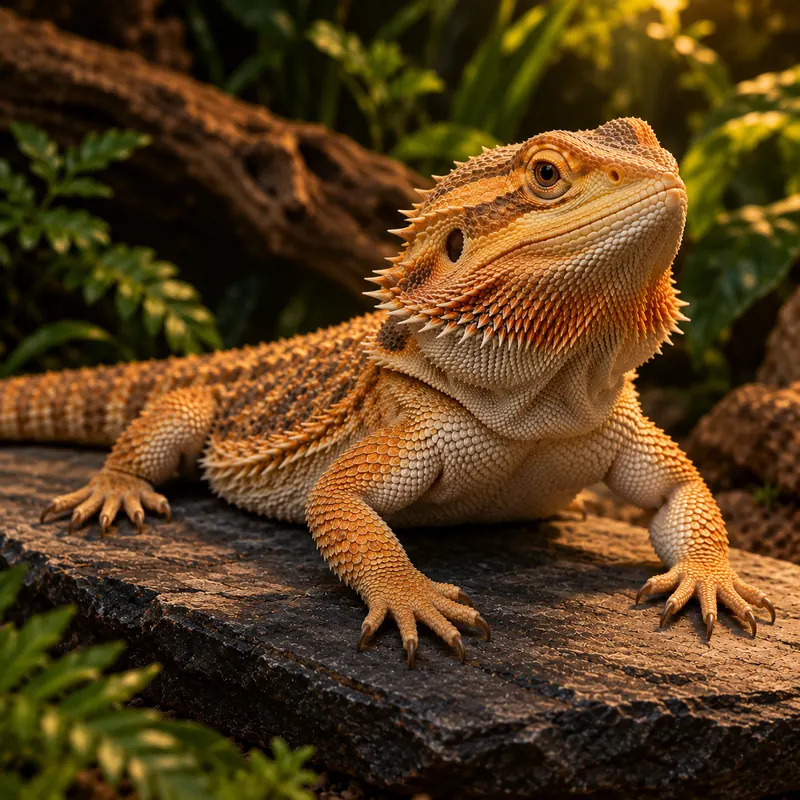
Bearded dragons are omnivores. Babies eat mostly insects and adults eat mostly greens, with a light dusting of calcium and vitamins to keep their bones strong. The exact ratios differ between sources, so this page gives the ranges and lets you settle the details with your vet.
How the diet changes with age
| Age | Insects vs plants | How often |
|---|---|---|
| Babies | RSPCA: about 65% live food, 35% greens. ReptiFiles: 60 to 80% protein. | RSPCA: twice daily. ReptiFiles (0 to 3 months): insects once daily, as many as they will eat, plus greens daily. |
| Juveniles | ReptiFiles: about 60% protein. | ReptiFiles: 5 to 6 head-sized insects daily, greens daily. VCA: young dragons eat once or twice a day. |
| Adults | RSPCA (over 30 cm / 12 in): about 40% live food, 60% greens. ReptiFiles: 15 to 30% protein. | VCA: every 24 to 72 hours, depending on appetite. ReptiFiles: 3 to 4 head-sized insects twice a week, greens three times a week. |
VCA describes the overall diet as roughly half plant and half insect, varying with age. The RVC simply says dragons need less live food as they get older.
The shared message is clear: lots of insects while growing, then mostly greens once grown. ReptiFiles notes that skipping an occasional feeding is fine and helps keep a dragon at a healthy weight.
Insect size: ReptiFiles says an insect should be no wider than the space between the dragon’s eyes. The RVC says remove uneaten live food after 30 minutes.
Feeder insects
Staples (most meals):
- Crickets
- Dubia and discoid roaches
- Black soldier fly larvae
- Locusts or grasshoppers
Occasional or treats (higher fat, or harder to digest):
- Mealworms. The RVC says in moderation only.
- Superworms and waxworms. VCA says sparingly, not daily, because of their fat. The RVC calls waxworms occasional treats.
- Hornworms and silkworms. VCA lists both; ReptiFiles counts them as treats.
Never:
- Wild-caught insects. VCA and ReptiFiles both warn they may carry pesticides or be toxic.
- Fireflies. VCA says never feed them.
- Box elder bugs. ReptiFiles lists them as toxic.
Greens and vegetables
VCA says leafy greens should make up 80 to 90% of the plant portion. Wash everything and chop it small; VCA suggests mixing items so the dragon cannot pick out a favorite.
Good everyday greens (on both VCA’s and ReptiFiles’ lists):
- Collard greens
- Mustard greens
- Bok choy
- Escarole
- Watercress
ReptiFiles also lists arugula, endive and cactus pads as staples. VCA adds turnip greens, dandelion greens, alfalfa, cilantro, clover and parsley.
Feed less often: VCA lists carrots, peas, squash and cucumber as less frequent items. ReptiFiles treats squash, zucchini, bell pepper and dandelion greens as occasional mixers.
Where sources disagree:
- Kale: ReptiFiles lists it as a staple. VCA says use caution with kale, cabbage and mustard greens because they contain goitrogens, which can affect the thyroid.
- Spinach: ReptiFiles lists it as an occasional mixer. VCA says feed spinach, Swiss chard and beet greens sparingly, because their oxalates block calcium absorption.
- Mushrooms: VCA lists them as an occasional item; ReptiFiles says avoid.
A simple way through this: build meals around the greens both sources agree on, and keep the disputed ones occasional.
Avoid: avocado and onion (ReptiFiles), and anything treated with chemicals.
Fruit and flowers
- Fruit is a treat. VCA keeps fruit to 10 to 20% of the plant portion and says it is low in minerals. ReptiFiles is stricter: about one piece a month at most, citing research linking fruit to dental disease.
- Flowers such as dandelion and hibiscus make good treats, as long as they are free of chemicals (VCA).
Gut-loading
Gut-loading means feeding your insects a nutritious diet before they become the dragon’s meal. Sources give different timings:
- VCA: within 12 hours of feeding them to the dragon.
- ReptiFiles: for 2 to 3 days beforehand.
- RVC: with a high-calcium gut-load food (8% calcium in dry matter).
Any of these is better than feeding insects straight from the shop box. Keep feeders in a clean, ventilated tub with their own food and a moisture source such as a slice of vegetable, so they are still healthy when you feed them out.
Calcium and vitamins
Supplements work together with UVB. The MSD Veterinary Manual lists an unbalanced calcium to phosphorus ratio and lack of vitamin D3 among the dietary causes of metabolic bone disease.
| Source | Calcium | D3 / multivitamin |
|---|---|---|
| VCA | Phosphorus-free calcium, lightly sprinkled on food daily | Calcium with D3 two to three times a week |
| ReptiFiles | Calcium on all food, lightly | Multivitamin twice weekly for babies and juveniles, once weekly for adults |
| RSPCA | Dust live food lightly with vitamin and mineral powders | With enough UV light, high dietary D3 is not needed |
Practical points:
- Dust lightly. ReptiFiles compares it to salting food. VCA warns that wrong supplementation is common.
- Pick one plan. Do not stack a D3 calcium and a D3 multivitamin on the same days without your vet’s advice.
- Feed dusted insects straight away (RVC), before the powder falls off.
- Gravid females need more care with supplements (RSPCA, ReptiFiles).
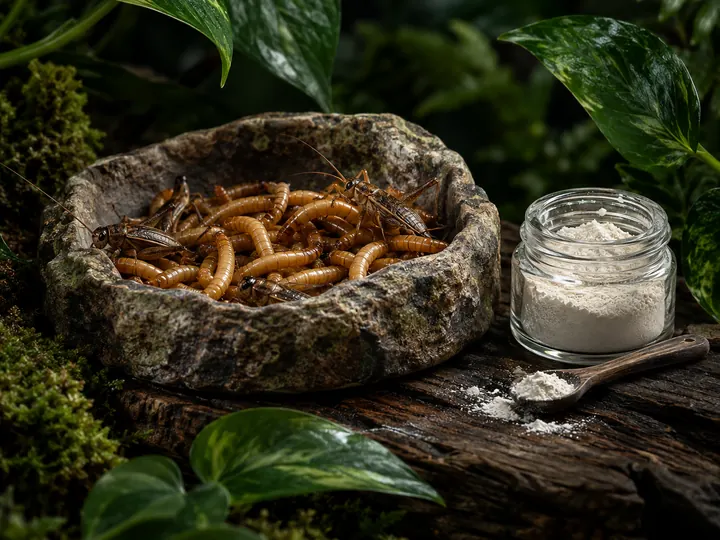
Calcium without D3
Zoo Med Repti Calcium without D3
A fine calcium carbonate powder with no vitamin D3, for dusting insects and greens. Zoo Med says the calcium is not from oyster shell.
- Calcium source
- Calcium carbonate
- Vitamin D3
- None
- Size
- 8 oz (US listing); 85 g (UK listing)
Best for
Routine dusting for a dragon that gets proper UVB and so makes its own vitamin D3.
Worth knowing
Schedules differ between sources (VCA and ReptiFiles give different ones), so follow your vet. Dust lightly; a thin coat is enough.
Multivitamin with D3
Zoo Med Reptivite with D3
A multivitamin and mineral powder that includes vitamin D3. Zoo Med says it has no soy, yeast or sugar fillers and was first developed for the San Diego Zoo.
- Type
- Multivitamin and mineral powder
- Vitamin D3
- Included
- Size
- 56.7 g (2 oz)
Best for
The weekly or twice-weekly multivitamin dusting most care sheets call for.
Worth knowing
More is not better: vitamins can be overdosed. Use it on the schedule your vet gives, not on every meal.
Putting it together: sample schedules
These follow the ReptiFiles schedule, with the VCA and RSPCA ranges in mind. Treat them as a starting point to adjust with your vet, not a fixed rule.
A baby (under about 3 months):
- Morning, once the dragon has warmed up: a bowl of finely chopped greens, lightly dusted with calcium.
- Late morning: as many small, dusted insects as it eats in one session. The RSPCA suggests feeding babies twice daily, so many keepers split this into two sessions.
- Twice a week: a light dusting of multivitamin on the salad instead of plain calcium.
- Every day: fresh water, and remove uneaten insects after about 30 minutes (RVC).
An adult (over about 12 inches, 30 cm):
- At least three days a week: a head-sized portion of mixed greens, misted with water. ReptiFiles gives three times weekly; VCA says adults eat every 24 to 72 hours, so many keepers offer greens most days.
- Two days a week: 3 to 4 head-sized, dusted insects (ReptiFiles), for example on a Monday and a Thursday.
- Once a week: a multivitamin dusting in place of plain calcium.
- Occasionally: a flower or a small piece of fruit as a treat.
Watch your dragon’s body shape over time. If an adult is getting heavy, cut back on insects before cutting back on greens. If a juvenile seems thin or is not growing, check basking temperatures first, then talk to your vet.
Water and hydration
Sources agree on a water dish but disagree on baths.
- Water dish: always available. The RSPCA says a large, shallow dish at the cool end, refreshed at least daily. ReptiFiles says shallow enough that the dragon cannot drown. VCA says clean and disinfect the bowl daily.
- Wet food: VCA suggests misting vegetables before feeding. ReptiFiles suggests soaking greens to add moisture.
- Misting: VCA suggests lightly misting the dragon. ReptiFiles suggests misting the enclosure once or twice a week.
- Baths: VCA suggests a warm soak of several minutes a few times a week. The RSPCA recommends baths only to help with shedding. ReptiFiles says bathing is not needed and to let dragons soak by choice no more than about monthly.
If you think your dragon is not drinking enough, ask a reptile vet rather than relying on baths.
What never to feed
- Wild-caught insects
- Fireflies and box elder bugs
- Avocado and onion
- Insects bigger than the gap between the eyes
- Lots of fruit or sugary food
- Anything from the garden that may have been sprayed
When to see a vet
Contact a reptile vet if your dragon stops eating for more than a few days outside of brumation, loses weight, has diarrhea or constipation with weight loss (the RSPCA flags these as possible parasite signs), or shows MBD signs such as a swollen jaw or limbs, twitching or a wobbly walk. This page is general guidance, not veterinary advice.
Feed babies like athletes and adults like gardeners. Dust lightly, feed the greens both sources agree on, and keep fruit for rare treats.