
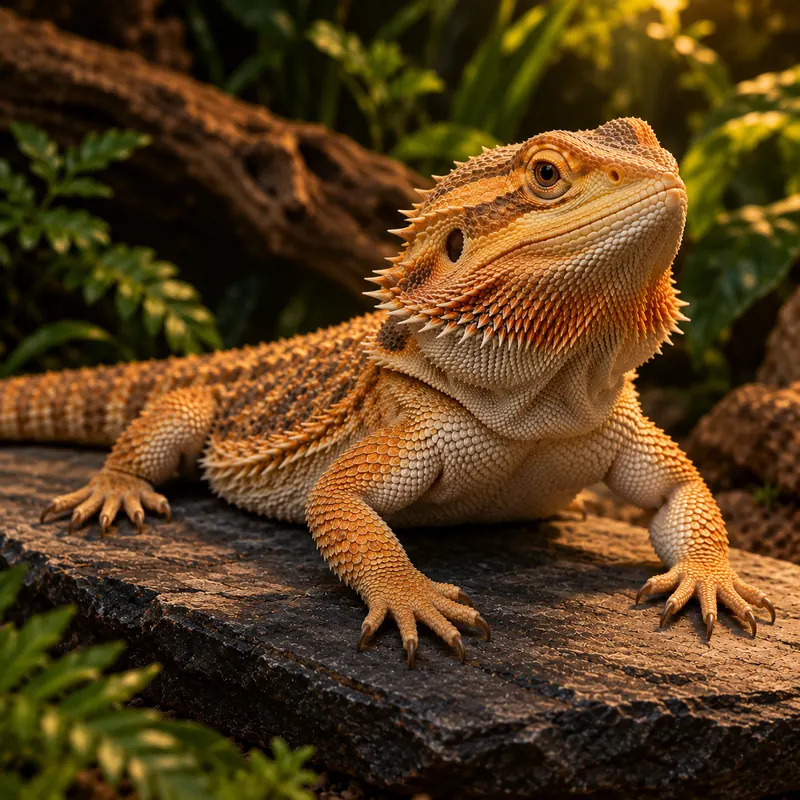
An adult bearded dragon needs an enclosure at least 4 feet long, 2 feet deep and 2 feet tall (120 x 60 x 60 cm), and some experts say 6 feet is better. The length is what matters most: it is what lets you build a hot basking end and a cool end far enough apart for the dragon to choose between them.
How big? What the sources say
| Source | Adult enclosure |
|---|---|
| RSPCA | Minimum 120 x 60 x 60 cm (about 4 x 2 x 2 ft, 48 x 24 x 24 in) |
| ReptiFiles | Minimum 6 x 2 x 2 ft (180 x 60 x 60 cm, 72 x 24 x 24 in); 4 x 2 x 2 ft acceptable for small adults under about 18 in (45 cm) |
| VCA Animal Hospitals | 60 to 100 gallons or larger; length at least 3 times the dragon’s total length; at least 16 in (40 cm) wide |
| RVC | As large a vivarium as possible |
These do not fully agree, so here is how to read them. Treat 4 x 2 x 2 ft as the floor, not the goal. If you have room for 6 x 2 x 2 ft, the extra length gives a gentler gradient and more space to move. ReptiFiles also suggests about 3 ft (90 cm) of usable height when possible, since dragons climb.
VCA’s length rule is a useful check on any tank. The RSPCA puts an adult at about 18 inches (45 cm) long. Three times that is 54 inches (about 137 cm): already longer than a 4 ft enclosure.
Why 40-gallon starter kits are outgrown
Pet stores often sell “bearded dragon kits” in 20 to 40 gallon tanks. A standard 40-gallon breeder tank is about 36 x 18 x 16 inches (91 x 46 x 41 cm). That is fine for a hatchling for a short while (VCA gives 20 gallons as a juvenile minimum), but it falls short of every adult figure in the table above.
Dragons grow quickly, so a starter tank is usually a few months of use before a second purchase. Buying the adult enclosure first is cheaper overall.
Can a baby go straight into a full-size enclosure?
Yes, as long as the setup works at baby scale. Some keepers worry that a small dragon will not find its food or will feel exposed in a big space. You can solve both:
- Put food in a shallow dish near the basking area, where the dragon spends its day.
- Add plenty of cover and clutter so there is always somewhere close to hide.
- Check the gradient at the height a baby actually sits, not just at adult height.
VCA’s 20-gallon juvenile figure is a minimum, not an instruction to use a small tank.
Glass vs PVC vs wood
Each material works if it holds the temperatures, takes the lamps and opens from the front.
| Material | Strengths | Watch out for |
|---|---|---|
| Glass | Easy to see in, easy to clean, widely sold | Loses heat through the sides; many open from the top; heavy at 4 ft and up |
| PVC | Holds heat well, light, solid sides for security, front doors | Usually a bigger outlay; check how lamps mount |
| Wood / melamine | Holds heat, solid sides, common in the UK as “vivariums” | Needs sealing against moisture; lamps inside need guards |
The RVC says wooden or fiberglass vivaria are ideal because they give the lizard visual security and allow ventilation at lizard level. The ReptiFiles enclosure examples are PVC. Glass works too, though clear sides give less of the visual security the RVC mentions. A background on the back and sides helps.
Front-opening matters more than the material. Reaching down from above looks like a predator to a lizard, and it makes cleaning harder.
Size to shop for (US)
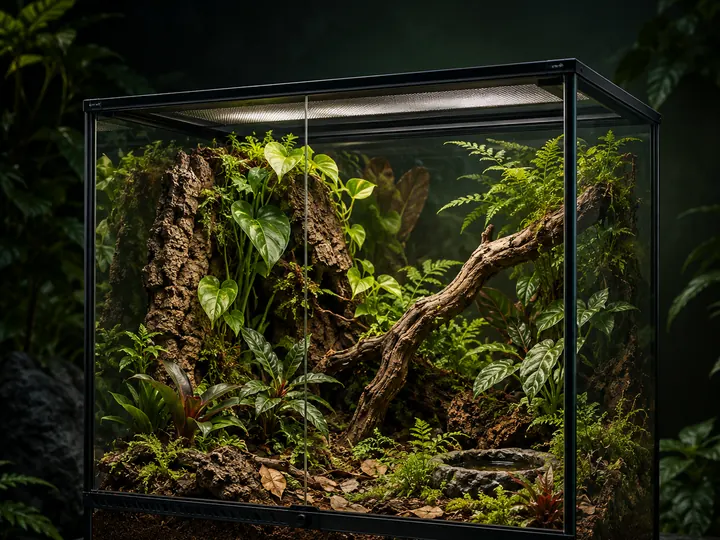
4 x 2 x 2 ft front-opening reptile enclosure (120 gallon)
Not one product but the size to shop for: a 48 x 24 x 24 inch (about 120 x 60 x 60 cm) enclosure with front doors. That footprint matches the RSPCA minimum for one adult dragon and leaves room for a real hot-to-cool gradient.
- Size to look for
- 48 x 24 x 24 in (about 120 x 60 x 60 cm) or larger
- Access
- Front-opening doors
- Top
- Mesh or solid top that can carry lamp fixtures
- Materials
- PVC, glass or melamine
Best for
US keepers who want one enclosure from baby to adult, without buying a starter tank first.
Worth knowing
Listings vary a lot. Check the inside dimensions, that the top can carry a T5 UVB fixture and heat domes, and whether the lamps sit over mesh (which cuts UVB) or mount inside.
4ft vivarium (UK)
Repti-Life 48 x 24 x 24 inch Vivarium (4ft, flatpacked)
A UK-made wooden vivarium in the 4 x 2 x 2 ft size, built from 15 mm melamine-faced board with a toughened glass front. Wooden vivaria hold heat well and give a dragon solid walls for security.
- Size
- 48 x 24 x 24 in (about 122 x 61 x 61 cm)
- Material
- 15 mm MFC (melamine-faced chipboard)
- Front
- 4 mm toughened safety glass
- Ventilation
- Four large vents
- Other
- Stackable, solid back, made in the UK
Best for
UK keepers who want a full adult-size vivarium at the RSPCA minimum footprint.
Worth knowing
It arrives flatpacked, so plan an hour or two to build it. Lamps mount inside a wooden viv, so every heat bulb needs a guard and a thermostat.
Laying it out
Think of the enclosure in three zones along its length.
1. The basking zone (one end). A flat stone or slate tile, raised close to the heat lamps and under the UVB tube. It should be the highest point in the enclosure and closest to the UVB (ReptiFiles). The hot patch should be at least as big as the whole dragon, tail included.
2. The middle. Branches, ledges and rocks at different heights, so the dragon can sit at in-between temperatures. This is where enrichment lives.
3. The cool end. A hide big enough to turn around in, and the water dish. The RVC suggests hides at both the warm and cool ends.
Keep the UVB tube on the same side as the heat lamps. ReptiFiles suggests a tube about half the enclosure length, so the cool end has shade from UVB as well as from heat.
For lamp distances and target temperatures, see lighting and heating.
Substrate: the honest version
Substrate is the most argued-about topic in dragon care. Good sources disagree, so here are both positions.
Solid or paper-based flooring. VCA recommends newspaper, butcher paper or recycled paper pellets, changed regularly, and accepts reptile carpet if you keep two pieces and wash one weekly. VCA lists sand, gravel, wood shavings, corn cob, walnut shell, cat litter and calcium sand as causes of impaction (a gut blockage). The RVC lists newspaper and Astroturf, and says wood chip substrates should never be used.
Naturalistic, diggable floor. The RSPCA accepts reptile-safe sand (such as children’s play sand) or a sand and soil mix. ReptiFiles rates packed sand and soil 4 to 6 inches (10 to 15 cm) deep as the best option because dragons dig in the wild. ReptiFiles cites a 2017 veterinary study of 529 captive dragons in which few were impacted, and argues that dehydration, low basking temperatures and parasites cause impaction more than sand does. ReptiFiles rates reptile carpet as a do-not-use, because it traps bacteria and can catch claws.
Where they agree:
- No calcium sand.
- No wood chips, bark, walnut shell or corn cob.
- A sick or injured dragon goes on paper towel until it recovers.
- Spot-clean daily. ReptiFiles says to replace sand fully every 3 to 6 months.
If you go naturalistic, keep basking temperatures right and offer water every day, since those are the factors ReptiFiles links to impaction. If you prefer the cautious route, paper or tile is simple and easy to clean.
One dragon per enclosure
VCA says dragons can share a large enclosure if they get along, with only one adult male. The RSPCA and ReptiFiles go further and advise housing every dragon alone, because they are territorial and fights cause injuries to toes and tails. We follow the welfare advice: one dragon, one enclosure.
Measure your dragon, multiply by three, and compare it to the tank. If the tank is shorter, the dragon needs a bigger home.