
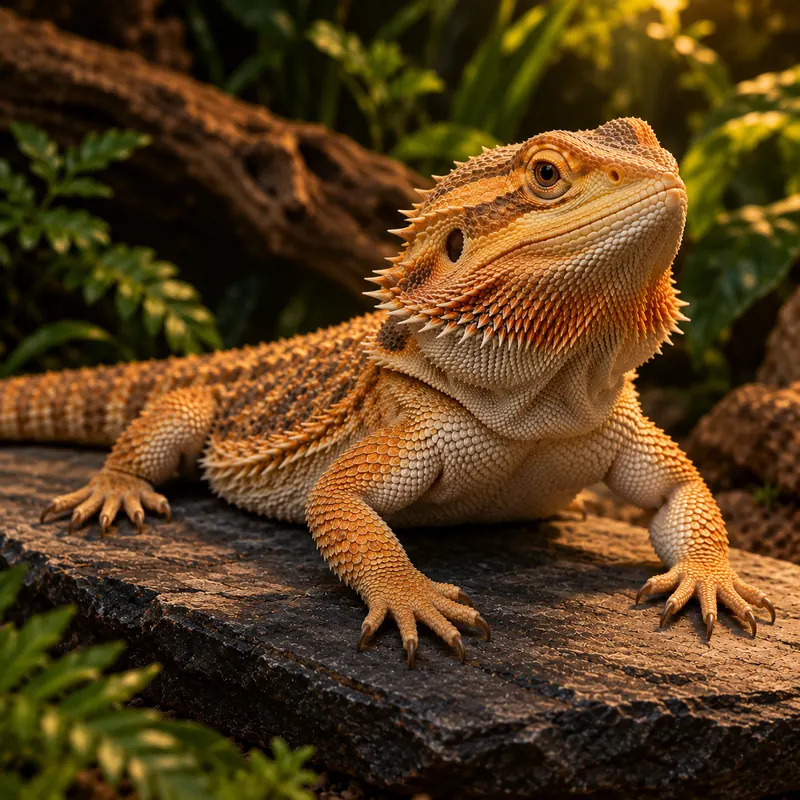
Lighting and heat are the most important part of a bearded dragon setup. These lizards bask in strong desert sun, so they need a very hot basking spot, a cooler end to escape to, and strong UVB to use calcium. Get these right and most of the common health problems never start.
Temperatures: what the sources say
Good sources give slightly different numbers. They overlap enough that you can aim for the middle.
| Zone | RSPCA | VCA | ReptiFiles |
|---|---|---|---|
| Basking | 38 to 42°C (100 to 108°F) | Warm end 90 to 100°F (32 to 38°C) | Surface 108 to 113°F (42 to 45°C) |
| Cool end | 22 to 26°C (72 to 79°F) | 75 to 80°F (24 to 27°C) | Surface 77 to 85°F (25 to 29°C) |
| Night | Not below 20 to 22°C (68 to 72°F) | Cool end 65 to 80°F (18 to 26°C) | 55 to 75°F (12 to 24°C) |
The RVC gives a basking spot of 35 to 40°C (95 to 104°F), a cool end of 25°C (77°F) and nights not below 20°C (68°F).
How to use this table:
- Basking: measure the surface of the basking stone with an infrared gun. A surface reading in roughly the 100 to 113°F (38 to 45°C) range covers the RSPCA and ReptiFiles figures. ReptiFiles’ higher number is a surface temperature; VCA’s is a general warm-end figure.
- Cool end: somewhere in the mid 70s to low 80s °F (about 24 to 28°C).
- Night: this is where sources differ most. The RSPCA wants nights no lower than 68°F (20°C); ReptiFiles says drops to 55°F (12°C) are fine if days are right. If your home stays above the RSPCA floor, you need no night heat. If it gets colder, ask your vet which floor to use.
ReptiFiles says the hot patch should be at least as big as the dragon’s whole body, and to take readings about three hours after the lamps come on.
Basking heat: halogen, deep heat projector or ceramic?
| Heat source | Gives light? | Best use |
|---|---|---|
| Halogen flood | Yes, bright | Main basking heat. ReptiFiles’ first choice. |
| Incandescent basking spot | Yes | Basking heat inside the enclosure. Also listed by ReptiFiles. |
| Deep heat projector | No | Extra daytime ambient heat or night heat |
| Ceramic heat emitter | No | Night heat in cold rooms. The RSPCA suggests a non-light ceramic heater. |
| Heat mat | No | Not a basking source for a dragon. VCA says pads must run on a thermostat. |
ReptiFiles explains why halogen comes first: halogen bulbs give off near infrared (IR-A and IR-B), which warms deeper into the body, like the sun. Ceramic heaters and heat mats give mostly far infrared, which warms the skin surface. That makes ceramic and projector heaters good for background warmth but weaker as the main basking heat.
ReptiFiles recommends at least two halogen bulbs side by side in domes with ceramic sockets, so the warm patch covers the whole body. If the spot is too hot, lower the stone or use a lower wattage; if too cool, raise the stone or go up in wattage.

Basking bulb (US)
Zoo Med Repti Tuff Splashproof Halogen Lamp, 75W (2 pack)
A 75W halogen heat lamp from Zoo Med, sold as a two-pack. Halogen bulbs give the bright, intense heat that basking lizards use, and two side by side warm the whole body rather than one small spot.
- Type
- Halogen heat lamp
- Wattage
- 75W
- Pack
- 2 bulbs
- Rated life
- Up to 2,500 hours (per Zoo Med)
Best for
Building a basking spot in a US setup, two bulbs in two domes over a flat stone.
Worth knowing
Zoo Med markets it for turtle tanks, but it is a standard halogen heat bulb. Use a dome with a ceramic socket rated for the wattage, and always run it through a thermostat.
Basking bulb (UK)
Halogen flood basking bulb, 75W (E27)
The UK equivalent of a halogen basking bulb: a 75W halogen flood with an E27 screw fitting. A flood spreads heat over a wider patch than a narrow spot bulb, which suits a dragon that basks full length.
- Type
- Halogen flood
- Wattage
- 75W (try 50W or 100W if the basking spot is too hot or too cool)
- Fitting
- E27 screw
Best for
UK keepers building a basking spot; two bulbs side by side cover a large adult.
Worth knowing
Pick a halogen flood made for reptile use, not a mercury vapor bulb (those cannot go on a thermostat). Run it through a dimming thermostat and fit a bulb guard inside a wooden viv.
A note on mercury vapor bulbs: the RVC lists them as a combined heat and UVB source but warns they cannot be fitted to a thermostat and can overheat a small vivarium. A separate halogen and T5 tube is easier to control.
Thermostats and dimmers
Every heat source goes on a thermostat. The RSPCA says so directly, and VCA warns against heat rocks, which burn reptiles that sit on them too long.
- Dimming thermostat: best for halogen bulbs. It turns the power down smoothly, so the light stays steady instead of flicking on and off.
- On/off thermostat: fine for a ceramic heat emitter. ReptiFiles says ceramic heaters can use either type, and that heat panels and projectors should use a dimming thermostat or rheostat.
- Probe placement: put the probe where you want the temperature held, usually at the basking spot. Then confirm the surface with an infrared gun.
Dimming thermostat (UK)
Habistat Dimming Thermostat, 600W
A dimming thermostat made for light-emitting heat bulbs. Instead of switching the bulb on and off, it turns the power up or down to hold the temperature, so the light stays steady.
- Type
- Dimming thermostat
- Max load
- 600W
- Min load
- 40W
- Made for
- Light-emitting heat bulbs
Best for
UK setups running halogen basking bulbs.
Worth knowing
It needs a minimum load of 40W, so it will not run a very small bulb on its own.
Thermostat (US)
Zoo Med ReptiTemp Digital Thermostat
A digital on/off thermostat with a remote probe. It switches heat sources on and off to hold a set temperature, keeps its settings after a power cut, and sounds an alarm at extreme highs or lows.
- Type
- Digital on/off thermostat
- Range
- 50 to 122°F
- Max load
- 600W of heating
- Probe
- Remote sensor on a 6 ft cable
- Extras
- Settings memory, high and low alarm
Best for
US keepers who want every heat source under thermostat control, including a night ceramic heater.
Worth knowing
It is an on/off thermostat, so a basking bulb will switch fully on and off rather than dimming. Put the probe at the basking spot and check the surface with an infrared thermometer.
UVB: the part you cannot see
UVB lets a dragon make vitamin D3 in its skin, and D3 lets it absorb and use calcium. The MSD Veterinary Manual names lack of UVB and inadequate heat, along with poor diet, as causes of nutritional secondary hyperparathyroidism, the most common form of metabolic bone disease (MBD) in reptiles.
How strong?
- Ferguson zone: the BIAZA UV-Tool (Baines et al., 2016) places the inland bearded dragon in zones 3 to 4, the open-sun baskers. The tool gives a maximum recorded UVI of 2.9 to 7.4 for zone 3 and 4.5 to 9.5 for zone 4, and suggests UVI 7.0 to 8.0 as the absolute safe maximum for zone 4 animals under artificial lamps.
- Basking target: the RSPCA gives UVI 3.0 to 5.0 in the basking zone, falling to zero in shade. ReptiFiles aims for UVI 4.0 to 4.5.
- Pale morphs: the RSPCA says albino dragons need a maximum of UVI 3.0, and ReptiFiles says the same for hypomelanistic, translucent and silkback dragons.
Which tube?
- A linear T5 HO tube of 10 to 14%. The RSPCA says 10 to 12%; ReptiFiles recommends Arcadia’s T5 HO Desert 12% or Dragon 14%.
- About half the enclosure length, on the same side as the heat (ReptiFiles). That is a 22 inch tube for a 4 ft enclosure, 34 inch for 6 ft.
- No glass or plastic in the way. VCA and ReptiFiles both say they block UVB.

Best UVB kit
Arcadia ProT5 UVB Kit, Desert 12%, 24W
A complete high-output T5 UVB kit: the 12% Desert lamp, the controller, a removable curved reflector and a link cable. The 24W size is about 22 inches long, which is roughly half the length of a 4 ft enclosure.
- Lamp
- T5 HO, D3+ 12% UVB (Desert)
- Wattage
- 24W
- Length
- About 570 mm (22.4 in) fitting
- In the box
- Controller, lamp, removable reflector, power and link cables
- Mounting
- Inside the enclosure or over suitable mesh
Best for
The core UVB light for a 4 x 2 x 2 ft bearded dragon setup, in either market.
Worth knowing
Distance matters more than the box. Mesh between lamp and dragon cuts UVB, so the basking spot sits closer when the lamp is over mesh. Replace the tube on the schedule Arcadia gives (ReptiFiles says every 12 months for T5).
How far from the dragon?
Distance is measured from the tube to the top of the dragon’s back on the basking spot. ReptiFiles’ starting points:
| Tube | Over mesh | No mesh (mounted inside) |
|---|---|---|
| Arcadia T5 HO 12% Desert | about 11 in (27 cm) | 16 to 17 in (40 to 42 cm) |
| Arcadia T5 HO 14% Dragon | 11 to 12 in (28 to 30 cm) | 17 to 18 in (43 to 45 cm) |
Mesh blocks part of the UVB, which is why the basking spot sits closer when the lamp is on top of a screen. ReptiFiles says that without a UV meter, add 1 to 3 inches (2.5 to 7.5 cm) to these distances to allow for your dragon’s height. VCA gives a broader range of 6 to 18 inches (15 to 45 cm), which covers weaker and stronger bulbs.
Measure with a UV index meter
A UV index meter turns distance guesses into a reading. ReptiFiles says the Solarmeter 6.5 is the only handheld meter that measures UVI accurately, and warns that other tools can mislead you.
When to replace the tube
UVB fades long before the visible light does. ReptiFiles gives every 12 months for T5 tubes and every 6 months for T8. VCA says every 6 months or as the manufacturer directs. The RSPCA says replace when the manufacturer recommends and check output regularly. A meter tells you when output has dropped.
Day length and night
- Photoperiod: the RSPCA suggests 12 hours on, 12 hours off, on a timer. The UV-Tool lists 13 to 14 hours of light a day (13:11 and 14:10 cycles) for this species.
- Night: the RSPCA says turn all lights off at night. If you need night heat, use something that gives no light.
Why coil bulbs and colored night bulbs are out
- Coil and compact UVB bulbs make a small pool of UVB rather than a long gradient. The sources we cite recommend linear T5 HO tubes for dragons.
- Red, blue or purple “night” bulbs still give off light. The RSPCA advises all lights off at night, and a non-light ceramic heater if extra warmth is needed.
Preventing metabolic bone disease
MBD is preventable. The MSD Veterinary Manual lists poor diet (an unbalanced calcium to phosphorus ratio or lack of vitamin D3) and poor husbandry (too little UVB or heat) as the causes. Prevention follows directly:
- Strong T5 UVB at the right distance, replaced on schedule.
- A basking spot hot enough to digest food.
- Calcium dusting and a multivitamin on a steady schedule (see diet).
See a reptile vet if you notice signs the MSD manual lists: lack of appetite, lethargy, an abnormal walk, a swollen jaw or limbs, muscle twitching, or a broken bone. The ARAV directory lists reptile vets. This page is general guidance, not veterinary advice.
Heat lets a dragon digest. UVB lets it build bone. Measure both with real tools, not guesses, and check them again every time you change a bulb.