
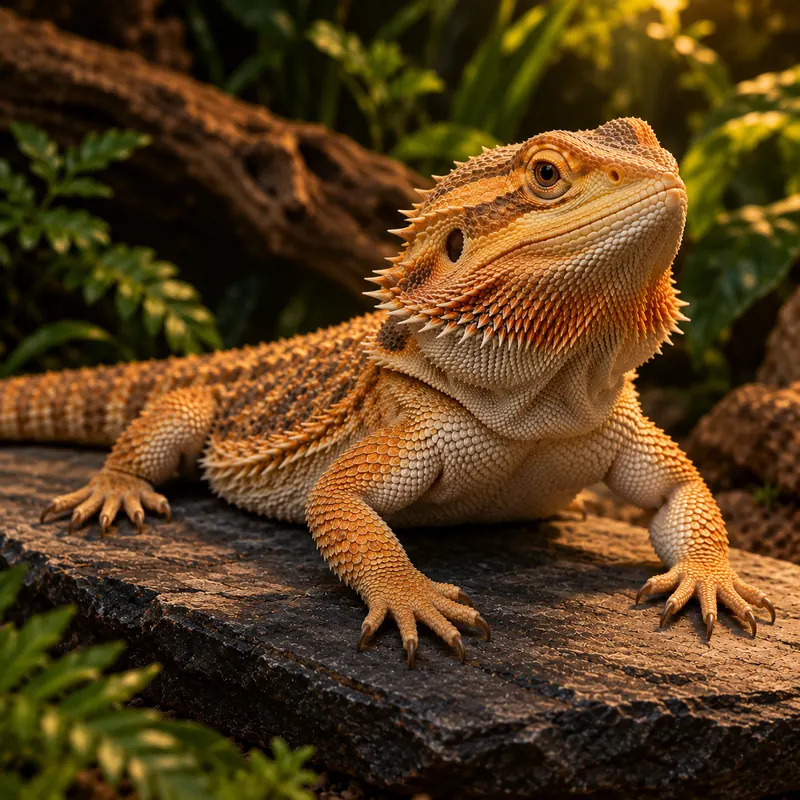
A bearded dragon needs a big enclosure, a hot basking spot, strong UVB light and a thermostat on every heat source. Buy all of it before the dragon, run the setup for about a week, and only bring your dragon home once the basking spot and UVB read right every day.
ReptiFiles rates bearded dragon care as intermediate, and this gear is most of the reason. This page is the full list, grouped in the order you will set things up. Each group links to a deeper guide if you want the detail.
The core kit
-
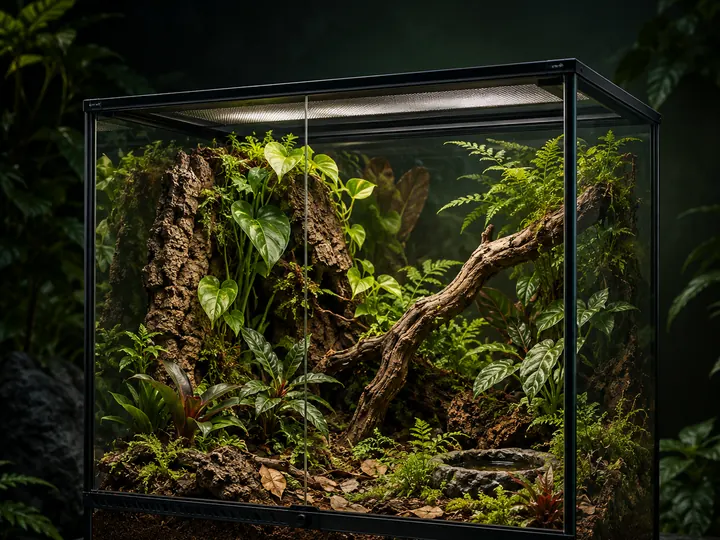 Enclosure 4 x 2 x 2 ft front-opening reptile enclosure (120 gallon) Amazon
 - Enclosure Repti-Life 48 x 24 x 24 inch Vivarium (4ft, flatpacked) Amazon UK
-
 UVB kit Arcadia ProT5 UVB Kit, Desert 12%, 24W Amazon
 - UVB kit Arcadia ProT5 UVB Kit, Desert 12%, 24W Amazon UK
-
 Basking bulb Zoo Med Repti Tuff Splashproof Halogen Lamp, 75W (2 pack) Amazon
 - Basking bulb Halogen flood basking bulb, 75W (E27) Amazon UK
- Thermostat Zoo Med ReptiTemp Digital Thermostat Amazon
- Thermostat Habistat Dimming Thermostat, 600W Amazon UK
- Temp gun Etekcity Lasergrip Infrared Thermometer Amazon
- Temp gun Etekcity Lasergrip Infrared Thermometer Amazon UK
The short version
| Group | What you need |
|---|---|
| Enclosure | 4 x 2 x 2 ft (120 x 60 x 60 cm) or larger, front-opening, ventilated |
| Heat | Halogen basking bulbs in ceramic-socket domes, a flat stone to bask on, a thermostat |
| UVB | A T5 HO 12% or 14% UVB tube about half the enclosure length, a timer |
| Floor and furniture | Your chosen substrate, a cool-end hide, branches or ledges to climb |
| Food | Live insects, greens, calcium powder, multivitamin, a shallow water dish |
| Monitoring | Infrared temperature gun, digital probe thermometer, hygrometer |
1. Enclosure
What to get: an enclosure at least 4 x 2 x 2 ft (48 x 24 x 24 inches, 120 x 60 x 60 cm). That is the RSPCA minimum for one adult. ReptiFiles goes further and recommends 6 x 2 x 2 ft (180 x 60 x 60 cm), with 4 x 2 x 2 ft acceptable only for small adults under about 18 inches (45 cm). VCA gives the adult range as 60 to 100 gallons or larger, with the length at least three times the dragon’s total length.
Why it matters: the size is what makes a temperature gradient possible. A dragon needs a very hot end to bask and a cooler end to cool off, and a short tank cannot hold both.
Look for: front-opening doors (easier and less alarming than reaching down from above), good ventilation, and a top that can carry lamp fixtures. One dragon per enclosure: the RSPCA and ReptiFiles both advise keeping them alone.
Enclosure size to shop for (US)
4 x 2 x 2 ft front-opening reptile enclosure (120 gallon)
Not one product but the size to shop for: a 48 x 24 x 24 inch (about 120 x 60 x 60 cm) enclosure with front doors. That footprint matches the RSPCA minimum for one adult dragon and leaves room for a real hot-to-cool gradient.
- Size to look for
- 48 x 24 x 24 in (about 120 x 60 x 60 cm) or larger
- Access
- Front-opening doors
- Top
- Mesh or solid top that can carry lamp fixtures
- Materials
- PVC, glass or melamine
Best for
US keepers who want one enclosure from baby to adult, without buying a starter tank first.
Worth knowing
Listings vary a lot. Check the inside dimensions, that the top can carry a T5 UVB fixture and heat domes, and whether the lamps sit over mesh (which cuts UVB) or mount inside.
4ft vivarium (UK)
Repti-Life 48 x 24 x 24 inch Vivarium (4ft, flatpacked)
A UK-made wooden vivarium in the 4 x 2 x 2 ft size, built from 15 mm melamine-faced board with a toughened glass front. Wooden vivaria hold heat well and give a dragon solid walls for security.
- Size
- 48 x 24 x 24 in (about 122 x 61 x 61 cm)
- Material
- 15 mm MFC (melamine-faced chipboard)
- Front
- 4 mm toughened safety glass
- Ventilation
- Four large vents
- Other
- Stackable, solid back, made in the UK
Best for
UK keepers who want a full adult-size vivarium at the RSPCA minimum footprint.
Worth knowing
It arrives flatpacked, so plan an hour or two to build it. Lamps mount inside a wooden viv, so every heat bulb needs a guard and a thermostat.
Full detail: Enclosure and tank size.
2. Heat
What to get:
- One or two halogen basking bulbs. ReptiFiles recommends at least two bulbs side by side so the heat covers the whole body.
- A dome for each bulb with a ceramic socket rated for the wattage.
- A flat stone or slate tile under the lamps to bask on.
- A thermostat. The RSPCA says to use one to regulate the temperature, and VCA warns against heat rocks.
- Optional: a ceramic heat emitter (no light) for cold rooms at night, also on a thermostat.
Why it matters: dragons need heat to digest food and stay healthy. The target is a basking surface somewhere in the range the sources give (RSPCA 100 to 108°F, 38 to 42°C; ReptiFiles 108 to 113°F, 42 to 45°C) with a cool end in the 70s °F (low to mid 20s °C).
Basking bulb (US)
Zoo Med Repti Tuff Splashproof Halogen Lamp, 75W (2 pack)
A 75W halogen heat lamp from Zoo Med, sold as a two-pack. Halogen bulbs give the bright, intense heat that basking lizards use, and two side by side warm the whole body rather than one small spot.
- Type
- Halogen heat lamp
- Wattage
- 75W
- Pack
- 2 bulbs
- Rated life
- Up to 2,500 hours (per Zoo Med)
Best for
Building a basking spot in a US setup, two bulbs in two domes over a flat stone.
Worth knowing
Zoo Med markets it for turtle tanks, but it is a standard halogen heat bulb. Use a dome with a ceramic socket rated for the wattage, and always run it through a thermostat.
Thermostat (UK)
Habistat Dimming Thermostat, 600W
A dimming thermostat made for light-emitting heat bulbs. Instead of switching the bulb on and off, it turns the power up or down to hold the temperature, so the light stays steady.
- Type
- Dimming thermostat
- Max load
- 600W
- Min load
- 40W
- Made for
- Light-emitting heat bulbs
Best for
UK setups running halogen basking bulbs.
Worth knowing
It needs a minimum load of 40W, so it will not run a very small bulb on its own.
Full detail: Lighting and heating.
3. UVB light
What to get:
- A linear T5 HO UVB tube, 10 to 14% strength. The RSPCA says 10 to 12%; ReptiFiles recommends Arcadia’s 12% Desert or 14% Dragon tubes.
- A reflector fixture to hold it. Kits come with one.
- A plug-in timer. The RSPCA suggests 12 hours on, 12 hours off.
Why it matters: UVB lets a dragon make vitamin D3, which it needs to use calcium. Without it, dragons develop metabolic bone disease. The RSPCA gives a target of UV index (UVI) 3.0 to 5.0 in the basking zone; ReptiFiles aims for 4.0 to 4.5. The BIAZA UV-Tool places bearded dragons in Ferguson zones 3 to 4, the open-sun baskers.
Get the length right: ReptiFiles suggests a tube about half the enclosure length, on the same side as the heat. For a 4 ft enclosure that is a 22 inch (24W) tube.
Best UVB kit
Arcadia ProT5 UVB Kit, Desert 12%, 24W
A complete high-output T5 UVB kit: the 12% Desert lamp, the controller, a removable curved reflector and a link cable. The 24W size is about 22 inches long, which is roughly half the length of a 4 ft enclosure.
- Lamp
- T5 HO, D3+ 12% UVB (Desert)
- Wattage
- 24W
- Length
- About 570 mm (22.4 in) fitting
- In the box
- Controller, lamp, removable reflector, power and link cables
- Mounting
- Inside the enclosure or over suitable mesh
Best for
The core UVB light for a 4 x 2 x 2 ft bearded dragon setup, in either market.
Worth knowing
Distance matters more than the box. Mesh between lamp and dragon cuts UVB, so the basking spot sits closer when the lamp is over mesh. Replace the tube on the schedule Arcadia gives (ReptiFiles says every 12 months for T5).
4. Floor and furniture
What to get:
- A substrate. This is the most debated choice in dragon care. VCA prefers paper-based flooring; the RSPCA accepts reptile-safe sand or a sand and soil mix; ReptiFiles rates packed sand and soil 4 to 6 inches (10 to 15 cm) deep as best. All of them say no calcium sand.
- A hide at the cool end big enough for an adult to turn around in.
- Climbing branches, ledges or rocks. ReptiFiles says the setup should not look sparse.
- A shallow water dish (the RSPCA says at the cool end, changed at least daily).
Why it matters: hides give security, and climbing and digging give a dragon something to do. A bare tank is a bored dragon.

Cool-end hide
Exo Terra Reptile Cave, Large
A heavy resin hide with a natural rock look and a wide, stable base, so a large lizard cannot tip it over.
- Size
- Large
- Material
- Resin
- Base
- Wide and stable
Best for
The cool-end hide where a dragon sleeps and retreats.
Worth knowing
Check that an adult can turn around inside. A grown dragon may need the extra-large size.
5. Food and supplements
What to get:
- Live feeder insects sized no wider than the space between the dragon’s eyes (ReptiFiles’ rule).
- A supply of greens: collards, dandelion greens, turnip greens and similar.
- Calcium powder without D3, and a multivitamin with D3. VCA also suggests a calcium with D3 two to three times a week; follow one schedule your vet agrees with, not both at once.
- Feeding tongs and a shallow food dish.
Why it matters: young dragons eat mostly insects and adults mostly greens. The calcium and vitamin dusting is the other half of preventing bone disease.
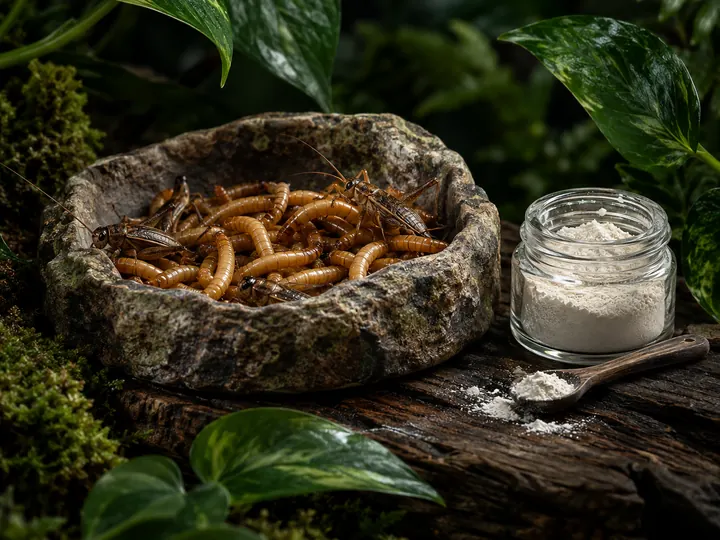
Calcium powder
Zoo Med Repti Calcium without D3
A fine calcium carbonate powder with no vitamin D3, for dusting insects and greens. Zoo Med says the calcium is not from oyster shell.
- Calcium source
- Calcium carbonate
- Vitamin D3
- None
- Size
- 8 oz (US listing); 85 g (UK listing)
Best for
Routine dusting for a dragon that gets proper UVB and so makes its own vitamin D3.
Worth knowing
Schedules differ between sources (VCA and ReptiFiles give different ones), so follow your vet. Dust lightly; a thin coat is enough.
Full detail: Diet and feeding.
6. Monitoring
What to get:
- An infrared temperature gun for the basking surface.
- A digital probe thermometer for air temperature, with min/max memory if you can.
- A hygrometer. The RSPCA gives 30 to 40% humidity at the cool end; ReptiFiles allows 30 to 60%.
- Optional but useful: a Solarmeter 6.5 UV index meter. ReptiFiles says it is the only handheld meter that reads UVI accurately.
Why it matters: you cannot see heat or UVB. Every number on this page means nothing until you have measured it in your own setup.
Temperature gun
Etekcity Lasergrip Infrared Thermometer
A handheld infrared thermometer that reads surface temperature without touching it. That is the reading that matters for a basking stone, which gets hotter than the air above it.
- Measures
- Surface temperature, no contact
- Units
- °F and °C
- Use
- Basking spot, cool end and night checks
Best for
Checking the basking surface and the cool end in seconds.
Worth knowing
It reads surfaces, not air. Pair it with a probe thermometer, and take readings once the lamps have been on for a few hours.
The order to set it up
- Place the enclosure on a sturdy stand away from windows and drafts.
- Add substrate and the heavy items first: basking stone, hide, branches. Heavy rocks go on the floor, not on top of loose substrate, so they cannot be dug under.
- Mount the UVB fixture on the warm side, so the basking spot sits under both heat and UVB.
- Fit the heat domes over the basking stone and plug them into the thermostat. Put the thermostat probe at the basking spot.
- Put the lights on a timer. All lights off at night (RSPCA).
- Place thermometer probes at the basking spot and the cool end.
Run it for a week before the dragon arrives
The RSPCA says to run the vivarium for at least a week before introducing your dragon. Use that week to check:
- Basking surface: read it with the temperature gun about three hours after the lamps come on (ReptiFiles’ timing). Adjust the stone height or bulb wattage until it sits in your target range.
- Basking area size: ReptiFiles says the hot patch should be at least as big as the dragon’s whole body, tail included.
- Cool end: should stay in the 70s °F (22 to 29°C depending on source).
- Night: read the min/max thermometer each morning. The RSPCA says not below 68 to 72°F (20 to 22°C); VCA allows 65 to 80°F (18 to 26°C) at the cool end; ReptiFiles says 55 to 75°F (12 to 24°C) is fine. If your room drops below your chosen floor, add a ceramic heater on a thermostat.
- UVB distance: measure from the tube to the top of the basking stone. ReptiFiles gives about 11 inches (27 cm) for the 12% tube over mesh and 16 to 17 inches (40 to 42 cm) with no mesh. A UVI meter takes the guesswork out.
- Thermostat: make sure it actually cuts or dims the heat when it should.
Before you bring the dragon home
- Find a reptile vet now, before you need one. The ARAV has a Find A Vet directory.
- Stock a week of insects and greens.
- Read your first week at home so you know what normal looks like.
Go deeper
- Supplies list with picks
- Enclosure and tank size
- Lighting and heating
- Diet and feeding
- First week at home
- Common mistakes
- FAQ
This is general husbandry guidance from the sources listed below, not veterinary advice for your own animal.
Buy the big enclosure, the strong UVB and the thermostat first. Everything else is easy to change later; those three are what keep a dragon healthy.