
Most of a bearded dragon’s health is decided by three purchases: the enclosure, the UVB light and the heat with its thermostat. Spend your budget there first. The rest of the list is cheaper, easier to swap later, and matters less if you get those three right.
Below is every item, grouped by job, with what to look for and a pick for US and UK keepers. Brands differ between the two markets, so some picks show only in one. Picks are based on the care guidance cited at the bottom of this page and the manufacturers’ own specs; we have not tested them ourselves.
The short version
-
 Enclosure 4 x 2 x 2 ft front-opening reptile enclosure (120 gallon) Amazon
 - Enclosure Repti-Life 48 x 24 x 24 inch Vivarium (4ft, flatpacked) Amazon UK
-
 UVB kit Arcadia ProT5 UVB Kit, Desert 12%, 24W Amazon
 - UVB kit Arcadia ProT5 UVB Kit, Desert 12%, 24W Amazon UK
-
 Basking bulb Zoo Med Repti Tuff Splashproof Halogen Lamp, 75W (2 pack) Amazon
 - Basking bulb Halogen flood basking bulb, 75W (E27) Amazon UK
- Heat dome Exo Terra Reptile Dome Fixture, Large (PT2349) Amazon
- Heat dome Exo Terra Reptile Dome Fixture, Large (PT2349) Amazon UK
- Thermostat Zoo Med ReptiTemp Digital Thermostat Amazon
- Thermostat Habistat Dimming Thermostat, 600W Amazon UK
- Temp gun Etekcity Lasergrip Infrared Thermometer Amazon
- Temp gun Etekcity Lasergrip Infrared Thermometer Amazon UK
- Probe thermometer Exo Terra Digital Thermometer with probe Amazon
- Probe thermometer Exo Terra Digital Thermometer with probe Amazon UK
-
 Calcium Zoo Med Repti Calcium without D3 Amazon
 - Calcium Zoo Med Repti Calcium without D3 Amazon UK
- Multivitamin Zoo Med Reptivite with D3 Amazon
- Multivitamin Zoo Med Reptivite with D3 Amazon UK
-
 Hide Exo Terra Reptile Cave, Large Amazon
 - Hide Exo Terra Reptile Cave, Large Amazon UK
1. Enclosure
What to look for:
- Size: at least 4 x 2 x 2 ft (48 x 24 x 24 inches, 120 x 60 x 60 cm) for one adult. That is the RSPCA’s minimum. ReptiFiles prefers 6 x 2 x 2 ft (180 x 60 x 60 cm) and treats 4 x 2 x 2 ft as acceptable for smaller adults. VCA gives 60 to 100 gallons or more.
- Front doors: easier to clean and less frightening than a hand coming from above.
- A top that carries lamps: you will hang a UVB fixture and two heat domes on or in it.
- Ventilation: VCA asks for a well-ventilated enclosure with a secure top.
Skip: the 20 to 40 gallon “starter kits”. VCA gives 20 gallons as a juvenile minimum only. Dragons grow fast and you will be buying again within months.
Best enclosure size (US)
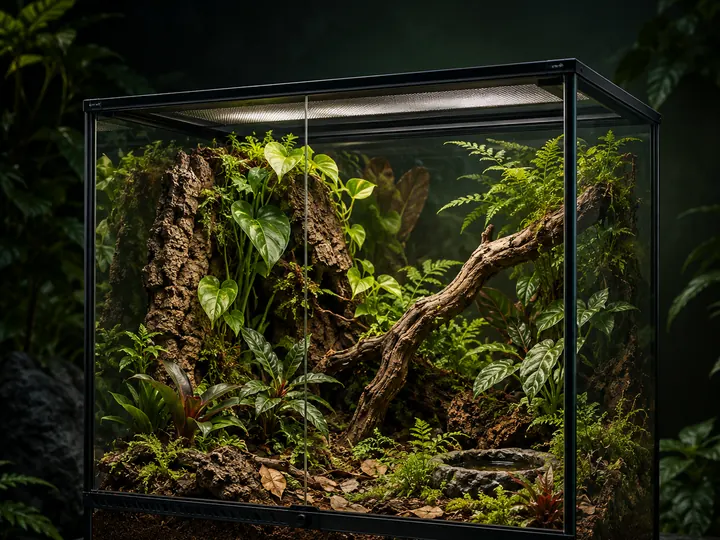
4 x 2 x 2 ft front-opening reptile enclosure (120 gallon)
Not one product but the size to shop for: a 48 x 24 x 24 inch (about 120 x 60 x 60 cm) enclosure with front doors. That footprint matches the RSPCA minimum for one adult dragon and leaves room for a real hot-to-cool gradient.
- Size to look for
- 48 x 24 x 24 in (about 120 x 60 x 60 cm) or larger
- Access
- Front-opening doors
- Top
- Mesh or solid top that can carry lamp fixtures
- Materials
- PVC, glass or melamine
Best for
US keepers who want one enclosure from baby to adult, without buying a starter tank first.
Worth knowing
Listings vary a lot. Check the inside dimensions, that the top can carry a T5 UVB fixture and heat domes, and whether the lamps sit over mesh (which cuts UVB) or mount inside.
Best 4ft vivarium (UK)
Repti-Life 48 x 24 x 24 inch Vivarium (4ft, flatpacked)
A UK-made wooden vivarium in the 4 x 2 x 2 ft size, built from 15 mm melamine-faced board with a toughened glass front. Wooden vivaria hold heat well and give a dragon solid walls for security.
- Size
- 48 x 24 x 24 in (about 122 x 61 x 61 cm)
- Material
- 15 mm MFC (melamine-faced chipboard)
- Front
- 4 mm toughened safety glass
- Ventilation
- Four large vents
- Other
- Stackable, solid back, made in the UK
Best for
UK keepers who want a full adult-size vivarium at the RSPCA minimum footprint.
Worth knowing
It arrives flatpacked, so plan an hour or two to build it. Lamps mount inside a wooden viv, so every heat bulb needs a guard and a thermostat.
More on sizes and materials: Enclosure and tank size.
2. UVB lighting
This is the item not to economize on. Bearded dragons are open-sun baskers (Ferguson zones 3 to 4 in the BIAZA UV-Tool), and their UVB needs are among the highest of any common pet lizard.
What to look for:
- Linear T5 HO tube, not a coil or compact bulb. ReptiFiles recommends Arcadia’s T5 HO Desert 12% or Dragon 14%. The RSPCA says a 10 to 12% tube.
- About half the enclosure length. ReptiFiles suggests a 22 inch tube for a 4 ft enclosure and a 34 inch tube for 6 ft.
- A reflector. It pushes more UVB down toward the basking spot.
- No glass or plastic cover. VCA and ReptiFiles both note that glass and plastic block UVB.
Target: a UV index (UVI) of about 3.0 to 5.0 at the basking spot (RSPCA) or 4.0 to 4.5 (ReptiFiles). Replace T5 tubes every 12 months (ReptiFiles) or as the maker directs.
Best UVB kit (US and UK)
Arcadia ProT5 UVB Kit, Desert 12%, 24W
A complete high-output T5 UVB kit: the 12% Desert lamp, the controller, a removable curved reflector and a link cable. The 24W size is about 22 inches long, which is roughly half the length of a 4 ft enclosure.
- Lamp
- T5 HO, D3+ 12% UVB (Desert)
- Wattage
- 24W
- Length
- About 570 mm (22.4 in) fitting
- In the box
- Controller, lamp, removable reflector, power and link cables
- Mounting
- Inside the enclosure or over suitable mesh
Best for
The core UVB light for a 4 x 2 x 2 ft bearded dragon setup, in either market.
Worth knowing
Distance matters more than the box. Mesh between lamp and dragon cuts UVB, so the basking spot sits closer when the lamp is over mesh. Replace the tube on the schedule Arcadia gives (ReptiFiles says every 12 months for T5).
Worth adding if you can: a Solarmeter 6.5 UV index meter. ReptiFiles says it is the only handheld meter that reads UVI accurately. It turns guesswork about distance into a number.
3. Basking heat
What to look for:
- Halogen bulbs. ReptiFiles calls halogen or incandescent floods the best basking heat, and recommends at least two bulbs side by side so the warm patch covers the whole body.
- Wattage you can tune. ReptiFiles says 90 to 100W should reach basking temperature in a 4 or 6 ft enclosure. Fine-tune by raising or lowering the basking stone, or by changing bulb wattage.
- Domes with ceramic sockets, rated for the bulb wattage. A plastic socket under a hot bulb is a fire risk.
- A flat basking stone or slate tile. ReptiFiles prefers light-colored stone, which holds heat well.
Basking bulb (US)
Zoo Med Repti Tuff Splashproof Halogen Lamp, 75W (2 pack)
A 75W halogen heat lamp from Zoo Med, sold as a two-pack. Halogen bulbs give the bright, intense heat that basking lizards use, and two side by side warm the whole body rather than one small spot.
- Type
- Halogen heat lamp
- Wattage
- 75W
- Pack
- 2 bulbs
- Rated life
- Up to 2,500 hours (per Zoo Med)
Best for
Building a basking spot in a US setup, two bulbs in two domes over a flat stone.
Worth knowing
Zoo Med markets it for turtle tanks, but it is a standard halogen heat bulb. Use a dome with a ceramic socket rated for the wattage, and always run it through a thermostat.
Basking bulb (UK)
Halogen flood basking bulb, 75W (E27)
The UK equivalent of a halogen basking bulb: a 75W halogen flood with an E27 screw fitting. A flood spreads heat over a wider patch than a narrow spot bulb, which suits a dragon that basks full length.
- Type
- Halogen flood
- Wattage
- 75W (try 50W or 100W if the basking spot is too hot or too cool)
- Fitting
- E27 screw
Best for
UK keepers building a basking spot; two bulbs side by side cover a large adult.
Worth knowing
Pick a halogen flood made for reptile use, not a mercury vapor bulb (those cannot go on a thermostat). Run it through a dimming thermostat and fit a bulb guard inside a wooden viv.
Heat dome
Exo Terra Reptile Dome Fixture, Large (PT2349)
An aluminum reflector dome with a heat-resistant ceramic socket and a 6 ft cord with an inline switch. It holds a basking bulb or ceramic heater over the mesh top of an enclosure.
- Diameter
- 21 cm (about 8.3 in)
- Socket
- Heat-resistant ceramic
- Cord
- 180 cm (6 ft) with inline switch
- Model
- PT2349
Best for
Holding halogen basking bulbs over a mesh top; buy two for a two-bulb basking spot.
Worth knowing
Check the maximum wattage printed on the fixture against your bulb. The dome sits on mesh, so the mesh will block some heat and light.
4. Thermostat
Every heat source goes on a thermostat. The RSPCA says so plainly, and VCA requires one for heat pads.
What to look for:
- Dimming thermostat for light-emitting bulbs. It turns the power down instead of switching the bulb on and off, so the light stays steady.
- On/off thermostat is fine for a ceramic heat emitter (ReptiFiles says ceramic heaters can use either type).
- Enough wattage for everything you plug into it.
Dimming thermostat (UK)
Habistat Dimming Thermostat, 600W
A dimming thermostat made for light-emitting heat bulbs. Instead of switching the bulb on and off, it turns the power up or down to hold the temperature, so the light stays steady.
- Type
- Dimming thermostat
- Max load
- 600W
- Min load
- 40W
- Made for
- Light-emitting heat bulbs
Best for
UK setups running halogen basking bulbs.
Worth knowing
It needs a minimum load of 40W, so it will not run a very small bulb on its own.
Thermostat (US)
Zoo Med ReptiTemp Digital Thermostat
A digital on/off thermostat with a remote probe. It switches heat sources on and off to hold a set temperature, keeps its settings after a power cut, and sounds an alarm at extreme highs or lows.
- Type
- Digital on/off thermostat
- Range
- 50 to 122°F
- Max load
- 600W of heating
- Probe
- Remote sensor on a 6 ft cable
- Extras
- Settings memory, high and low alarm
Best for
US keepers who want every heat source under thermostat control, including a night ceramic heater.
Worth knowing
It is an on/off thermostat, so a basking bulb will switch fully on and off rather than dimming. Put the probe at the basking spot and check the surface with an infrared thermometer.
5. Night heat (only if you need it)
Many homes never need it. The RSPCA says not to let nights fall below 68 to 72°F (20 to 22°C) and to use a non-light ceramic heater if they do. ReptiFiles is more relaxed and says 55 to 75°F (12 to 24°C) is fine if days are right. Measure your room overnight for a week before buying anything.
If you need one, use a ceramic heat emitter or deep heat projector (both give no visible light), on a thermostat.
Night heat (US)
Zoo Med ReptiCare Ceramic Infrared Heat Emitter, 100W
A ceramic heater that gives off heat but no light. Zoo Med says it can raise the air temperature 10 to 20°F above the room. Use it only if your room gets colder at night than your sources allow.
- Type
- Ceramic infrared heat emitter (no light)
- Wattage
- 100W
- Effect
- Raises air 10 to 20°F above room temperature (per Zoo Med)
Best for
Cold homes where night temperatures in the enclosure fall below the range your vet or care sheet gives.
Worth knowing
It gets very hot, needs a ceramic-socket dome, and must run on a thermostat. Many homes never need it; measure first.
6. Thermometers and monitoring
You need two kinds of reading, and ReptiFiles says not to rely on one without the other:
- Surface temperature with an infrared gun. This is how you check the basking stone.
- Air temperature with a digital probe thermometer, ideally with min/max memory for overnight lows.
- Humidity with a hygrometer at the cool end. Targets: 30 to 40% (RSPCA) or 30 to 60% (ReptiFiles).
Best temperature gun
Etekcity Lasergrip Infrared Thermometer
A handheld infrared thermometer that reads surface temperature without touching it. That is the reading that matters for a basking stone, which gets hotter than the air above it.
- Measures
- Surface temperature, no contact
- Units
- °F and °C
- Use
- Basking spot, cool end and night checks
Best for
Checking the basking surface and the cool end in seconds.
Worth knowing
It reads surfaces, not air. Pair it with a probe thermometer, and take readings once the lamps have been on for a few hours.
Probe thermometer
Exo Terra Digital Thermometer with probe
A small digital thermometer with a remote probe and minimum/maximum memory, so you can see how cold the enclosure got overnight without being up to check.
- Type
- Digital, remote probe
- Units
- °C and °F
- Memory
- Minimum and maximum
Best for
Leaving in place to track air temperature at the cool end and overnight lows.
Worth knowing
One probe reads one spot. Use two (warm and cool end) or move it around during your first week.
7. Supplements
Supplements cost little but matter a lot, because they work with UVB to prevent metabolic bone disease.
What to look for:
- Calcium without D3 for routine dusting. VCA recommends a phosphorus-free calcium lightly sprinkled on food daily.
- A multivitamin with D3. ReptiFiles gives it twice weekly for juveniles and once weekly for adults.
- Some keepers use a calcium with D3 instead, which VCA suggests two to three times a week. Pick one plan with your vet and do not stack products.
Calcium
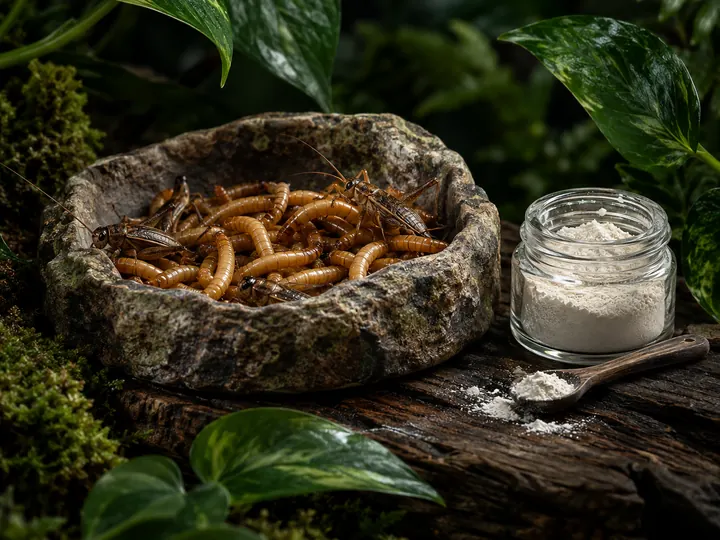
Zoo Med Repti Calcium without D3
A fine calcium carbonate powder with no vitamin D3, for dusting insects and greens. Zoo Med says the calcium is not from oyster shell.
- Calcium source
- Calcium carbonate
- Vitamin D3
- None
- Size
- 8 oz (US listing); 85 g (UK listing)
Best for
Routine dusting for a dragon that gets proper UVB and so makes its own vitamin D3.
Worth knowing
Schedules differ between sources (VCA and ReptiFiles give different ones), so follow your vet. Dust lightly; a thin coat is enough.
Multivitamin
Zoo Med Reptivite with D3
A multivitamin and mineral powder that includes vitamin D3. Zoo Med says it has no soy, yeast or sugar fillers and was first developed for the San Diego Zoo.
- Type
- Multivitamin and mineral powder
- Vitamin D3
- Included
- Size
- 56.7 g (2 oz)
Best for
The weekly or twice-weekly multivitamin dusting most care sheets call for.
Worth knowing
More is not better: vitamins can be overdosed. Use it on the schedule your vet gives, not on every meal.
More on schedules: Diet and feeding.
8. Hides and decor
What to look for:
- A cool-end hide an adult can turn around in. Heavy and stable so it cannot tip.
- Climbing: branches, ledges, cork. ReptiFiles says the setup should not look sparse.
- A shallow water dish at the cool end, too shallow to drown in.
- A shallow food dish for greens.
Best hide
Exo Terra Reptile Cave, Large
A heavy resin hide with a natural rock look and a wide, stable base, so a large lizard cannot tip it over.
- Size
- Large
- Material
- Resin
- Base
- Wide and stable
Best for
The cool-end hide where a dragon sleeps and retreats.
Worth knowing
Check that an adult can turn around inside. A grown dragon may need the extra-large size.
9. Substrate
There is no single agreed answer here, so we lay out both sides.
- Solid flooring: VCA prefers newspaper, butcher paper or paper pellets, and accepts reptile carpet if washed weekly.
- Naturalistic, diggable floor: ReptiFiles rates packed sand and soil mixes 4 to 6 inches (10 to 15 cm) deep as best, and the RSPCA accepts reptile-safe sand or a sand and soil mix. ReptiFiles’ DIY mix is part play sand, part topsoil and part excavator clay.
- Everyone agrees: no calcium sand, and no wood chips, walnut shell or corn cob. Sick dragons go on paper towel.
If you choose the naturalistic route, clay helps a mix hold its shape:
Clay for a dig mix (US)
Zoo Med Excavator Clay Burrowing Substrate, 10 lb
A natural clay substrate with no dyes. Mixed with water and shaped, it dries hard and holds tunnels without collapsing. ReptiFiles lists it as one part of a packed sand, soil and clay mix.
- Weight
- 10 lb
- Type
- Clay burrowing substrate
- Holds shape
- Tunnels do not collapse once dry
- Additives
- No dyes or chemicals (per Zoo Med)
Best for
Keepers who choose a packed, diggable naturalistic floor after reading both sides of the substrate debate.
Worth knowing
Loose substrate is debated: VCA advises paper-based flooring, while ReptiFiles and the RSPCA accept packed sand or soil mixes. Never use it for a sick or injured dragon.
10. Useful extras
None of these is essential on day one, but each one makes the setup easier to run or closer to what the sources describe.
- A plug-in timer. The RSPCA suggests 12 hours of light and 12 hours dark. A timer keeps that steady when you are busy or away, and it is the simplest way to stop lights being left on overnight.
- A surge protector. ReptiFiles notes that halogen basking bulbs are sensitive to swings in the power supply and burn out sooner without one.
- Bright daylight lighting. ReptiFiles recommends a bright, roughly 6500K LED or plant-grow lamp covering 75 to 100% of the enclosure length, in addition to the UVB tube. It links bright light to activity, appetite and general wellbeing. This is a second fixture, not a replacement for UVB.
- Feeding tongs. Soft-tipped tongs let you offer insects without fingers near a hungry mouth, and help you see exactly how much the dragon eats.
- A small kitchen scale. A weekly weight log is one of the easiest early warnings that something is wrong, and it is useful during brumation.
- Spare UVB tube and bulbs. UVB fades with age and halogens fail without warning. Having a spare means no gap in heat or UVB while you wait for a delivery.
Where to spend and where to save
If the budget is tight, this is the order that protects the dragon:
- Spend on UVB. A good T5 HO kit at the right distance is the single biggest factor in preventing bone disease. See lighting and heating for why.
- Spend on the thermostat. It is what stops a heat lamp from overheating the enclosure on a warm day.
- Spend on enclosure size. Buying the adult size once is cheaper than a starter tank plus an upgrade.
- Save on decor. Clean, sturdy branches, flat stones and a plain hide do the job as well as expensive ornaments.
- Save on substrate. Paper is the cheapest option VCA recommends. If you prefer a naturalistic floor, a home mix of sand, soil and clay (the ReptiFiles approach) costs less than many bagged products.
- Save on the thermometer brand, not the type. Any reliable infrared gun and digital probe thermometer will do.
Skip these
- Heat rocks. VCA calls hot rocks dangerous and ineffective, and says they often burn reptiles.
- Calcium sand. The RSPCA, VCA and ReptiFiles all list it as a substrate to avoid.
- Coil or compact UVB bulbs. They light a small patch, not the whole dragon. The care sheets we cite recommend linear T5 tubes.
- Colored “night” bulbs. The RSPCA says turn all lights off at night. If you need night heat, use a heater that gives no light.
- Any heat source without a thermostat.
- Glass or plastic between the UVB tube and the dragon, including lamp covers. It blocks UVB.
- A second dragon for company. The RSPCA and ReptiFiles both advise housing them alone.
- Small starter kits sold as “bearded dragon setups” in 20 to 40 gallon sizes. You will outgrow them.
The short shopping list
| Priority | Item |
|---|---|
| 1 | 4 x 2 x 2 ft (120 x 60 x 60 cm) or larger enclosure |
| 2 | T5 HO 12% or 14% UVB kit, about half the enclosure length |
| 3 | Two halogen basking bulbs, ceramic-socket domes, basking stone |
| 4 | Thermostat for every heat source |
| 5 | Infrared temperature gun and probe thermometer |
| 6 | Calcium and multivitamin powders |
| 7 | Hide, climbing decor, water dish |
| 8 | Substrate of your choice |
| Optional | UV index meter, night heater, daylight LED |
Ready to put it together? Follow the setup checklist, then check the numbers on the lighting and heating page.
Put your money into space, UVB and a thermostat. A dragon can live happily with a plain hide and paper floor; it cannot live well without the big three.