
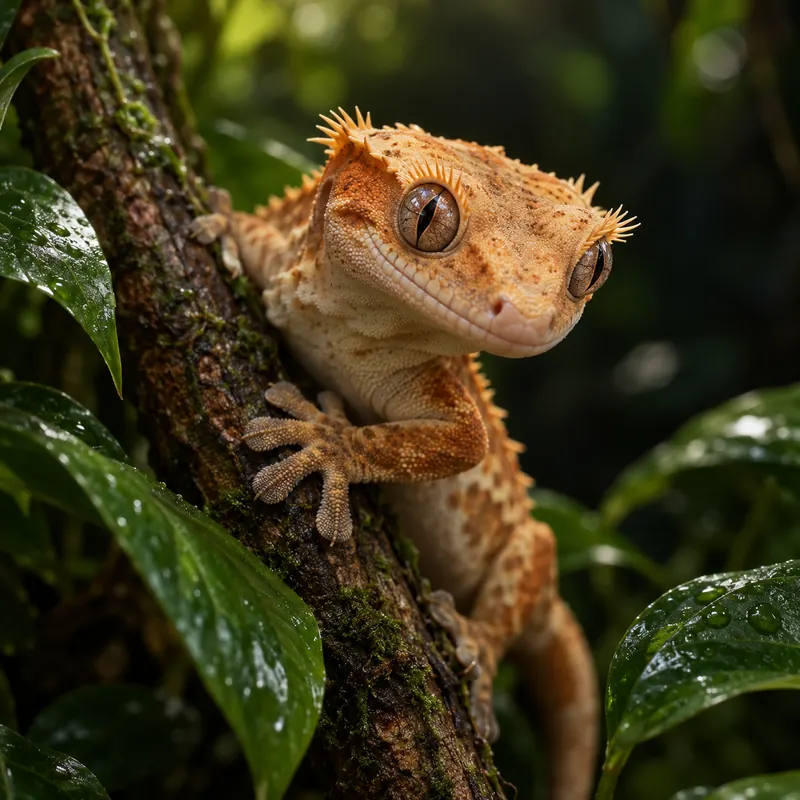
Most crested gecko problems come from treating them like other pet lizards: too much heat, too little height, or a diet built around fruit. Each one has a simple fix. Here are the mistakes keepers make most, roughly in the order they matter.
1. Letting the terrarium overheat
The mistake: a heat lamp sized for a desert lizard, a terrarium in a sunny window, or no plan for a summer heat wave.
Why it matters: ReptiFiles warns that sustained temperatures above 85°F (29°C) risk stress and heat stroke, and PetMD advises avoiding long exposure above 80°F (27°C). That is only a few degrees above a warm room.
The fix: keep the terrarium in the coolest stable room, out of direct sun. Use a heat lamp only if the room runs cool, and only on a thermostat. Check the top branch on the hottest afternoon. The lighting and heating guide has the full table.
2. Running a heater without a thermostat
The mistake: plugging a heat lamp or mat straight into the wall.
Why it matters: an unregulated heater keeps going as the room warms up. For a species with a low ceiling, that is risky. The RVC says heat sources must be attached to a thermostat.
The fix: put every heater on a thermostat, with the probe at the top branch, and check it against a separate gauge.
3. A short, bare terrarium
The mistake: a long, low tank, or a tall one with nothing to climb.
Why it matters: crested geckos are arboreal. The RSPCA links floppy tail syndrome to inadequate climbing space. A low tank also leaves no cooler zone to escape heat.
The fix: a tall enclosure, ideally 18 x 18 x 36 in (45 x 45 x 90 cm) per ReptiFiles, and at least 45 x 45 x 60 cm per the RSPCA and RVC. Fill it with branches, cork and plants from floor to ceiling. See the enclosure size guide.
4. Keeping it wet all the time
The mistake: misting so often, or ventilating so little, that the terrarium never dries.
Why it matters: ReptiFiles warns that constant moisture encourages mold and mildew. The RSPCA says the substrate should not become waterlogged.
The fix: mist once a day, usually in the evening, and let humidity fall to about 50% (ReptiFiles says even 40%) before the next mist. Keep some ventilation.
5. Keeping it too dry
The mistake: a screen cage in a dry home, or forgetting to mist.
Why it matters: crested geckos drink mainly from droplets, as ReptiFiles notes. The RSPCA links poor shedding to toe loss, and loss of toe-pad stickiness to low humidity or diet problems.
The fix: mist daily so humidity peaks around 70 to 80%, use a moisture-holding substrate, and keep a water dish. If shed sticks, the RSPCA suggests soaking in tepid water and never pulling it off. See a vet if it keeps happening.
6. Feeding mostly fruit or baby food
The mistake: fruit, jars of baby food or homemade purees as the main diet.
Why it matters: fruit alone is not complete, and ReptiFiles warns that baby food lacks the right nutrients and can cause malnutrition. The RSPCA lists metabolic bone disease (MBD) among crested gecko health problems.
The fix: feed a complete powdered diet from a recommended brand, such as Pangea or Repashy, as the staple. Keep fruit as a rare treat. The diet guide has the schedule.
7. Skipping calcium on insects
The mistake: feeding crickets or roaches straight from the tub.
Why it matters: ReptiFiles, PetMD, the RVC and the RSPCA all advise dusting insects with a supplement, and a lack of calcium is linked to metabolic bone disease.
The fix: dust insects with calcium just before feeding. ReptiFiles suggests calcium without D3 if you use UVB and with D3 if you do not.
8. Grabbing the tail
The mistake: picking a gecko up by the tail, or squeezing it as it tries to jump.
Why it matters: crested geckos drop their tails as a defense, and unlike many geckos they cannot regrow them, as the RSPCA and RVC both note. ReptiFiles lists sudden loud noises, pinching, squeezing and grabbing as triggers. The RSPCA adds that losing the tail is stressful and costs the gecko fat reserves.
The fix: never hold the tail. Let the gecko walk onto your hand, handle it low over something soft, and keep sessions short. If the tail does drop, ReptiFiles says it is not a medical emergency. Keep the terrarium clean, and see a vet if the wound looks infected.
9. Handling too soon, or too long
The mistake: handling a new gecko on day one, or for long sessions.
Why it matters: a new gecko is still settling in, and grabbing and squeezing are tail-drop triggers. The RSPCA says not to handle in the first week, and ReptiFiles suggests waiting two weeks.
The fix: wait, then start with about 5 minutes every other day, building up to 15 minutes. ReptiFiles suggests keeping it under 20 minutes a day even once tame.
10. Housing two males together
The mistake: buying a pair “for company”, or two unsexed juveniles that turn out to be male.
Why it matters: ReptiFiles warns males will fight and can injure or kill each other. The RSPCA says crested geckos are best kept singly and males should never be kept together permanently. A male and female will breed.
The fix: one gecko per terrarium. If you keep two females, give them at least double the space, multiple food and water stations, and plenty of cover, and separate them at the first sign of chasing, biting or tail shaking, as the RSPCA advises.
11. Loose substrate for a tiny gecko, or the wrong substrate for any
The mistake: loose substrate for a hatchling, or bark chips, pine, cedar or reptile carpet at any age.
Why it matters: ReptiFiles says loose substrate is an impaction risk for geckos under about 13 g, and warns that bark chips risk impaction, pine and cedar oils are harmful, and carpet fibers catch toes. The RSPCA lists impaction from swallowed substrate as serious.
The fix: paper towel for small juveniles. Coconut fiber or a soil and coconut mix for larger geckos, and serve food in cups on a ledge, as the RVC suggests not feeding directly on the substrate.
When it is time for the vet
Some problems need a professional. The RSPCA describes metabolic bone disease (swellings or a misshapen leg, mouth or spine) as needing urgent vet care, and lists weight loss and abnormal droppings as possible signs of parasites. The RVC recommends a yearly health check. See a reptile vet for any of these, or for a gecko that stops eating or loses weight. This page is general guidance, not veterinary advice.
Keep it cool, keep it tall, and keep fruit as a treat. Nearly every crested gecko mistake comes from giving too much heat or too little height, and both are easy to put right.