

Crested geckos are omnivores. In the wild they eat fruit, nectar, insects and even small lizards, the RVC notes. In a terrarium, most keepers feed a complete powdered diet mixed with water as the staple, plus a few live insects. That makes this one of the easiest lizards to feed well.
The staple: a complete powdered diet
A complete crested gecko diet (often called CGD or MRP) is a powder of fruit, protein, vitamins and minerals. You mix it with water and serve it in a small cup. The RVC says crested geckos are typically fed a complete formulated diet.
Which brands. ReptiFiles recommends a short list: Pangea, Repashy, Black Panther Zoological, Lugarti, Blue River Diets, Zoo Med (new formula only), and Arcadia (only with appropriate UVB). It advises avoiding other brands.
Rotate. ReptiFiles suggests rotating at least three flavors or brands, which also helps with fussy eaters.
How to serve. Mix to a ketchup or smoothie texture, as ReptiFiles describes, and serve it in a small cup on a ledge high in the terrarium. Offer it in the evening, when the gecko becomes active. The RSPCA advises removing it daily.
Complete diet
Pangea Fruit Mix with Insects Complete Gecko Diet, 2 oz
A complete powdered diet that you mix with water. Pangea lists fruit plus cricket and black soldier fly larva protein. ReptiFiles lists Pangea among the prepared diets it recommends.
- Form
- Powder, mixed with water
- Protein
- Includes crickets and black soldier fly larvae
- Size
- 2 oz
Best for
The everyday staple meal, rotated with at least two other flavors or brands.
Worth knowing
Mix only what will be eaten and remove leftovers. Rotating brands and flavors, as ReptiFiles suggests, keeps a fussy gecko interested.
Second diet for rotation
Repashy Crested Gecko MRP Diet
The original Repashy meal replacement powder for crested geckos and other fruit-eating geckos. ReptiFiles lists Repashy among its recommended prepared diets.
- Form
- Powder, mixed with water
- Type
- Complete meal replacement
Best for
A second brand in the rotation alongside Pangea.
Worth knowing
Several Repashy crested gecko blends exist. Check the listing says Crested Gecko MRP or Crested Gecko Diet, not a treat.

Feeding ledge
Komodo 2-Cup Magnetic Feeding Ledge
A magnetic ledge that clips to the glass and holds two small cups, one for the mixed diet and one for water, up where a crested gecko spends its time.
- Cups
- 2
- Mount
- Magnetic
- Width
- About 10 in
Best for
Serving the prepared diet high in the terrarium, as ReptiFiles suggests.
Worth knowing
Magnets need glass thin enough to hold through. Wash the cups daily.
A note on the RSPCA’s approach
The RSPCA’s care page treats the powdered diet as one part of a rotation with supplemented fruit and live food, rather than the main staple. Most other sources we checked, including the RVC, PetMD and ReptiFiles, put a complete diet at the center. Either way, the gecko needs a varied, supplemented diet, not fruit alone.
How much to mix
Mix only what your gecko can eat in one night. A small condiment cup is plenty for one gecko. Follow the mixing directions on the packet, then adjust the water until the texture looks like ketchup. Throw out leftovers rather than topping them up, and wash the cup or use a fresh one. ReptiFiles suggests small biodegradable cups, which makes this easy.
Keep the dry powder sealed and stored as the packet directs.
How often to feed
| Age | Complete diet | Insects | Source |
|---|---|---|---|
| Juvenile (0 to 12 months) | Daily | 1 to 2 times a week | ReptiFiles |
| Adult (over 12 months) | Every 2 to 3 days | 0 to 1 times a week | ReptiFiles |
| Any age | Daily | 1 to 2 times a week | PetMD |
The figures differ mainly for adults. Feeding an adult every two to three days, as ReptiFiles suggests, is a common approach. If your gecko is getting heavy, cut back on insects first. A gram scale is the simplest way to tell. ReptiFiles suggests weighing weekly, because sudden weight loss often signals illness.
Insects
Insects add protein and give the gecko something to hunt.
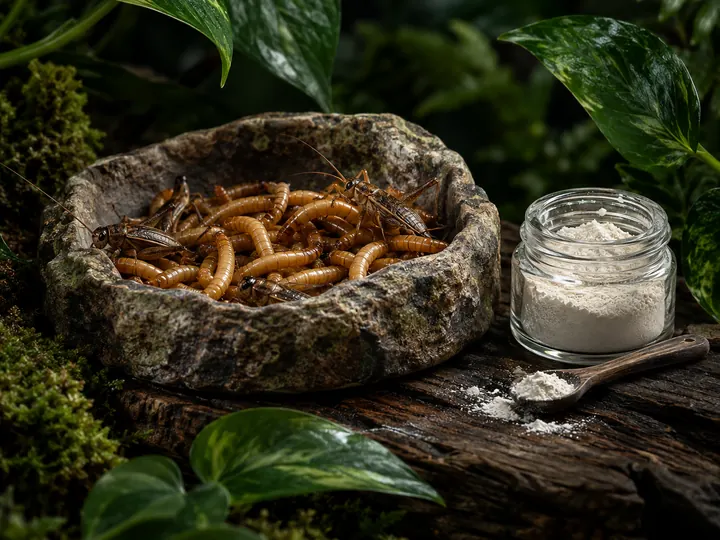
Good choices (ReptiFiles): crickets, dubia roaches, discoid roaches, small captive-bred hornworms, black soldier fly larvae and silkworms. The RVC also lists locusts, and the RSPCA lists calciworms.
Size. ReptiFiles says no wider than the space between the gecko’s eyes. PetMD says no wider than the gecko’s head. Smaller is safer.
How many. PetMD suggests about 5 to 10 crickets or 3 to 4 worms per session for an adult.
Gut-load first. Feed the insects a nutritious diet before offering them: 2 to 3 days per ReptiFiles, 24 to 48 hours per the RSPCA.
Remove leftovers. The RVC suggests removing insects not eaten within 30 minutes.
Worms with care. Sources disagree here. ReptiFiles advises avoiding mealworms and superworms because of impaction risk. The RVC says mealworms only in moderation, and waxworms and morio worms only as occasional treats because of their fat. PetMD includes mealworms and waxworms in its list. A safe reading is to keep worms rare and use roaches and crickets as the main insects. Never feed wild-caught hornworms, which ReptiFiles warns are toxic.
Calcium and vitamins
Most complete diets already include calcium and vitamins, so supplements are mainly for insects. The advice varies:
- ReptiFiles: dust all insects with calcium. Use calcium without D3 if you provide UVB, and with D3 if you do not.
- PetMD: dust insects with calcium plus vitamin D before each feeding, and with a reptile multivitamin once or twice a week.
- RVC: alternate a calcium supplement with a combined vitamin and mineral supplement.
- RSPCA: lightly dust insects with supplement just before offering them.
If you use UVB and feed a complete diet, a plain calcium dust on insects follows the ReptiFiles approach. If you are not using UVB, choose calcium with D3. Ask your vet if you are unsure.
Calcium for insects
Zoo Med Repti Calcium with D3, 8 oz
A fine calcium carbonate powder with vitamin D3 for dusting insects just before you offer them.
- Contents
- Calcium carbonate with vitamin D3
- Size
- 8 oz (227 g)
Best for
Dusting crickets and roaches, especially if you are not using UVB.
Worth knowing
ReptiFiles says to use calcium without D3 if you provide UVB, and with D3 if you do not. Most prepared diets already contain calcium, so this is for insects only.
Why it matters. The RSPCA lists metabolic bone disease (MBD) among the problems seen in crested geckos, with swellings or a misshapen leg, mouth or spine. It needs urgent vet care. A good complete diet, dusted insects and appropriate UVB are the main defenses.
Fruit and treats
Fruit is a treat, not a meal.
- ReptiFiles suggests figs, mango, apricots, papaya, berries and banana as occasional treats, and warns that frequent fruit can make a gecko refuse its prepared diet.
- The RSPCA lists blueberries, pears, papaya, strawberries and mango as safe, and says to avoid citrus fruit and banana.
- PetMD suggests unsweetened, single-ingredient fruit puree as an occasional treat.
Because the RSPCA and ReptiFiles disagree on banana, it is easy to just leave it out.
Foods to avoid
- Baby food. ReptiFiles warns it lacks the right nutrients and can cause malnutrition.
- Citrus fruit, per the RSPCA.
- Wild-caught insects, especially hornworms.
- Prepared diets from brands outside the recommended list, per ReptiFiles.
- Fruit as the main diet. It is not complete.
Feeding a juvenile
Young crested geckos grow fast and need food every day, per both ReptiFiles and PetMD. Offer fresh diet each evening, and one or two sessions of small, dusted insects a week. Insects must be small enough: no wider than the space between the eyes. Weigh a juvenile regularly. Steady gains are the clearest sign the feeding plan works.
Water
Offer fresh water every day, even if you mist. The RSPCA and RVC both say water should always be available and changed when fouled. ReptiFiles suggests using tap water rather than distilled or reverse-osmosis water. Crested geckos still drink droplets after misting, so do both.
When a gecko will not eat
A new gecko may eat little while it settles in. Beyond that, check temperatures first: ReptiFiles warns that sustained temperatures at or below 72°F (22°C) can cause poor appetite. Try a different flavor or brand of diet. If your gecko keeps refusing food or is losing weight, see a reptile vet. This is general guidance, not veterinary advice.
A good powdered diet, a few gut-loaded insects dusted with calcium, and fresh water every day. Crested geckos are among the easiest reptiles to feed well, so long as fruit stays a treat.