
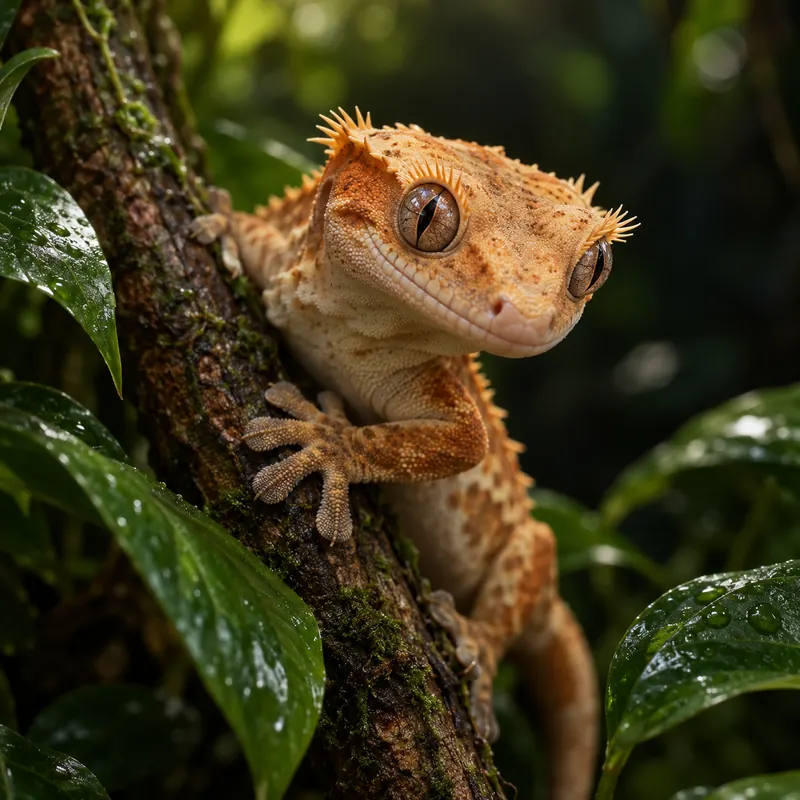
Most pet lizards need you to add heat. A crested gecko mostly needs you to stop it getting too hot. Its comfortable range sits close to normal room temperature, and the biggest temperature risk is a warm room, a sunny window or an unregulated lamp pushing the terrarium past about 85°F (29°C).
This page covers the numbers, how to hold them, the daily humidity cycle, and the low-level UVB current guidance recommends.
Target temperatures
Sources broadly agree, with small differences:
| Zone | Temperature | Source |
|---|---|---|
| Warm spot (top of terrarium) | 79 to 82°F (26 to 28°C) | RSPCA (RVC: about 28°C, 82°F) |
| Warm spot (top of terrarium) | 82 to 85°F (28 to 29°C) | ReptiFiles |
| Cooler area (lower down) | 68 to 75°F (20 to 24°C) | RSPCA (ReptiFiles: 70 to 75°F, 21 to 24°C) |
| Night | 64 to 72°F (18 to 22°C) | RSPCA, ReptiFiles (RVC: not below about 68°F, 20°C) |
| Danger line | Sustained above 85°F (29°C) | ReptiFiles |
PetMD gives lower figures: a warm end of 72 to 75°F (22 to 24°C), a cool end of 68 to 75°F (20 to 24°C), and a warning against long exposure above 80°F (27°C).
So the safe working range is narrow. A sensible target is a top branch around 78 to 82°F (26 to 28°C), a lower area in the low to mid 70s °F (21 to 24°C), and a top that never sits above 85°F (29°C) for long.
ReptiFiles also warns that sustained temperatures of 72°F (22°C) or lower risk lethargy, poor appetite and illness. In a cold room, some heat is needed.
Overheating: the main risk
The only way a crested gecko can cool down is to move somewhere cooler, and in a small or bare enclosure there may be nowhere cool enough. ReptiFiles links sustained temperatures above 85°F (29°C) to stress and heat stroke.
How terrariums overheat:
- Sun through a window. Glass terrariums warm fast in direct sun.
- A summer heat wave. If the room is 84°F (29°C), the top of the terrarium will be warmer still once the lamps are on.
- A heat lamp with no thermostat, or a thermostat probe that has fallen to the cool floor.
- A UVB or plant light that adds more warmth than expected in a small enclosure.
How to prevent it:
- Place the terrarium in the coolest stable room, out of direct sun.
- Put every heater on a thermostat, with the probe at the top branch.
- Use a gauge with a probe at the top, and check it on the hottest part of the day.
- In a heat wave, turn off any heat lamp, keep the room cool, and mist a little more. If the top still runs hot, move the terrarium somewhere cooler.
- Use a tall enclosure. Height gives a cooler bottom to retreat to. The enclosure size guide explains why.
Heat sources, if you need them
If your room keeps the top of the terrarium in range, you may not need a heat lamp at all. If it runs cool, add one small heat source.
- A low-wattage white heat bulb. ReptiFiles calls this the best heat source for crested geckos, starting at about 25 W in a small dome and adjusting. The RVC describes a light-emitting spot bulb giving a basking area of about 28°C (82°F), switched off at night.
- For night heat in a cold room, the RSPCA suggests a heater that gives off no light, such as a ceramic heater or heat mat, on a thermostat. The RVC lists a heat mat on the back wall, a heat plate or a ceramic bulb on a thermostat.
- Hatchlings in small tubs. ReptiFiles notes small enclosures have no room for a safe gradient. It suggests a small heat pad on one side, on a proportional thermostat, kept at or below 85°F (29°C) and off at night.
The RVC asks for heat sources to be guarded so the gecko cannot touch them.

Small heat lamp (only if needed)
Exo Terra Daytime Heat Lamp, low wattage (about 25 W)
A small white-light incandescent heat bulb. ReptiFiles suggests starting with a 25 W Exo Terra Daytime Heat Lamp and adjusting from there, to give a gentle warm spot near the top of the terrarium.
- Type
- Incandescent, white light
- Starting wattage
- About 25 W, per ReptiFiles
Best for
A cool room where the top of the terrarium will not reach the basking range on its own.
Worth knowing
Only if needed, always on a dimming thermostat, and in a dome with a ceramic socket. Turn it off at night. In a warm room it may not be needed at all.
Thermostats
A thermostat reads a probe and holds the heater at the temperature you set. For a species with a hard ceiling at 85°F (29°C), it is the item that turns a heat lamp from a risk into a tool. The RVC says heat sources must be attached to a thermostat.
- Dimming thermostats suit heat bulbs, which give light.
- Pulse-proportional thermostats suit heat mats and ceramic heaters.
- Set it below the ceiling. Around 80 to 82°F (27 to 28°C) at the probe leaves room for error.
Thermostat (US)
Exo Terra Dimming and Pulse Proportional Thermostat
A reptile thermostat with both dimming and pulse-proportional control and a waterproof probe. Dimming suits a small heat lamp, and pulse control suits heat mats and ceramic heaters.
- Model
- PT2461
- Max load
- 300 W
- Range
- 64 to 100°F (18 to 38°C)
- Control
- Dimming and pulse proportional
Best for
Keeping a low-wattage heat lamp from pushing the top of the terrarium past a safe temperature.
Worth knowing
Put the probe at the basking branch, where the gecko actually sits, and check it with a separate thermometer.
Thermostat (UK)
Habistat Dimming Thermostat, Classic Range (600 W)
A UK-made dimming thermostat for heat lamps. It turns the lamp down smoothly as the probe reaches the set temperature instead of switching it fully on and off.
- Max load
- 600 W
- Control
- Dimming
Best for
Running a small basking lamp in a UK terrarium with a firm ceiling on temperature.
Worth knowing
It has a minimum load, so very low-wattage bulbs may not dim correctly. Check the minimum against your bulb before buying.
Humidity: a cycle, not a constant
Crested geckos need humidity that rises after misting and falls again. They also drink mainly from droplets on leaves and glass, as ReptiFiles notes, so the daily mist is their main water source as well as their humidity.
Sources give different targets:
- RSPCA: about 40 to 50% normally, raised up to 80% by spraying.
- RVC: 50 to 70%.
- ReptiFiles: 60 to 80%, drying to about 50%, or even 40%, before the next mist.
- PetMD: 70 to 80%.
The overlap is a daily peak around 70 to 80% after misting, falling to roughly 50% before the next one. ReptiFiles warns that constant moisture encourages mold and mildew, which is why the dry-out matters as much as the mist.
How to run the cycle:
- Mist every evening, when crested geckos become active. Mist in the morning too if humidity drops very low.
- Let it dry out. Most of the droplets should be gone before the next mist.
- Use a moisture-holding substrate, such as coconut fiber 2 to 4 in (5 to 10 cm) deep, so humidity does not crash straight away.
- Keep fresh water in a dish as well. The RSPCA and RVC both ask for it.
- Check with a hygrometer daily, as PetMD advises.
Signs humidity is too low include stuck shed and toe pads losing their grip. The RSPCA links poor shedding to toe loss and loss of stickiness to low humidity or diet problems.

Thermometer and hygrometer
Zoo Med Digital Thermometer and Humidity Gauge (TH-31)
A small digital gauge with a probe that shows temperature and humidity on one screen. ReptiFiles names this Zoo Med gauge for crested gecko setups.
- Display
- Digital
- Probe
- Waterproof
- Battery
- 1 x LR44
Best for
Watching the top-of-tank temperature and the humidity cycle after each misting.
Worth knowing
Put the probe near the basking branch, not on the floor. Buy two if you want a reading at the top and bottom.
Automatic mister
Exo Terra Monsoon Solo II Misting System
A compact programmable mister with a small pump, one adjustable nozzle and a built-in reservoir. You set how often and how long it mists, so the evening misting happens even when you are out.
- Model
- PT4200
- Reservoir
- 1.5 L
- Nozzles
- 1 included, takes a second
- Pump pressure
- 2.5 bar (36.25 psi)
Best for
One terrarium, when you want a reliable evening mist without a hand sprayer.
Worth knowing
Mist, then let the terrarium dry out. A mister on too often keeps everything wet, which encourages mold. Use a hygrometer to set the timer.
UVB: low and gentle
Crested geckos are crepuscular, active mostly at dawn and dusk. For years many were kept with no UVB. Current guidance has moved towards providing it:
- RVC: crested geckos appear to benefit from UVB; use a low-output lamp (for example 6%) to mimic the low sunlight they get in the wild.
- RSPCA: a 5 to 7% UVB lamp, with a UV index (UVI) of 0.7 in the basking zone falling to zero in the shade.
- ReptiFiles: UVB for all reptiles, aiming for a UVI of 1.0 to 2.0 at the basking branch.
- PetMD: 10 to 12 hours of UVB a day, replacing bulbs every six months.
Ferguson zone 1. Reptiles are grouped into four Ferguson zones by how much UV they meet in the wild. Exo Terra’s summary of the research places crested geckos in zone 1, the shade dwellers, with an average UVI of about 0 to 0.7 and a maximum of about 0.6 to 1.4. That is why a low-output tube with lots of shade is the standard advice.
Distance. Without a UV meter, ReptiFiles suggests about 8 to 12 in (20 to 30 cm) between a 12 in Arcadia ShadeDweller 7% tube and the gecko, with the lamp above the mesh. A 24 in ShadeDweller Max 2.5% tube sits closer, at 6 to 9 in (15 to 23 cm). Keep glass and plastic out of the way: ReptiFiles notes they block UVB.
Replace on schedule. You cannot see UVB, so a tube that still lights up may no longer be giving useful UV. Follow the maker’s replacement interval, as the RSPCA and RVC advise.

UVB kit
Arcadia ShadeDweller ProT5 UVB Kit (7%, 8 W, 12 in)
A short T5 UVB lamp made for shade-dwelling and crepuscular species, supplied with its fitting and a removable reflector. ReptiFiles names the 12 inch 7% ShadeDweller for adult crested geckos, and the RSPCA asks for a 5 to 7% lamp.
- UVB
- 7% (UVA 17%)
- Power
- 8 W
- Length
- About 12 in (30 cm)
- Type
- T5 with removable reflector
Best for
Giving a crested gecko low-level UVB at the top of a tall terrarium, with shade below.
Worth knowing
ReptiFiles gives a distance of about 8 to 12 in (20 to 30 cm) from lamp to gecko when the lamp sits on a mesh top. Leave plenty of plants and shade, and replace the tube on the maker's schedule.
Day and night
- Day length: about 12 hours on and 12 off, per the RSPCA and RVC. ReptiFiles suggests 14 hours in summer and 10 in winter if you want to follow the seasons.
- Night: all lights off. ReptiFiles advises against red, blue and black bulbs for night viewing or heat, and says a night drop is healthier.
Quick weekly check
- Top branch below 85°F (29°C) on the warmest afternoon.
- Lower area in the low to mid 70s °F (21 to 24°C).
- Night no colder than about 64°F (18°C).
- Humidity peaking after misting and drying out before the next.
- Thermostat probe still at the top branch.
- UVB tube within its replacement date.
If the terrarium has overheated and your gecko seems weak or unresponsive, cool the room and call a reptile vet. This is general guidance, not veterinary advice.
Keep it comfortable, not hot. A crested gecko with a gentle warm spot, a cooler floor, a daily mist that dries off, and a thermostat guarding the ceiling is set up for a long, quiet life.