
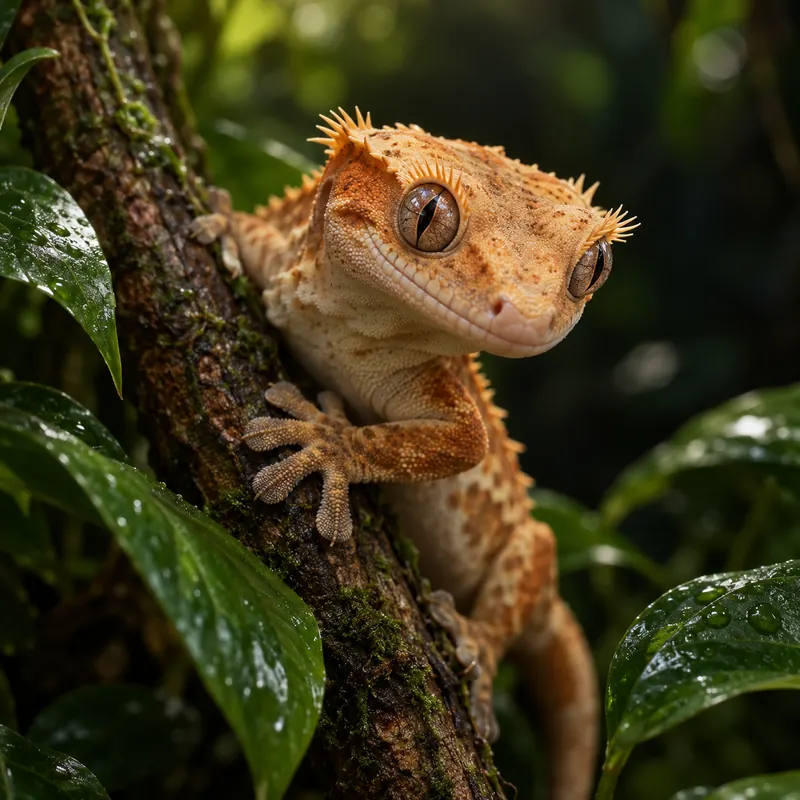
A crested gecko spends its life climbing, so the most important number on any terrarium is its height. A tall enclosure gives it branches to move through, room to jump, and a natural temperature difference between a warmer top and a cooler bottom.
How big? What the sources say
| Source | Minimum for one adult | Notes |
|---|---|---|
| ReptiFiles | 18 x 18 x 36 in (about 45 x 45 x 90 cm) | For any gecko over 12 g; “larger is always better” |
| RSPCA | 45 cm wide x 60 cm tall x 45 cm deep (about 18 x 24 x 18 in) | Hatchlings may start smaller |
| Royal Veterinary College | 45 x 45 x 60 cm | “As large a vivarium as possible” |
| PetMD | 20 gallons or more | Height matters more than floor space |
The sources agree on shape (tall rather than long) but not on height. The RSPCA and RVC set a lower bar of about 24 in (60 cm) tall, while ReptiFiles asks for 36 in (90 cm). The ReptiFiles author keeps their own gecko in 24 x 24 x 48 in (about 60 x 60 x 120 cm).
Our suggestion: buy 18 x 18 x 36 in (45 x 45 x 90 cm) for an adult if you can fit it. It meets every source above and gives a clearer gap between the warm top and cool bottom.
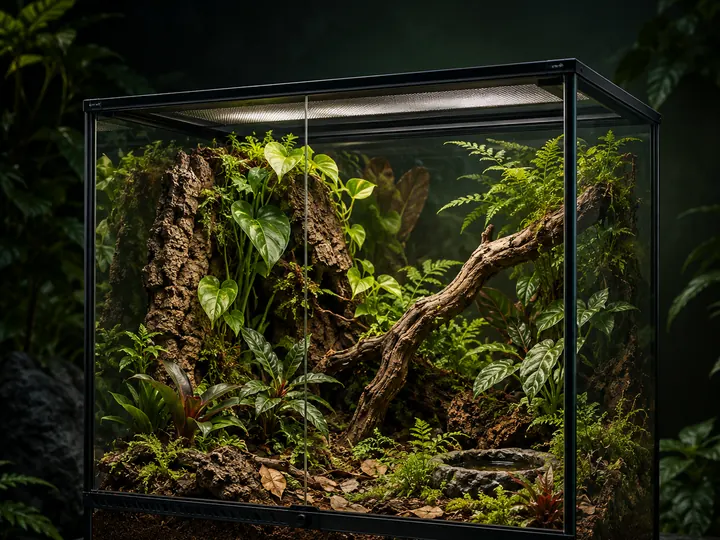
Best terrarium
Tall front-opening glass terrarium, 18 x 18 x 36 in (45 x 45 x 90 cm)
Crested geckos live up in the branches, so height matters more than floor space. This link searches for the 18 x 18 x 36 inch (about 45 x 45 x 90 cm) size that ReptiFiles gives as the minimum for juveniles and adults, which is taller than the 45 x 45 x 60 cm minimum set by the RSPCA and the Royal Veterinary College.
- Target size
- 18 x 18 x 36 in (about 45 x 45 x 90 cm)
- Material
- Glass, as the RSPCA and RVC prefer
- Access
- Front-opening doors with a lock
- Top
- Mesh, so a UVB lamp can sit on it
Best for
One adult crested gecko, with room for branches, plants and a vertical temperature gradient.
Worth knowing
Check all three measurements: many "tall" tanks are only 24 in (60 cm) high. Look for front-opening doors that lock and a mesh top for the UVB lamp. Glass holds humidity well, so make sure there is some ventilation.
Hatchlings and juveniles
ReptiFiles suggests a 12 x 12 x 12 in (30 x 30 x 30 cm) enclosure for hatchlings under 12 g, moving to the full adult size once the gecko passes 12 g. The RSPCA also says hatchlings may need a smaller setup that you upgrade as they grow.
A small gecko in a huge, sparsely filled terrarium can struggle to find its food. If you put a juvenile straight into an adult terrarium, pack it with plants and put food where the gecko sleeps.
Glass, PVC or screen?
- Glass is the usual choice. The RSPCA prefers glass to wood because of the humidity, and the RVC notes glass vivariums with mesh tops are typically used, which also avoids moisture damaging wood.
- PVC also handles humidity well and holds warmth, which can be a drawback in a hot room.
- All-screen cages let humidity escape fast. They can work in a humid climate but make the misting cycle hard to manage in a dry home.
- Wood can warp and rot in a humid setup unless it is fully sealed.
Whatever the material, look for:
- Front-opening doors that lock. Crested geckos are good at slipping through gaps.
- A mesh top, so a UVB lamp can sit on it with nothing blocking the light.
- Some ventilation. The RVC says good ventilation is needed, and stale, wet air encourages mold.
Upgrading as it grows
You can buy the adult terrarium on day one or move up in steps. Buying once is usually simpler and cheaper overall, because a crested gecko spends most of its long life at adult size: ReptiFiles says they mature at about 15 to 18 months, and they live 15 to 20 years.
If you start a hatchling in the full-size terrarium:
- Fill it densely with plants and branches, so the gecko always has cover close by.
- Put the feeding ledge near where it sleeps.
- Use paper towel on the floor until it passes about 13 g, as ReptiFiles suggests.
- Weigh it regularly to make sure it is finding food and growing.
One gecko or two?
Plan for one gecko per terrarium. The RSPCA says crested geckos are best kept singly and males should never live together. ReptiFiles warns that males will fight and can injure or kill one another, and that even two females is “still not optimal.” If you do keep two females, ReptiFiles suggests at least twice the 18 x 18 x 36 in volume, with extra food and water stations and plenty of cover. Separate them at once if you see chasing, tail or crest biting, or weight loss.
How to lay it out
Think in layers, from floor to ceiling.
Floor. Coconut fiber or a soil mix 2 to 4 in (5 to 10 cm) deep, as ReptiFiles suggests, or paper towel for a juvenile under about 13 g. Leaf litter on top helps hold moisture.
Middle. Branches running across and up at different angles, so the gecko can move from bottom to top without jumping. ReptiFiles notes wild crested geckos spend time among thin branches. Cork bark tubes make hides off the ground. The RSPCA links floppy tail syndrome to inadequate climbing space, so give plenty of surfaces to grip.
Top. The warm spot, under the lamps. A branch a few inches below the UVB tube becomes the basking perch. Keep dense leaves nearby so the gecko can step out of the light.
Cover everywhere. Plants, live or artificial, break up sight lines and give the gecko places to sleep in the day. ReptiFiles lists gecko-safe live plants such as pothos, bromeliads, ferns and snake plant. Live plants hold water droplets for drinking, but need light to grow.
Feeding station. A ledge with small cups fixed high on the glass. The water dish can sit on the floor or on a ledge.

Climbing hide
Zoo Med Natural Cork Bark Round, Large
A hollow tube of natural cork bark that can stand upright as a climbing hide or lie at an angle as a ramp. The RSPCA suggests cork bark tubes as hiding spots.
- Material
- Natural cork bark
- Size
- Large (varies)
- Model
- CF9-L
Best for
A daytime hide up off the floor, and a climbing route between levels.
Worth knowing
Wedge it firmly so it cannot topple onto the gecko. Natural pieces vary in size.
Feeding ledge
Komodo 2-Cup Magnetic Feeding Ledge
A magnetic ledge that clips to the glass and holds two small cups, one for the mixed diet and one for water, up where a crested gecko spends its time.
- Cups
- 2
- Mount
- Magnetic
- Width
- About 10 in
Best for
Serving the prepared diet high in the terrarium, as ReptiFiles suggests.
Worth knowing
Magnets need glass thin enough to hold through. Wash the cups daily.
Bioactive or simple?
A simple setup with paper towel or coconut fiber and artificial plants is easy to keep clean. The RSPCA and RVC suggest spot cleaning waste as soon as you see it and a full clean once a month. PetMD suggests a full disinfection at least weekly. Sources differ, so let how dirty it gets guide you.
A bioactive setup uses a drainage layer, a soil mix, leaf litter, live plants and small animals that break down waste. The RSPCA suggests considering it for permanent housing. It costs more to start but needs only spot cleaning once it settles.
Where to put the terrarium
Temperature is the biggest risk for this species, so placement matters:
- Not in direct sun. Sunlight through a window can push a glass terrarium past 85°F (29°C) quickly.
- Not next to a radiator, heater or air vent.
- In a room that stays fairly steady through the year.
- At a height you can reach from the front.
- Away from loud noise and slamming doors. ReptiFiles lists sudden loud noises among the triggers for tail dropping.
Go tall, fill every level, and keep it out of the sun. A crested gecko with branches from floor to ceiling will use every inch you give it.