
Feeder insects are only as good as what you put in and on them. Farmed crickets and worms are low in calcium, so an insect-eating reptile needs its food gut-loaded before feeding and dusted with powder at the meal. Which powder, and how often, depends mainly on whether your reptile has UVB. This guide covers the common feeders, the size rule, the supplement routine and the short list of things never to feed.
The short version
-
 Calcium without D3 (with UVB) Zoo Med Repti Calcium without D3 Amazon
 - Calcium without D3 (with UVB) Zoo Med Repti Calcium without D3 Amazon UK
- Calcium with D3 (no UVB) Zoo Med Repti Calcium with D3 Amazon
- Calcium with D3 (no UVB) Zoo Med Repti Calcium with D3 Amazon UK
- Multivitamin Zoo Med Reptivite with D3 Amazon
- Multivitamin Zoo Med Reptivite with D3 Amazon UK
- Gut-load food for insects Arcadia InsectFuel Gut Load Amazon
- Gut-load food for insects Arcadia InsectFuel Gut Load Amazon UK
- Cricket keeper Lee's Kricket Keeper, Large Amazon
- Feeding tongs Stainless Steel Feeding Tongs (about 10 to 12 in) Amazon
- Feeding tongs Stainless Steel Feeding Tongs (about 10 to 12 in) Amazon UK
Why insects need help
The MSD Veterinary Manual says the calcium to phosphorus ratio of most foods offered to reptiles is inadequate. It recommends a diet with at least as much calcium as phosphorus (1:1), and preferably twice as much (2:1). Farmed insects fall well short on their own.
When calcium, vitamin D3 or UVB run short, the result is nutritional secondary hyperparathyroidism, the most common form of metabolic bone disease. The MSD manual lists a low calcium to phosphorus ratio and vitamin D3 deficiency among its causes, alongside too little UVB and heat. Gut-loading and dusting are how you fix the ratio.
Common feeder insects compared
ReptiFiles sorts feeders into staples (fed most days) and treats (fed now and then). Its lists for leopard geckos and bearded dragons agree on most insects but not all:
| Feeder | Leopard gecko (ReptiFiles) | Bearded dragon (ReptiFiles) | Notes |
|---|---|---|---|
| Crickets | Staple | Staple | The classic feeder. Do not leave uneaten ones in the enclosure. |
| Dubia roaches | Staple | Staple | A common alternative to crickets. |
| Black soldier fly larvae | Staple | Staple | Small larvae. |
| Mealworms | Staple | Treat | VCA lists them among accepted foods for dragons. Sources differ. |
| Silkworms | Staple | Treat | Soft bodied. |
| Hornworms | Staple (captive-bred only) | Treat | Never use wild hornworms. |
| Superworms | Treat | Treat | High in fat. |
| Waxworms and butterworms | Treat | Treat (waxworms) | High in fat; VCA says waxworms and superworms should not be offered daily. |
| Locusts and grasshoppers | Not listed | Staple | Farmed only. |
ReptiFiles limits fatty treats to no more than once a week for leopard geckos and warns that, for dragons, too many treats can lead to obesity. Variety helps: the MSD Veterinary Manual says offering two or more prey types is preferred over relying on one.
The size rule
- Size: ReptiFiles says an insect should be no bigger than the space between your reptile’s eyes. Soft worms can be a little longer.
- How many: for leopard geckos, ReptiFiles suggests about two insects per inch of the gecko’s length, or as many as it eats in 15 minutes.
Prey that is too big can be hard to swallow. Take out anything not eaten: ReptiFiles warns that crickets left in the enclosure can nibble a sleeping gecko and cause real injuries.
Feeding tongs
Stainless Steel Feeding Tongs (about 10 to 12 in)
Long stainless tongs for offering thawed prey, so the snake strikes at the rodent and not your hand.
- Material
- Stainless steel
- Length
- About 10 to 12 in
Best for
Every feed. The RSPCA advises feeding with tongs.
Worth knowing
Hold the prey by the scruff or tail and let go as soon as the snake strikes and coils.
Gut-loading
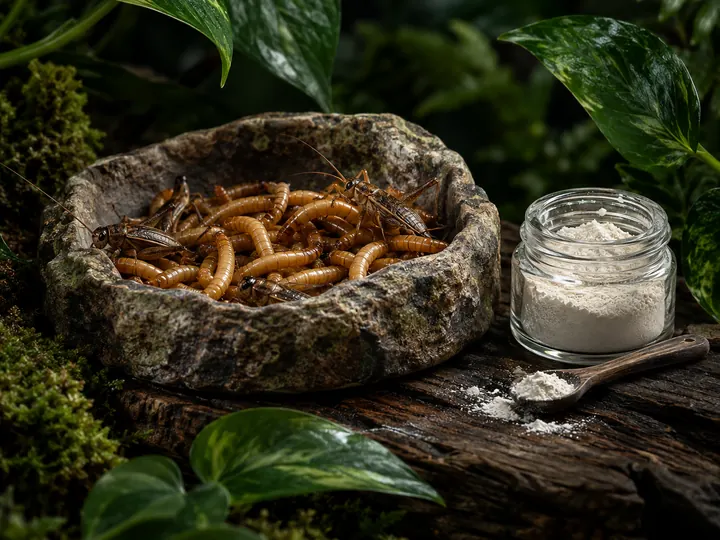
Gut-loading means feeding the insects a nutritious diet before they become food, so they arrive full of nutrients. Sources give different timings:
- VCA (leopard geckos): a high-quality diet for at least 24 hours before feeding.
- VCA (bearded dragons): within 12 hours of feeding them to the dragon.
- ReptiFiles: 2 to 3 days on a dedicated gut-load diet. It adds that vegetable scraps are maintenance feeding, not true gut-loading.
- MSD Veterinary Manual: a mineral supplement with at least 8 to 10% calcium for 72 hours before feeding. It says this can raise the insects’ calcium from 0.01% to 0.5% on a dry matter basis.
The overlap is simple: give feeders a proper gut-load food for a day or more before they are eaten. Gut-loading does not replace dusting; do both.
Gut-load food
Arcadia InsectFuel Gut Load
A food for feeder insects, given in the days before they are fed to the gecko so they arrive full of nutrition. ReptiFiles lists it as one of the commercial gut-loading options.
- Use
- Gut-load food for feeder insects
Best for
Gut-loading crickets, roaches and worms for a couple of days before feeding.
Worth knowing
Gut-loading does not replace calcium dusting. Do both.
Calcium: with D3 or without?
Vitamin D3 is what lets the gut absorb calcium. Reptiles make D3 in their skin under UVB, or get it from food and supplements. So the choice of calcium powder follows your lighting:
- With good UVB: use calcium without D3 at most feedings. ReptiFiles recommends this for leopard geckos kept with UVB.
- Without UVB: use calcium with D3. ReptiFiles recommends this for leopard geckos kept without UVB.
VCA’s routine for bearded dragons mixes the two: a light dusting of phosphorus-free calcium daily, and calcium with D3 two or three times a week. VCA also suggests leopard geckos have a small dish of calcium powder available at all times.
Calcium without D3 (with UVB)
Zoo Med Repti Calcium without D3
A fine calcium carbonate powder with no vitamin D3, for dusting insects and greens. Zoo Med says the calcium is not from oyster shell.
- Calcium source
- Calcium carbonate
- Vitamin D3
- None
- Size
- 8 oz (US listing); 85 g (UK listing)
Best for
Routine dusting for a dragon that gets proper UVB and so makes its own vitamin D3.
Worth knowing
Schedules differ between sources (VCA and ReptiFiles give different ones), so follow your vet. Dust lightly; a thin coat is enough.
Calcium with D3 (without UVB)
Zoo Med Repti Calcium with D3
A fine, phosphorus-free calcium carbonate powder with added vitamin D3, for dusting insects. ReptiFiles advises a calcium with D3 for insect eaters kept without UVB, and a D3-free one when UVB is provided.
- Calcium
- 38 to 43% (per Zoo Med)
- Vitamin D3
- Added (cholecalciferol)
- Phosphorus
- None
- Sizes
- 3 oz, 8 oz, 12 oz and 48 oz
Best for
Insect eaters kept without UVB, or on the schedule your vet sets alongside a D3-free calcium.
Worth knowing
D3 can be overdone. Do not use it at every feeding on top of strong UVB unless your vet says so.
More is not better. The MSD Veterinary Manual links mineral deposits in soft tissue to, among other causes, vitamin D toxicity, and warns that injected vitamin A in excess can damage the skin. Stick to a schedule rather than adding extra.
Multivitamins
A multivitamin covers what calcium powder does not. Two things to look for:
- Preformed vitamin A (retinol), not just beta carotene. The MSD Veterinary Manual says many reptiles cannot use beta carotene, and that vitamin A deficiency is common in insect-eating lizards fed diets without preformed vitamin A. ReptiFiles gives the same advice.
- D3 or not: match it to your calcium. If you already dust with a D3 calcium, a D3-free multivitamin avoids doubling up.
Schedules from ReptiFiles:
- Leopard geckos: once a week when young, every other week as adults.
- Bearded dragons: twice a week for hatchlings, juveniles and gravid females; once a week for adults, on salads.
Multivitamin with D3
Zoo Med Reptivite with D3
A multivitamin and mineral powder that includes vitamin D3. Zoo Med says it has no soy, yeast or sugar fillers and was first developed for the San Diego Zoo.
- Type
- Multivitamin and mineral powder
- Vitamin D3
- Included
- Size
- 56.7 g (2 oz)
Best for
The weekly or twice-weekly multivitamin dusting most care sheets call for.
Worth knowing
More is not better: vitamins can be overdosed. Use it on the schedule your vet gives, not on every meal.
Dusting schedules at a glance
| Setup | Every feeding | Some feedings | Multivitamin |
|---|---|---|---|
| Insect eater with UVB | Calcium without D3 | Calcium with D3 two to three times a week (VCA, dragons) | Weekly or every other week |
| Insect eater without UVB | Calcium with D3 (ReptiFiles, leopard geckos) | None | Weekly or every other week, D3-free if your calcium has D3 |
These are starting points from the care sheets. Your vet may adjust them for age, breeding, or a health problem.
How to dust: put the insects in a cup or bag with a pinch of powder and shake gently until they look lightly coated, like powdered sugar. Feed them straight away, before they clean it off. ReptiFiles says it is fine to skip a dusting now and then.
Keeping feeders alive
A gut-load only works if the insects are alive and eating, and dead ones should never be fed.
- Keep them in a ventilated container with egg crate or card to hide in.
- Give them gut-load food and a water source. ReptiFiles suggests gel water crystals for hydration.
- Take out dead insects daily and clean the container between batches.
- Do not overcrowd. Buy what you will use in a week or two.
Cricket keeper (US)
Lee's Kricket Keeper, Large
A ventilated plastic box for keeping feeder crickets between pet store trips. Crickets climb into the textured tubes, which you pull out and tap into a dusting cup or the enclosure, so you never chase crickets by hand.
- Size
- Large
- Includes
- Lid and removable feeder tubes
Best for
Keeping a week or so of crickets alive, fed and easy to portion out.
Worth knowing
Seller listings disagree on how many crickets it holds. Do not overcrowd it, clean it between batches, and give the crickets food and a water source such as gel crystals.
What not to feed
- Fireflies. VCA says they are generally toxic to lizards.
- Wild-caught insects. VCA says garden bugs may carry fertilizers and insecticides. ReptiFiles adds that some wild insects are naturally toxic, and names box elder bugs.
- Wild hornworms. ReptiFiles says they are toxic; feed only captive-bred ones.
- Dried insects as a staple. ReptiFiles says they tend to dehydrate reptiles.
- Pinky mice for lizards, except rarely: ReptiFiles limits them to once a month for dragons, and only for recovery after tail loss in leopard geckos.
Snakes eat rodents, not insects
Ball pythons, corn snakes and most pet snakes eat whole rodents. A whole animal includes bones and organs, so snakes on whole prey are not usually given calcium powder; ask your vet if you are unsure.
- Frozen-thawed is the standard. The RSPCA says to feed thawed frozen rodents, offered with tongs. The MSD Veterinary Manual says prey should come from commercial breeders and be offered dead.
- Size: the RSPCA says prey should be slightly wider than the snake’s widest point.
- Storage: the MSD manual says frozen rodents should be kept no longer than 6 months at -20°C (-4°F), and thawed somewhere cool, below 8°C (46°F).
See ball python diet for amounts and schedules.
Quick answers
Is gut-loading enough on its own? No. ReptiFiles and VCA both pair gut-loading with calcium dusting. Gut-loading improves the insect; dusting tops up calcium at the meal.
Do vegetable scraps count as gut-loading? ReptiFiles says no: scraps keep insects alive (maintenance feeding), while a dedicated gut-load diet is what raises their nutrient content.
Can I leave a dish of calcium in the enclosure instead of dusting? VCA suggests a dish for leopard geckos as well as dusting, not instead of it.
My reptile has UVB. Does it ever need D3 powder? Sources differ. ReptiFiles uses D3-free calcium with UVB for leopard geckos, while VCA adds calcium with D3 two or three times a week for bearded dragons. Ask your vet which suits your animal and lamp.
How do I know if my feeders are the right size? Compare each insect with the space between your reptile’s eyes, and watch the first few meals. If it struggles to swallow, go a size down.
By species
- Leopard gecko diet
- Bearded dragon diet
- Ball python diet
- Crested gecko diet
- Corn snake diet
- Veiled chameleon diet
See a reptile vet if your reptile stops eating, loses weight, or shows trembling or a soft jaw. This page is general guidance, not veterinary advice.
Feed the feeders, dust the meal, match the powder to the lamp. Three habits, and most bone problems never start.