
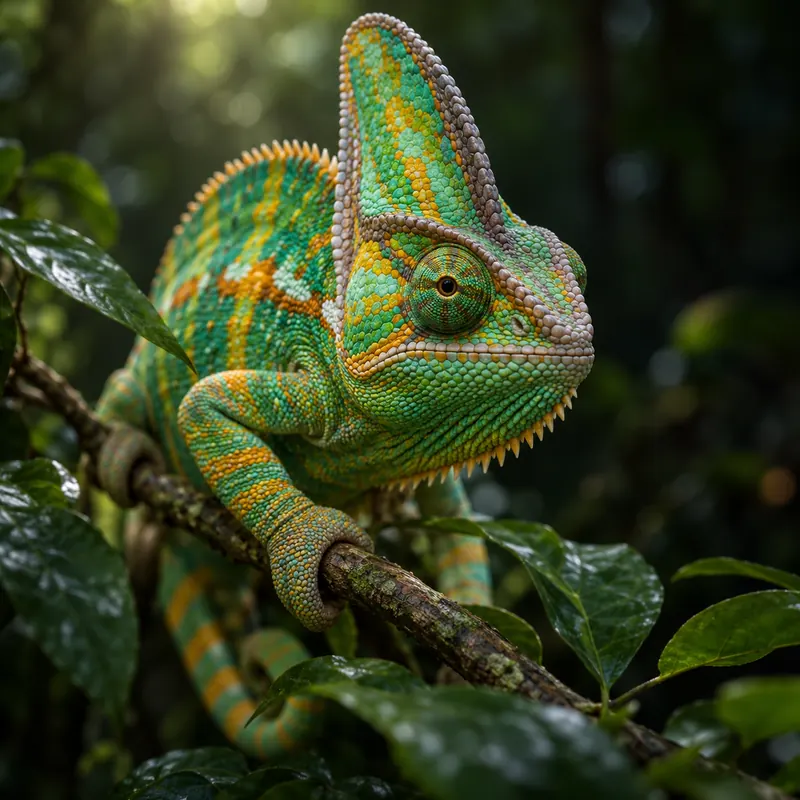
Veiled chameleons eat live insects, gut-loaded and lightly dusted with calcium, plus the odd bit of plant matter. They drink droplets from leaves, not water from a bowl, so misting is part of feeding. Young chameleons eat a lot every day; adults eat a little every other day, and overfeeding adults, especially females, causes problems.
What they eat
The RVC describes chameleons as insectivores that may take the occasional piece of plant matter. LIBEVC also offers some plant matter, which is one reason every plant in the enclosure must be nontoxic.
Good staple feeders (named by the Long Island Bird and Exotics vet clinic, LIBEVC, and ReptiFiles):
- Crickets
- Dubia and discoid roaches
- Silkworms
- Black soldier fly larvae
- Locusts (RVC, ReptiFiles), common in the UK
Variety and treats:
- Hornworms, occasionally (LIBEVC).
- Mealworms in moderation, and waxworms only as an occasional treat (RVC).
- ReptiFiles also lists flies, stick insects and captive-bred snails among safe options.
Plant matter: LIBEVC suggests a shallow bowl of dark leafy greens, finely chopped vegetables or edible flowers such as hibiscus. The RVC notes greens are often ignored. Offering them does no harm.
How much and how often
| Age | How often | How much |
|---|---|---|
| Juveniles | Daily: once or twice a day (LIBEVC, Reptiles Magazine) | As much as they will eat (ReptiFiles, LIBEVC) |
| Adults | Every other day (LIBEVC, ReptiFiles, PetMD, Reptiles Magazine) | 2 to 3 items (LIBEVC), 4 to 5 insects (ReptiFiles), or about 12 large crickets (PetMD) |
The adult figures vary a lot between sources, partly because insects vary so much in size. Watch body condition and weight, and ask your vet what is right for your chameleon.
Prey size: no longer than the width of the chameleon’s head (LIBEVC). PetMD says no wider than the head.
Remove leftovers. PetMD says to remove uneaten insects promptly, and the RVC says within 30 minutes. Insects left to wander the enclosure also lose their dusting and their gut-load.
Feeding methods: most keepers use a feeding cup fixed to a branch, release a few insects at a time, or offer them from tongs. Watching the tongue shoot out is one of the joys of keeping a chameleon, and it also lets you see exactly how much was eaten.
Why variety matters
ReptiFiles feeds a rotation of different insects rather than one kind, and LIBEVC lists several staples. Different feeders carry different nutrients, and a chameleon offered the same cricket every day may lose interest. If your chameleon refuses one insect, try another from the list before worrying. If a new chameleon still is not eating two weeks after arriving, ReptiFiles says to see an experienced reptile vet rather than wait longer.
Females need less
LIBEVC says overfeeding, especially in females, can contribute to egg binding. Female veiled chameleons can produce clutches of eggs without a male (Reptiles Magazine), and VCA notes veiled chameleons may lay 20 to 70 eggs at a time. Reptiles Magazine says producing infertile clutches takes a lot of energy and shortens a female’s life. Keep adult females lean, and talk to your vet about a feeding plan. More in common mistakes.
Gut-loading
Gut-loading means feeding the insects a nutritious diet before they become food, so your chameleon gets those nutrients too.
- How long: at least 48 hours (LIBEVC), 2 to 3 days (ReptiFiles), 24 to 72 hours (PetMD), or 12 hours with fresh greens or a commercial diet (VCA).
- What with: LIBEVC suggests vegetables rich in calcium, iron and vitamin A, or a commercial gut-load. VCA names commercial gut-load products and fresh vegetables or leafy greens, but not iceberg lettuce. The RVC says to check the label for calcium content and aims for a high-calcium gut-load.
- Water for the insects too: a slice of vegetable or a water gel keeps crickets alive and hydrated.
Supplements
Supplements work with UVB to prevent metabolic bone disease. The MSD Veterinary Manual lists an imbalanced calcium to phosphorus ratio and a lack of vitamin D3 among its causes.
The sources give quite different schedules:
| Source | Calcium | Vitamins and D3 |
|---|---|---|
| LIBEVC | Calcium without D3: daily for juveniles, every other day for adults | Multivitamin with preformed vitamin A, once a week |
| ReptiFiles | (Light dusting before every feeding) | Arcadia EarthPro-A every feeding; a D3 product twice a month |
| PetMD | Alternate calcium with D3 and calcium without D3 | Multivitamin once a week |
| VCA | Phosphorus-free calcium, two to three times a week | Not specified |
Whatever plan you choose, dust lightly, use one plan at a time, and do not stack products. Vitamins and D3 can be overdosed, so a reptile vet who sees your setup and lighting is the best person to set the schedule.
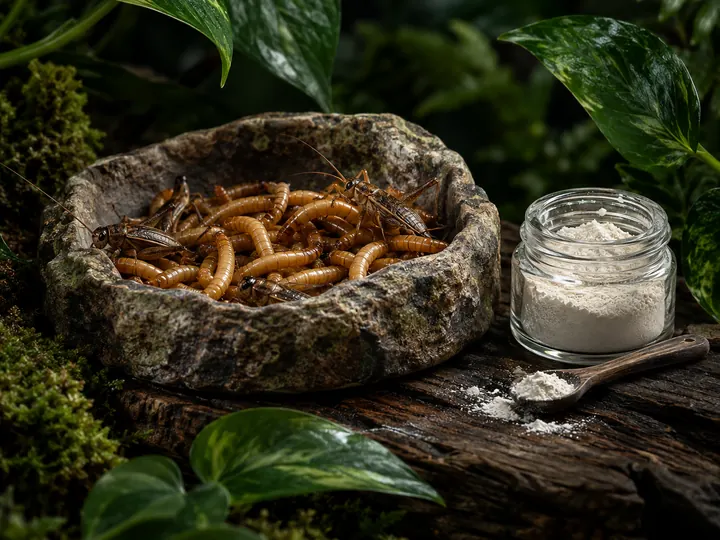
Calcium powder
Zoo Med Repti Calcium without D3
A fine calcium carbonate powder with no vitamin D3, for dusting insects. The Long Island Bird and Exotics vet clinic recommends calcium carbonate without D3 as the routine dusting for veiled chameleons.
- Calcium source
- Calcium carbonate
- Vitamin D3
- None
- Size
- 8 oz (US listing); 85 g (UK listing)
Best for
Routine dusting for a chameleon under good UVB, which makes its own vitamin D3.
Worth knowing
Sources give different schedules, so agree one with your vet. A light coat is enough.
Multivitamin
Arcadia EarthPro-A Multivitamin, 100 g
A multivitamin and mineral powder from Arcadia. ReptiFiles names EarthPro-A as the multivitamin to dust on veiled chameleon feeders.
- Type
- Multivitamin and mineral powder
- Size
- 100 g
Best for
The vitamin part of the dusting plan, used on the schedule your vet agrees.
Worth knowing
Vitamins can be overdosed. Do not stack several multivitamins, and check the plan with a reptile vet.
A sample week for an adult
As an example only, here is what LIBEVC’s schedule looks like for an adult on a Monday start. Your vet may adjust it.
| Day | Food | Dusting |
|---|---|---|
| Monday | 2 to 3 gut-loaded insects | Calcium without D3 |
| Tuesday | None | None |
| Wednesday | 2 to 3 gut-loaded insects | Calcium without D3 |
| Thursday | None | None |
| Friday | 2 to 3 gut-loaded insects | Multivitamin (the weekly dose) |
| Saturday | None | None |
| Sunday | 2 to 3 gut-loaded insects | Calcium without D3 |
Misting happens every day, whether or not it is a feeding day.
How chameleons drink
This is the part new keepers miss most often. Chameleons do not recognize still water. PetMD says they will not drink from a bowl; they drink droplets from leaves and other surfaces. LIBEVC says the same.
How to get water into them:
- Misting at least twice a day. LIBEVC asks for morning and evening misting with clean, room-temperature water. ReptiFiles mists morning and evening and adds a light mist mid-afternoon. PetMD suggests mist sessions several times a day.
- A dripper in the afternoon, dripping onto leaves (ReptiFiles, LIBEVC).
- An automatic misting system on a timer, so no session is ever missed.
- Distilled water for foggers, as ReptiFiles and LIBEVC advise, and for misters if your tap water leaves mineral marks.

Automatic misting
MistKing Starter Misting System
A pump, timer and nozzle kit that mists the cage on a schedule. ReptiFiles and the Long Island Bird and Exotics vet clinic both name the MistKing Starter as the automatic option for the misting a veiled chameleon needs to drink.
- In the kit (US 5th Gen)
- 24V pump, timer, one nozzle assembly, 15 ft of tubing, reservoir filter
- Nozzles
- Expandable to 10 (US 5th Gen listing)
- UK listing
- Version 4.0
Best for
Keepers who work long hours or travel, and anyone who wants misting to happen on time every day.
Worth knowing
Plan where the water goes: a screen cage needs a drainage tray or bucket below. Clean the reservoir and nozzles regularly, as the clinic advises, to stop mold and bacteria.
Dripper
Zoo Med The Big Dripper (1 gallon)
A one-gallon water container with an adjustable drip valve that hangs over the cage. Water drips onto the leaves below, where a chameleon can find and drink it. The Long Island Bird and Exotics vet clinic names it as a drip-system example.
- Capacity
- 1 gallon (per Zoo Med)
- Mounting
- Hangs above the enclosure on a folding handle
Best for
A slow afternoon drip between misting sessions, as ReptiFiles suggests.
Worth knowing
Set the drip over a plant, not the floor, and catch the runoff. Clean it often.
Signs of dehydration
VCA warns that dehydration can lead to severe kidney disease, and the MSD Veterinary Manual describes gout from kidney disease in a chameleon. LIBEVC lists sunken or closed eyes during the day among signs of illness. PetMD lists loss of appetite and lethargy among reasons to call a vet. If you notice any of these, increase misting and book a vet visit rather than waiting.
Gut-load the bugs, dust them lightly, keep adults lean, and make it rain every day. That is most of chameleon nutrition in one sentence.