
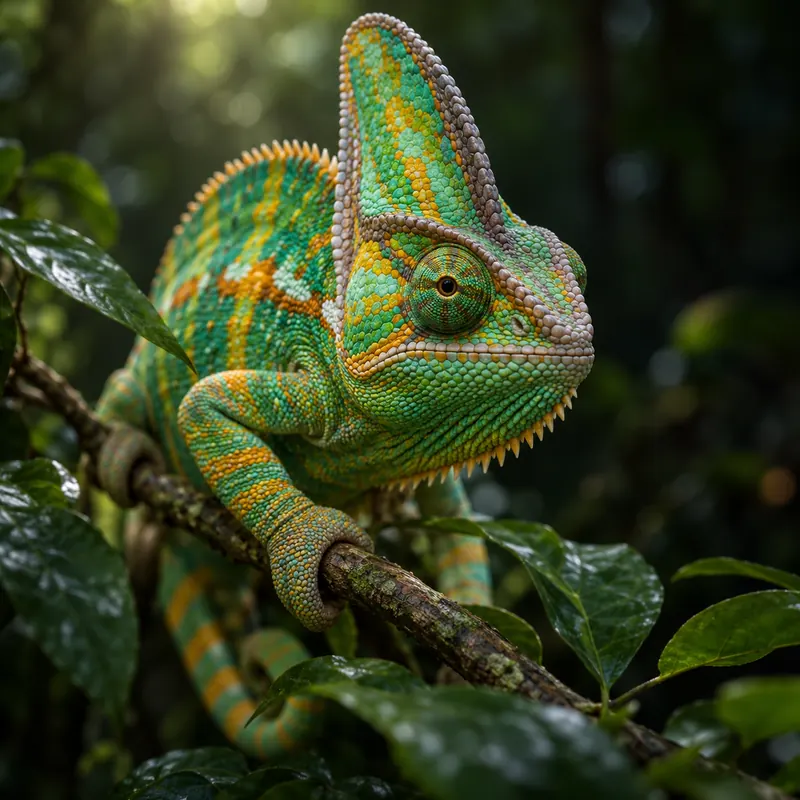
Four purchases decide most of a veiled chameleon’s health: a tall screen enclosure, a T5 UVB light, basking bulbs on a dimming thermostat, and a reliable way to mist. Put your budget there first. Plants, drippers and supplements cost less and are easy to adjust later.
Below is every item, grouped by job, with what to look for and a pick for US and UK keepers. Some brands sell in only one market, so some picks show only in one. Picks are based on the care guidance cited at the bottom of this page and on the makers’ own listings; we have not tested them ourselves.
The short version
-
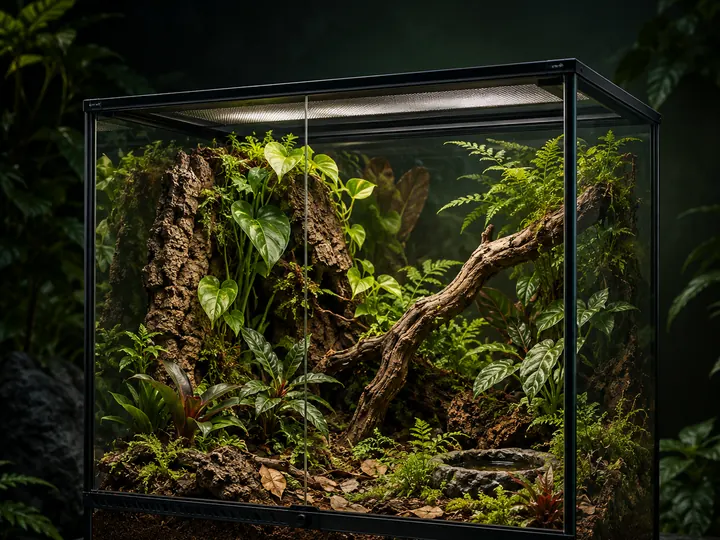 Enclosure Zoo Med ReptiBreeze Open Air Screen Cage, XL (24 x 24 x 48 in) Amazon
 - Enclosure Zoo Med ReptiBreeze Open Air Screen Cage, XL (24 x 24 x 48 in) Amazon UK
-
 UVB kit Arcadia ProT5 UVB Kit, Forest 6%, 24W Amazon
 - UVB kit Arcadia ProT5 UVB Kit, Forest 6%, 24W Amazon UK
-
 Basking bulbs Zoo Med Repti Basking Spot Lamp, 50W Amazon
 - Basking bulbs LUCKY HERP Reptile Basking Bulb, 50W (2 pack, E27) Amazon UK
- Basking dome Zoo Med Combo Mini Deep Dome Lamp Fixture (2 x 5.5 in) Amazon
- Basking dome Zoo Med Combo Mini Deep Dome Lamp Fixture (2 x 5.5 in) Amazon UK
- Thermostat Reptile dimming thermostat for heat lamps Amazon
- Thermostat Habistat Dimming Thermostat, 600W Amazon UK
-
 Misting system MistKing Starter Misting System Amazon
 - Misting system MistKing Starter Misting System Amazon UK
- Dripper Zoo Med The Big Dripper (1 gallon) Amazon
- Dripper Zoo Med The Big Dripper (1 gallon) Amazon UK
- Temp gun Etekcity Infrared Thermometer Amazon
- Temp gun Etekcity Infrared Thermometer Amazon UK
-
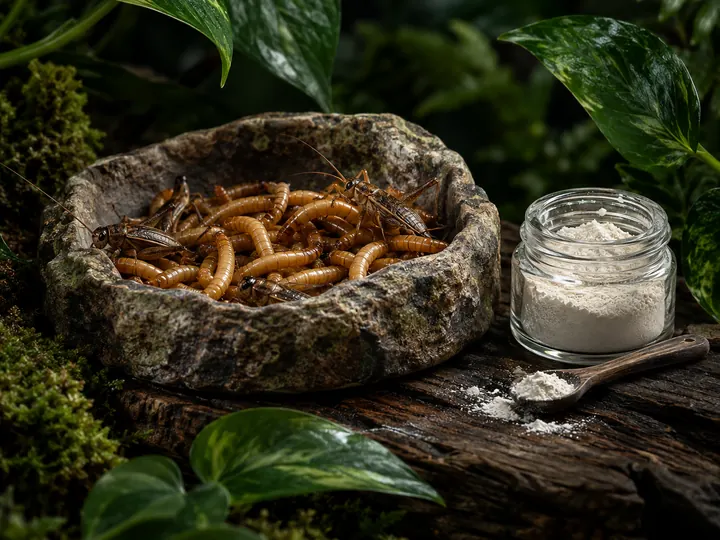 Calcium Zoo Med Repti Calcium without D3 Amazon
 - Calcium Zoo Med Repti Calcium without D3 Amazon UK
- Multivitamin Arcadia EarthPro-A Multivitamin, 100 g Amazon
- Multivitamin Arcadia EarthPro-A Multivitamin, 100 g Amazon UK
1. Enclosure
What to look for:
- Height first. At least 24 x 24 x 48 inches tall (60 x 60 x 120 cm) for one adult, the minimum given by the Long Island Bird and Exotics vet clinic (LIBEVC) and ReptiFiles. LIBEVC prefers 36 x 30 x 48 inches (91 x 76 x 122 cm) for large males.
- Screen or hybrid. LIBEVC recommends screen or hybrid (screen with some solid panels) and advises against fully enclosed glass. The RVC says mesh sides give the ventilation these lizards need.
- A top that carries lamps. The UVB tube, daylight lamp and basking dome all sit on the screen.
- Drainage. A tray or bucket underneath, because water goes in every day.
Dry home? ReptiFiles notes that in a dry climate a hybrid, glass or PVC enclosure may hold humidity better. You can also cover some screen sides with panels.
Best screen enclosure (US and UK)
Zoo Med ReptiBreeze Open Air Screen Cage, XL (24 x 24 x 48 in)
A tall aluminum screen cage at exactly the minimum size the Long Island Bird and Exotics vet clinic and ReptiFiles give for one adult veiled chameleon. Screen sides give the airflow chameleons need, and the height suits a lizard that lives in the branches.
- Size
- 24 x 24 x 48 in (61 x 61 x 122 cm)
- Material
- Black anodized aluminum screen
- Doors
- Large front door, plus a bottom door for cleaning
- Model
- NT-13 (per Zoo Med)
- Assembly
- Hardware included, screwdriver only
Best for
One adult veiled chameleon, in either market, set on a stand with a drainage tray below.
Worth knowing
Screen lets humidity escape fast in a dry home; ReptiFiles and the clinic suggest covering some sides with clear or opaque panels if needed. Large males may need more room. The bottom tray is sold separately.
More on sizes and layout: Enclosure size.
2. UVB lighting
This is not the place to save. Veiled chameleons sit in Ferguson zone 3, the partial or open-sun baskers, according to the Reptile Centre’s zone list. Without UVB, a chameleon cannot use calcium and develops metabolic bone disease.
What to look for:
- A linear T5 HO tube, about 22 inches long, in 5% or 6% strength. LIBEVC and ReptiFiles both name the Arcadia T5 HO 6% and the Zoo Med ReptiSun T5 HO 5.0. VCA suggests a stronger 10.0 bulb for large cages or heavily planted setups.
- A reflector, which pushes more UVB down toward the basking branch.
- No coil bulbs. They light a small patch, not the whole animal.
Target: a UV index of 2.5 to 3.0 at the basking spot (LIBEVC) or about 3.0 (ReptiFiles). Screen mesh blocks 30 to 50% of UVB, according to LIBEVC, so the branch sits closer when the lamp is over mesh.
Best UVB kit
Arcadia ProT5 UVB Kit, Forest 6%, 24W
A complete high-output T5 UVB kit with the 6% Forest lamp, a reflector and a linkable controller. The Long Island Bird and Exotics vet clinic and ReptiFiles both name a 22 inch Arcadia T5 HO 6% as a suitable UVB lamp for a veiled chameleon.
- Lamp
- T5 HO, 6% UVB (Forest)
- Wattage
- 24W
- Fitting length
- About 22.5 in (570 mm)
- In the box
- Controller, lamp, reflector, link cable
- Mounting
- Inside the enclosure or over mesh
Best for
Lying across the top of a 24 x 24 x 48 in screen cage, over the basking branch.
Worth knowing
Screen mesh cuts UVB (the clinic says by 30 to 50%), so the branch height matters more than the box. Aim for a UV index of about 2.5 to 3.0 at the chameleon, checked with a meter, and keep lower branches for shade.
Worth adding: a Solarmeter 6.5 UV index meter. Both ReptiFiles and LIBEVC use one to set the branch height. It turns a guess into a number.
UV index meter
Solarmeter 6.5R Reptile UV Index Meter
A handheld meter that reads the UV index (UVI) your chameleon actually gets at the basking branch. ReptiFiles and the Long Island Bird and Exotics vet clinic both use a Solarmeter 6.5 to set the branch height.
- Measures
- UV index, 280 to 400 nm (per listing)
- Range
- 0 to 199.9 UVI
- Model
- 6.5R
Best for
Setting the basking branch height under screen mesh, and checking that an older UVB tube still puts out enough.
Worth knowing
It is the most expensive item on the list that the chameleon never sees. If you skip it, follow the lamp maker's distance chart and allow for the mesh.
3. Basking heat
What to look for:
- Two 50W white basking bulbs, side by side. ReptiFiles and LIBEVC both describe this setup, so the warm patch covers the whole chameleon.
- A dual dome with ceramic sockets, resting on the screen top, never inside the cage.
- A modest target. Sources give a basking range of about 85 to 95°F (29 to 35°C). Chameleons need far less heat than bearded dragons.
Basking bulb (US)
Zoo Med Repti Basking Spot Lamp, 50W
A white 50W basking bulb. ReptiFiles and the Long Island Bird and Exotics vet clinic both suggest two 50W white heat bulbs side by side for a veiled chameleon, rather than one stronger bulb.
- Type
- White basking spot bulb
- Wattage
- 50W
Best for
US keepers building the basking spot in a screen cage, two bulbs in a dual dome.
Worth knowing
A chameleon may sit under heat until it burns, so check the branch top with a temperature gun and run the bulbs on a dimming thermostat. Never use colored or red bulbs.
Basking bulbs (UK)
LUCKY HERP Reptile Basking Bulb, 50W (2 pack, E27)
A two-pack of 50W basking bulbs with an E27 screw fitting, which matches the two-bulb, 50W setup ReptiFiles and the Long Island Bird and Exotics vet clinic describe.
- Wattage
- 50W
- Pack
- 2 bulbs
- Fitting
- E27 screw
- Rated life
- Up to 2,000 hours (per listing)
Best for
UK keepers who want both basking bulbs in one box.
Worth knowing
Run them through a dimming thermostat and check the branch top with a temperature gun. If the spot runs hot, raise the bulbs, lower the thermostat or drop a wattage.
Dual basking dome
Zoo Med Combo Mini Deep Dome Lamp Fixture (2 x 5.5 in)
Two 5.5 inch deep domes on one fixture, each with its own switch. It holds both 50W basking bulbs side by side on top of a screen cage, so the warm patch covers the whole chameleon.
- Domes
- Two 5.5 in (14 cm) deep domes
- Sockets
- Ceramic, up to 100W each (per Zoo Med)
- Switches
- One per dome
Best for
The two-bulb basking spot, in either market.
Worth knowing
Zoo Med rates each socket for up to 100W. Rest it flat on the screen, never inside where a chameleon can climb onto it.
4. Dimming thermostat
LIBEVC warns that veiled chameleons may not move away from overheating, which risks burns. A thermostat is what stops a warm afternoon from cooking the basking branch.
What to look for:
- Dimming type for light-emitting bulbs. It turns the bulbs down instead of switching them on and off.
- Enough load for both bulbs.
- The probe at the basking branch, out of the chameleon’s reach.
ReptiFiles also mentions a simple plug-in lamp dimmer to turn heat down. A thermostat does the same job automatically, which is safer.
Dimming thermostat (US)
Reptile dimming thermostat for heat lamps
Not one product but the type to shop for: a dimming (proportional) thermostat with a probe. It turns the basking bulbs down instead of switching them on and off, which holds the branch at your set temperature while the light stays steady.
- Type
- Dimming (proportional) thermostat
- Probe
- At the basking branch
- Load
- At least 100W for two 50W bulbs
Best for
US keepers running white basking bulbs over a screen cage.
Worth knowing
Check the maximum load covers both bulbs, and put the probe at the basking branch, out of the chameleon's reach. A plain on/off thermostat makes basking bulbs flicker on and off.
Dimming thermostat (UK)
Habistat Dimming Thermostat, 600W
A UK-made dimming thermostat designed for heat bulbs. It turns the power up or down to hold your set temperature rather than switching the bulb fully on and off.
- Type
- Dimming thermostat
- Max load
- 600W
- Min load
- 40W
Best for
UK setups running two 50W basking bulbs.
Worth knowing
It needs a minimum load of 40W, which two 50W bulbs easily meet.
5. Misting system
Chameleons drink droplets from leaves, not from bowls. PetMD and LIBEVC both say so. That means misting every day for the animal’s whole life, which is the biggest daily job in chameleon care.
What to look for:
- A timer, so misting happens at the same times whether you are home or not. LIBEVC asks for misting at least twice a day, morning and evening, and suggests doing it when the lights are off.
- Fine nozzles that wet the leaves without flooding the floor.
- An easy-to-clean reservoir. LIBEVC says to clean mist and fog systems regularly to prevent mold and bacteria.
Both ReptiFiles and LIBEVC name the MistKing Starter system.
Best automatic misting system
MistKing Starter Misting System
A pump, timer and nozzle kit that mists the cage on a schedule. ReptiFiles and the Long Island Bird and Exotics vet clinic both name the MistKing Starter as the automatic option for the misting a veiled chameleon needs to drink.
- In the kit (US 5th Gen)
- 24V pump, timer, one nozzle assembly, 15 ft of tubing, reservoir filter
- Nozzles
- Expandable to 10 (US 5th Gen listing)
- UK listing
- Version 4.0
Best for
Keepers who work long hours or travel, and anyone who wants misting to happen on time every day.
Worth knowing
Plan where the water goes: a screen cage needs a drainage tray or bucket below. Clean the reservoir and nozzles regularly, as the clinic advises, to stop mold and bacteria.
On a budget? A pump-up pressure sprayer is the hand-misting option LIBEVC lists. It is also a good backup when the automatic system needs cleaning.
Hand sprayer
Hand pump pressure sprayer (about 1.5 to 2 liters)
A garden-style pressure sprayer you pump up once and then spray for minutes. The Long Island Bird and Exotics vet clinic lists a pump-style pressure sprayer as one way to mist; it is much easier on the hand than a trigger bottle.
- Type
- Pump-up pressure sprayer
- Use
- Misting leaves and branches
Best for
Twice-daily hand misting, and as a backup if an automatic system fails.
Worth knowing
Use it only for the chameleon, never for garden chemicals, and rinse it out regularly.
6. Dripper
A dripper gives slow, steady droplets that catch the chameleon’s eye. ReptiFiles suggests one in the mid-afternoon, between misting sessions, and LIBEVC names Zoo Med’s Big Dripper as an example.
What to look for: an adjustable valve, enough capacity for a day, and a drip line that lands on a leaf above the drainage area.
Dripper
Zoo Med The Big Dripper (1 gallon)
A one-gallon water container with an adjustable drip valve that hangs over the cage. Water drips onto the leaves below, where a chameleon can find and drink it. The Long Island Bird and Exotics vet clinic names it as a drip-system example.
- Capacity
- 1 gallon (per Zoo Med)
- Mounting
- Hangs above the enclosure on a folding handle
Best for
A slow afternoon drip between misting sessions, as ReptiFiles suggests.
Worth knowing
Set the drip over a plant, not the floor, and catch the runoff. Clean it often.
7. Live plants and branches
What to look for:
- Nontoxic, pesticide-free live plants. LIBEVC suggests pothos on the walls with umbrella plant (schefflera) and ficus at the base. ReptiFiles lists coleus, croton, hibiscus, lipstick plant, money tree, pothos, umbrella plant, wandering Jew, weeping fig and ZZ plant as nontoxic choices. PetMD adds dracaena.
- Buy from a garden center, rinse the leaves, and replace the potting soil if it contains fertilizer pellets or additives.
- Branches and vines, mostly horizontal, at different heights. LIBEVC says the chameleon’s toes should wrap about halfway around.
Live plants hold the misting water the chameleon drinks. PetMD says silk plants cannot absorb water, so skip them as the main cover.
8. Monitoring
What to look for:
- An infrared temperature gun for the top of the basking branch.
- A thermometer and hygrometer with probes. ReptiFiles and LIBEVC measure humidity in the middle of the enclosure. Their targets are about 40 to 50% by day and 80 to 100% at night; other sources differ (see the lighting and heating guide).
Temperature gun
Etekcity Infrared Thermometer
A handheld infrared gun that reads surface temperature without touching anything. The Long Island Bird and Exotics vet clinic suggests a probe thermometer or temperature gun to check the basking spot.
- Measures
- Surface temperature, no contact
- Units
- °F and °C
Best for
Checking the top of the basking branch, where the chameleon actually sits.
Worth knowing
It reads surfaces, not air. Pair it with a probe thermometer for air temperature and overnight lows.
Thermometer and hygrometer
Digital reptile thermometer and hygrometer with remote probes
A digital gauge with remote probes, so you can read temperature and humidity in the middle of the cage, where ReptiFiles and the Long Island Bird and Exotics vet clinic say to measure humidity.
- Measures
- Temperature and humidity
- Probes
- Two external probes (US listing)
Best for
Tracking the daytime humidity dip and the night-time rise, plus ambient temperature.
Worth knowing
Cheap hygrometers drift. If a reading looks wrong, compare it with a second gauge before changing your misting.
9. Daylight lamp
LIBEVC and ReptiFiles both recommend a bright 6500K daylight lamp alongside the UVB tube, on the same 12-hour timer. It makes the enclosure brighter and keeps live plants growing.
Daylight LED
Arcadia Jungle Dawn LED Bar, 22.5 in
A bright full-spectrum LED bar that sits beside the UVB lamp. The Long Island Bird and Exotics vet clinic names it as one option for the 6500K daylight it recommends, and the extra light also helps live plants grow.
- Type
- Full-spectrum LED bar
- Length
- About 22.5 in (570 mm)
- Use
- Daylight and plant growth alongside UVB
Best for
Planted screen cages where the UVB tube alone leaves the lower leaves dim.
Worth knowing
It adds light, not UVB. It never replaces the T5 UVB tube, and it should run on the same 12-hour timer.
10. Supplements
What to look for:
- Calcium without D3 for routine dusting. LIBEVC recommends it daily for juveniles and every other day for adults.
- A multivitamin. LIBEVC asks for one with preformed vitamin A once a week. ReptiFiles uses Arcadia EarthPro-A.
- A D3 product, used sparingly. ReptiFiles adds one twice a month.
Schedules differ a lot between sources. Agree one plan with your vet and do not stack products.
Calcium
Zoo Med Repti Calcium without D3
A fine calcium carbonate powder with no vitamin D3, for dusting insects. The Long Island Bird and Exotics vet clinic recommends calcium carbonate without D3 as the routine dusting for veiled chameleons.
- Calcium source
- Calcium carbonate
- Vitamin D3
- None
- Size
- 8 oz (US listing); 85 g (UK listing)
Best for
Routine dusting for a chameleon under good UVB, which makes its own vitamin D3.
Worth knowing
Sources give different schedules, so agree one with your vet. A light coat is enough.
Multivitamin
Arcadia EarthPro-A Multivitamin, 100 g
A multivitamin and mineral powder from Arcadia. ReptiFiles names EarthPro-A as the multivitamin to dust on veiled chameleon feeders.
- Type
- Multivitamin and mineral powder
- Size
- 100 g
Best for
The vitamin part of the dusting plan, used on the schedule your vet agrees.
Worth knowing
Vitamins can be overdosed. Do not stack several multivitamins, and check the plan with a reptile vet.
More on schedules: Diet and hydration.
11. For females: a laying container
Female veiled chameleons can lay eggs without ever meeting a male. Reptiles Magazine suggests a 5 gallon bucket with about 8 inches (20 cm) of a damp sand and peat mix. Any deep, sturdy container you already have works; you do not need to buy a special product. See common mistakes for why this matters.
Useful extras
None of these is essential on day one, but each one makes daily care easier.
- A plug-in timer for the UVB, daylight and basking lamps. LIBEVC and ReptiFiles both give 12 hours of light, and a timer keeps that steady even when you are away.
- A cool-mist fogger for night humidity. LIBEVC and ReptiFiles describe one running from the early hours until sunrise. Use distilled water only, as both sources advise, and clean it often.
- Distilled water for the mister and fogger, which also keeps mineral spots off the leaves and glass.
- A feeding cup clipped to a branch. Insects stay in one place, and you can see how much your chameleon ate.
- Spare bulbs and a spare UVB tube. UVB fades with age and basking bulbs fail without warning, so a spare means no gap while you wait for delivery.
Where to spend and where to save
If the budget is tight, this order protects the chameleon:
- Spend on UVB. A good T5 tube at the right height is the main defense against bone disease.
- Spend on the thermostat. It is what stops the basking branch overheating.
- Spend on height. Buying the adult size once is cheaper than a small cage and then an upgrade.
- Spend on reliable water, whether that is an automatic system or a sprayer you will really use twice a day.
- Save on plants. Ordinary pothos and umbrella plants from a garden center work well.
- Save on decor. Clean branches and vines do the job of expensive ornaments.
Skip these
- Glass tanks with a small screen lid. LIBEVC advises against fully enclosed glass; airflow matters.
- Water bowls as the only water. Chameleons do not drink from bowls (PetMD).
- Coil or compact UVB bulbs. Use a linear T5 tube.
- Colored or red “night” bulbs. Lights off at night. If your home gets too cold, use a heater that gives no light, on a thermostat.
- Heat rocks or any heat without a thermostat. PetMD says not to use hot rocks.
- Loose bedding. VCA warns against particle bedding a chameleon could swallow, and the RVC says never use wood chips.
- Silk plants as the only cover. They do not hold water.
- A second chameleon “for company”. One per enclosure.
The short shopping list
| Priority | Item |
|---|---|
| 1 | Screen or hybrid enclosure, 24 x 24 x 48 in (60 x 60 x 120 cm) or larger |
| 2 | T5 HO 5% or 6% UVB kit, about 22 in |
| 3 | Two 50W basking bulbs, a dual dome, a dimming thermostat |
| 4 | Misting system or pressure sprayer, plus a dripper |
| 5 | Drainage tray or bucket |
| 6 | Live plants and branches |
| 7 | Temperature gun, thermometer and hygrometer |
| 8 | Calcium and multivitamin |
| Optional | UV index meter, daylight LED, night fogger |
Ready to build it? Follow the setup checklist, then check the numbers on the lighting and heating page.
Spend on height, UVB, a thermostat and misting. A chameleon can thrive with plain branches and a pothos from the garden center; it cannot thrive without water it can see falling.