
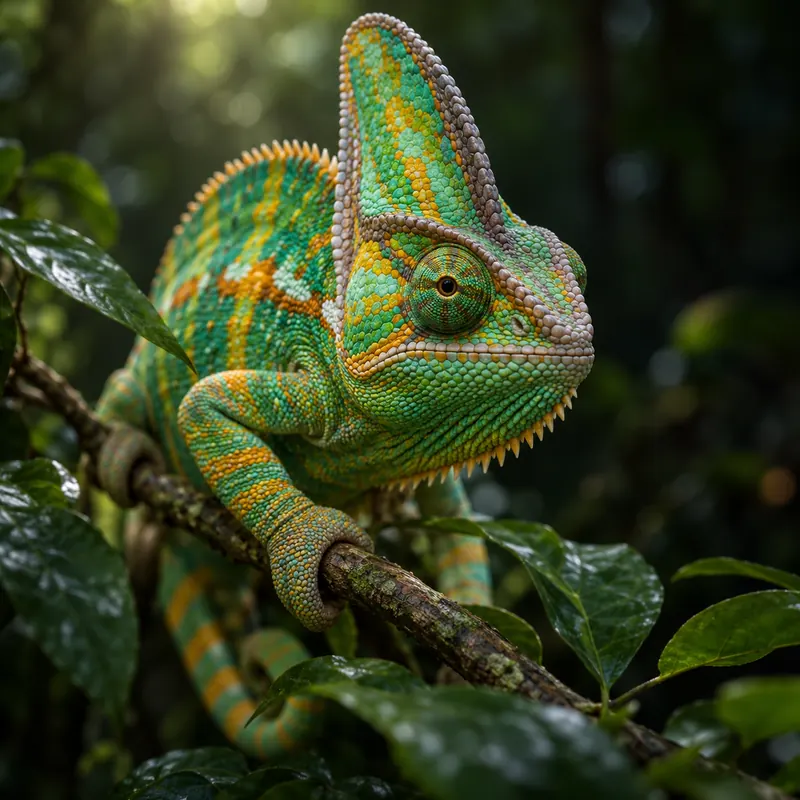
An adult veiled chameleon needs an enclosure at least 2 feet long, 2 feet deep and 4 feet tall (60 x 60 x 120 cm), and bigger is better. Height matters most, because these lizards live up in the branches. Screen or hybrid sides matter almost as much, because chameleons need air moving around them.
How big, in numbers
| Source | Adult minimum | Notes |
|---|---|---|
| Long Island Bird and Exotics vet clinic (LIBEVC) | 24 x 24 x 48 in tall (60 x 60 x 120 cm) | Prefers 36 x 30 x 48 in (91 x 76 x 122 cm), especially for large males |
| ReptiFiles | 24 x 24 x 48 in tall (60 x 60 x 120 cm) | “Larger is strongly recommended”; big males may need more |
| PetMD (vet-written) | 36 x 36 x 36 in (91 x 91 x 91 cm) | Says to provide the largest habitat possible, taller than wide |
| VCA | 24 x 24 x 48 in (60 x 60 x 120 cm) for large chameleons | Gives 12 x 12 x 24 in and 18 x 18 x 30 in for smaller species |
| RVC | As large as possible | Taller than wide, with mesh sides |
The sources agree on the shape: tall and roughly square. A 24 x 24 x 48 inch screen cage is the common starting point. If you have room for more, a male in particular will use it.
Why height beats length
Bearded dragons and leopard geckos live on the ground, so their enclosures are long. Chameleons are the opposite. The RVC says veiled chameleons spend most of their time in trees or bushes and feel most secure perching high up. A tall enclosure lets the chameleon move between a warm, bright top and cooler, shadier branches lower down. That vertical gradient is how it controls its own temperature and UVB exposure.
Juveniles
PetMD gives at least 24 x 24 x 24 inches (60 x 60 x 60 cm) for juveniles. Many keepers move a young chameleon straight into the adult enclosure instead. If you do, plant it densely and put food where the chameleon can find it easily, so a small animal is not lost in a big space. Veiled chameleons grow fast, so a small enclosure is outgrown within months.
Screen, hybrid or glass
- Screen (mesh) on all sides. LIBEVC recommends screen or hybrid, and the RVC says mesh sides give good ventilation, which is especially important for these lizards. The downside is that screen loses humidity fast in a dry home.
- Hybrid. Screen top and front with some solid (PVC or glass) side or back panels. LIBEVC names the Dragon Strand hybrid cages as an example, and suggests a screen cage can be modified with PVC panels to hold humidity.
- Glass or PVC. LIBEVC advises against fully enclosed glass tanks. ReptiFiles notes that in a dry climate a well-ventilated glass, wood or PVC enclosure may suit better. If you go this route, make sure the top and front have large mesh vents.
Mesh size and type. VCA recommends mesh between ½ x ½ inch and ½ x 1 inch, depending on the chameleon’s adult size. Check that there are no sharp edges or gaps where a toe could catch. Remember that the screen top sits between the UVB lamp and the chameleon: LIBEVC says mesh can block 30 to 50% of UVB, which is why the basking branch goes fairly close to the top. More on that in lighting and heating.
ReptiFiles also suggests covering some screen sides with opaque panels to give the chameleon a sense of security and reduce stress.
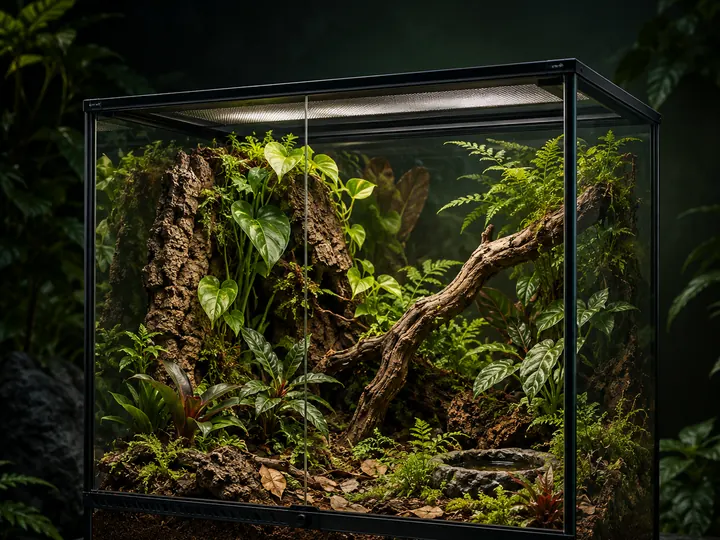
Screen enclosure
Zoo Med ReptiBreeze Open Air Screen Cage, XL (24 x 24 x 48 in)
A tall aluminum screen cage at exactly the minimum size the Long Island Bird and Exotics vet clinic and ReptiFiles give for one adult veiled chameleon. Screen sides give the airflow chameleons need, and the height suits a lizard that lives in the branches.
- Size
- 24 x 24 x 48 in (61 x 61 x 122 cm)
- Material
- Black anodized aluminum screen
- Doors
- Large front door, plus a bottom door for cleaning
- Model
- NT-13 (per Zoo Med)
- Assembly
- Hardware included, screwdriver only
Best for
One adult veiled chameleon, in either market, set on a stand with a drainage tray below.
Worth knowing
Screen lets humidity escape fast in a dry home; ReptiFiles and the clinic suggest covering some sides with clear or opaque panels if needed. Large males may need more room. The bottom tray is sold separately.
The floor and drainage
Every day, water goes into a chameleon enclosure. It needs somewhere to go.
- Bare floor with drainage. LIBEVC recommends a bare-bottom enclosure on risers over a drainage tray. ReptiFiles says most keepers fit a drain and run it to a bucket under the stand.
- No loose bedding. VCA says to avoid dirt or particle-type bedding a chameleon could swallow, and suggests a flat floor of artificial turf, indoor and outdoor carpet, or paper. The RVC says wood-chip substrates should never be used, because swallowed pieces can cause fatal blockages.
- Short-term fixes. If you cannot drain yet, LIBEVC suggests pee pads for a while with a covered bucket under the dripper, but not long term.
Laying it out
LIBEVC describes three zones every enclosure needs:
- An open, well-lit area near the top with the basking heat and UVB. ReptiFiles places the basking branch so the chameleon’s back sits about 6 inches (15 cm) below the top mesh.
- Dense planting throughout, so the chameleon can hide, drink from wet leaves and get out of the light.
- A branch network of mostly horizontal branches and vines at many heights, crossing from warm to cool. LIBEVC says branches should be thick enough for the toes to wrap about halfway around.
VCA adds climbing rope and suggests checking temperatures at both the top and bottom of the cage.
Safe live plants
Live plants hold misting droplets, raise humidity and give cover. Choose nontoxic, pesticide-free plants.
- LIBEVC: pothos mounted on the walls, umbrella plant (schefflera) and weeping fig (ficus benjamina) at the base.
- ReptiFiles: coleus, croton, hibiscus, lipstick plant, money tree, Philodendron ‘Pink Princess’, pothos, umbrella plant, wandering Jew, weeping fig and ZZ plant.
- PetMD: ficus and hibiscus, plus pothos, dracaena and schefflera. It says to avoid silk plants because they cannot absorb water.
Rinse new plants well before they go in. Veiled chameleons sometimes nibble leaves, which is one more reason to buy plants that were not sprayed.
Where to put the enclosure
LIBEVC advises keeping it away from drafts, air vents, busy walkways and windows that get direct sun, and out of reach of cats and dogs. A quiet corner of a room you use, at a height where the chameleon can look down on people, tends to work well. Raising the cage on a stand also leaves room for the drainage bucket.
One per enclosure
LIBEVC, ReptiFiles and PetMD all say to house veiled chameleons alone. LIBEVC says keeping several together causes stress, aggression and injury. The RVC puts it simply: in general, the happiest lizard is the solitary lizard. Do not put two enclosures where the chameleons can see each other if you can avoid it.
Cleaning
The RVC says to spot clean daily and give the enclosure a full clean with a suitable disinfectant at least once a week. With live plants, that means wiping the floor and drainage tray, removing dead insects and droppings, and trimming any rotting leaves.
Think tree, not tank: tall, airy, full of leaves, and dry underfoot. Get the shape right and the chameleon will spend its days high up and relaxed, which is exactly where you want it.