
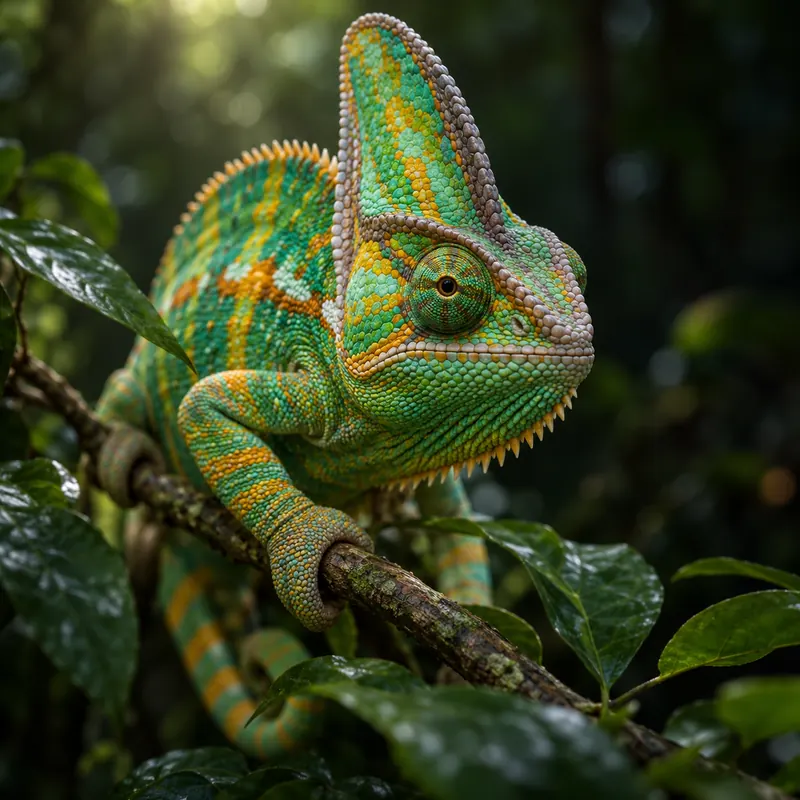
A veiled chameleon needs a warm basking branch near the top of its enclosure, cooler branches lower down, strong but not extreme UVB, and a 12-hour day. The most common heat mistake with chameleons is too much, not too little: they need far less heat than a bearded dragon, and they may not move away from a basking spot that is burning them.
The numbers at a glance
| Zone | Range across sources |
|---|---|
| Basking branch | 85 to 95°F (29 to 35°C) |
| Daytime ambient | About 72 to 85°F (22 to 29°C) |
| Night | 55 to 70°F (13 to 21°C) in most sources; the RVC says no lower than 73°F (23°C) |
| Humidity | 40 to 50% by day, 80 to 100% at night (ReptiFiles, LIBEVC); other sources differ |
| UVB | T5 HO 5% or 6%, UV index about 2.5 to 3.0 at the basking spot |
| Light cycle | 12 hours on, 12 hours off |
The sources do not agree on every figure, so the table gives ranges. Pick values inside them, check your setup with real measurements, and agree the details with your vet.
Basking temperature
- ReptiFiles: 85°F (29°C) at the basking area, 72 to 78°F (22 to 25°C) generally.
- Long Island Bird and Exotics vet clinic (LIBEVC): 95°F (35°C) basking, 75 to 85°F (24 to 29°C) daytime ambient.
- RVC: a basking spot of 35°C (95°F) and a cool end of 25°C (77°F).
- PetMD: 90 to 95°F (32 to 35°C) at the warm end and about 70°F (21°C) at the cool end.
So the safe zone is roughly 85 to 95°F (29 to 35°C) at the basking branch, with the lower and middle branches clearly cooler. Measure the top of the branch where the chameleon sits, with an infrared temperature gun, after the lamps have warmed up.
Why too much heat is dangerous
LIBEVC warns that veiled chameleons may not move away from overheating, which puts them at risk of thermal burns. A chameleon can also overheat in a small or poorly ventilated enclosure, and the RVC specifically warns about overheating in small vivaria. LIBEVC lists persistent open-mouth breathing among its emergency signs. If you see it, check the basking temperature straight away and call a reptile vet.
How to keep it safe:
- Use two 50W white bulbs, as ReptiFiles and LIBEVC describe, rather than one large bulb. Two smaller bulbs give a wider, gentler warm patch.
- Put the domes on top of the screen. Never let a bulb sit inside where the chameleon can climb onto it. LIBEVC suggests a protective barrier if a lamp is inside the enclosure.
- Run the bulbs on a dimming thermostat with the probe at the basking branch. ReptiFiles also mentions a lamp dimmer or lower-wattage bulbs if the spot runs hot.
- Check after a hot day. A warm room raises every number in the enclosure.

Dual basking dome
Zoo Med Combo Mini Deep Dome Lamp Fixture (2 x 5.5 in)
Two 5.5 inch deep domes on one fixture, each with its own switch. It holds both 50W basking bulbs side by side on top of a screen cage, so the warm patch covers the whole chameleon.
- Domes
- Two 5.5 in (14 cm) deep domes
- Sockets
- Ceramic, up to 100W each (per Zoo Med)
- Switches
- One per dome
Best for
The two-bulb basking spot, in either market.
Worth knowing
Zoo Med rates each socket for up to 100W. Rest it flat on the screen, never inside where a chameleon can climb onto it.
Dimming thermostat (UK)
Habistat Dimming Thermostat, 600W
A UK-made dimming thermostat designed for heat bulbs. It turns the power up or down to hold your set temperature rather than switching the bulb fully on and off.
- Type
- Dimming thermostat
- Max load
- 600W
- Min load
- 40W
Best for
UK setups running two 50W basking bulbs.
Worth knowing
It needs a minimum load of 40W, which two 50W bulbs easily meet.
How long the basking lamp stays on
Here the sources split. ReptiFiles and LIBEVC both run the heat lamp for only about 3 hours each morning, while the UVB and daylight lamps stay on for 12 hours. The RVC says the basking spot should be kept on all day. Either way, the chameleon must always be able to move away from the heat to cooler, shaded branches. Discuss which approach suits your home with your vet, especially if your room is cool.
Night temperatures
All lights go off at night. Sources differ on how cool it can get:
- ReptiFiles: 55 to 65°F (13 to 18°C).
- LIBEVC: 60 to 70°F (16 to 21°C).
- VCA: about 70 to 75°F (21 to 24°C) for most chameleon species.
- RVC: no lower than 23°C (73°F).
A night drop is normal for veiled chameleons in the hobby sources, but the vet sources set a higher floor, so this is a real disagreement. Read a min/max thermometer each morning for a week. If your room falls below the floor you and your vet choose, use a heat source that gives no light, such as a ceramic heater, on a thermostat. Never use colored “night” bulbs.
UVB: why it matters
UVB lets a chameleon make vitamin D3 in its skin, which it needs to absorb and use calcium. The MSD Veterinary Manual lists a lack of UVB light, along with diet problems, as a cause of metabolic bone disease in reptiles. The RVC says simply that chameleons must be exposed to UVB.
UVB: how strong
The BIAZA UV-Tool sorts reptiles into Ferguson zones by how much UV they meet in the wild. The Reptile Centre’s zone list puts the veiled (Yemen) chameleon in zone 3, the partial or open-sun baskers, with a maximum UV index of 2.9 to 7.4 in the basking zone.
In practice, the care sources aim lower than that maximum, at the basking branch:
- LIBEVC: UV index (UVI) 2.5 to 3.0 at the basking spot.
- ReptiFiles: about UVI 3.0 at basking height.
Lamp choice: a linear T5 HO tube. LIBEVC and ReptiFiles both name the 22 inch Arcadia T5 HO 6% and the Zoo Med ReptiSun T5 HO 5.0. VCA says most chameleons need a 5.0 UVB bulb, and a 10.0 bulb for large chameleons, large cages, or heavily planted setups that block light.

UVB kit
Arcadia ProT5 UVB Kit, Forest 6%, 24W
A complete high-output T5 UVB kit with the 6% Forest lamp, a reflector and a linkable controller. The Long Island Bird and Exotics vet clinic and ReptiFiles both name a 22 inch Arcadia T5 HO 6% as a suitable UVB lamp for a veiled chameleon.
- Lamp
- T5 HO, 6% UVB (Forest)
- Wattage
- 24W
- Fitting length
- About 22.5 in (570 mm)
- In the box
- Controller, lamp, reflector, link cable
- Mounting
- Inside the enclosure or over mesh
Best for
Lying across the top of a 24 x 24 x 48 in screen cage, over the basking branch.
Worth knowing
Screen mesh cuts UVB (the clinic says by 30 to 50%), so the branch height matters more than the box. Aim for a UV index of about 2.5 to 3.0 at the chameleon, checked with a meter, and keep lower branches for shade.
UVB: distance and mesh
Screen is great for air, but it eats UVB. LIBEVC says screen mesh can block 30 to 50% of UVB. That changes how close the branch should be:
- Lamp on top of the mesh: LIBEVC places the basking branch 6 to 8 inches (15 to 20 cm) below the bulb. ReptiFiles sets the branch so the chameleon’s back is about 6 inches (15 cm) below the top mesh.
- Lamp inside, below the mesh: LIBEVC moves the branch to 10 to 12 inches (25 to 30 cm) away, with a guard so the chameleon cannot touch the lamp.
- A gradient: LIBEVC asks for branches at different heights and distances, so the chameleon can choose how much UVB it gets. Dense plants lower down give shade.
The only way to know your real number is to measure. ReptiFiles and LIBEVC both use a Solarmeter 6.5 at the basking branch.
UV index meter
Solarmeter 6.5R Reptile UV Index Meter
A handheld meter that reads the UV index (UVI) your chameleon actually gets at the basking branch. ReptiFiles and the Long Island Bird and Exotics vet clinic both use a Solarmeter 6.5 to set the branch height.
- Measures
- UV index, 280 to 400 nm (per listing)
- Range
- 0 to 199.9 UVI
- Model
- 6.5R
Best for
Setting the basking branch height under screen mesh, and checking that an older UVB tube still puts out enough.
Worth knowing
It is the most expensive item on the list that the chameleon never sees. If you skip it, follow the lamp maker's distance chart and allow for the mesh.
UVB: replacing the tube
UVB output fades long before the visible light does. PetMD says to replace the bulb every 6 months, and the RVC says to check output regularly and change bulbs at least as often as the maker says. A UV index meter lets you replace on real readings rather than the calendar.
Daylight
LIBEVC and ReptiFiles both add a bright 6500K LED or fluorescent daylight lamp alongside the UVB, on the same 12-hour timer. VCA recommends full-spectrum light for enrichment and to help chameleons see their prey. It also keeps live plants healthy.
Humidity
Humidity is where the sources disagree most:
- ReptiFiles and LIBEVC: 40 to 50% during the day, rising to 80 to 100% at night, measured with a probe hygrometer near the middle of the enclosure.
- VCA: 60 to 90%.
- PetMD: under 60%.
The day-dry, night-humid pattern from ReptiFiles and LIBEVC lets the enclosure dry out between mistings, which helps prevent mold, while still giving high humidity overnight. Both describe a cool-mist fogger running from the early hours until sunrise, filled with distilled water only. VCA links low humidity to dehydration and severe kidney disease, so whichever target you choose, the chameleon must still get plenty of droplets to drink. More on that in diet and hydration.
A weekly check
Once everything is running, a few minutes a week keeps it right:
- Read the top of the basking branch with the temperature gun, at the same time of day.
- Read the min/max thermometer for the overnight low, and reset it.
- Glance at the hygrometer morning and evening to see the day and night humidity pattern.
- Check that the timer still switches every lamp on and off on time.
- If you have a UV meter, take a reading at the basking branch once a month and note it down. A falling number tells you the tube is fading.
Warm, not hot. Strong UVB, measured at the branch. Lights off at night and water in the air. Set those up carefully and most chameleon health problems never get the chance to start.