
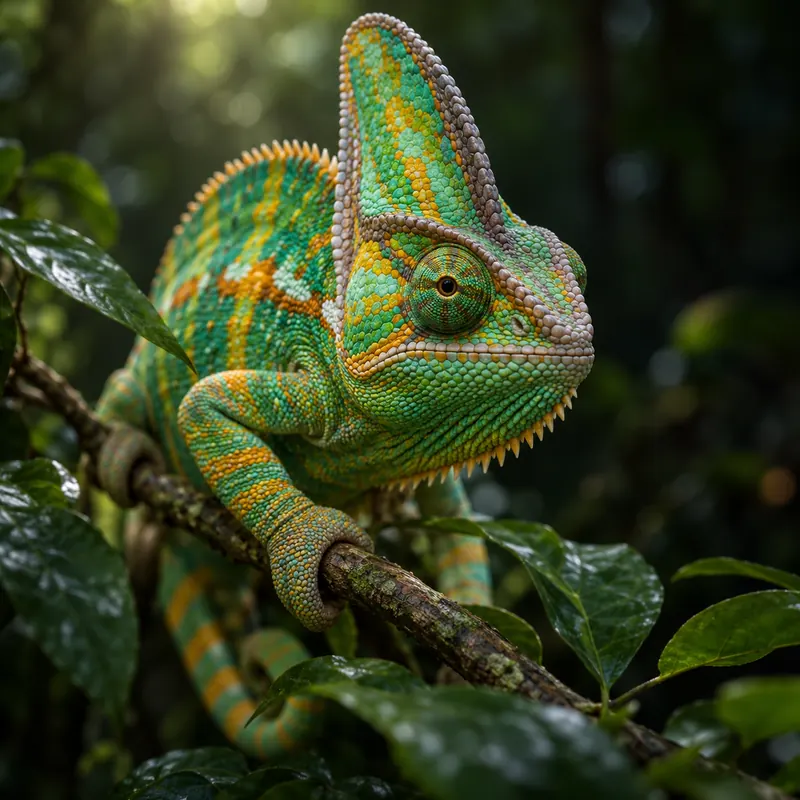
A veiled chameleon needs a tall, airy enclosure, a gentle basking spot, strong UVB, a way to drink from droplets, and somewhere for that water to drain. Buy and run all of it before the chameleon comes home, and only bring it home once the temperatures, UVB and misting have worked smoothly for several days.
Be honest with yourself before you start. The Royal Veterinary College calls the veiled chameleon probably the easiest chameleon to keep, but says all chameleons are high-maintenance and not suitable for first-time reptile keepers. ReptiFiles rates their care difficulty as high. If this would be your first reptile, read this whole list first and decide whether daily misting and careful lighting fit your life.
The core kit
-
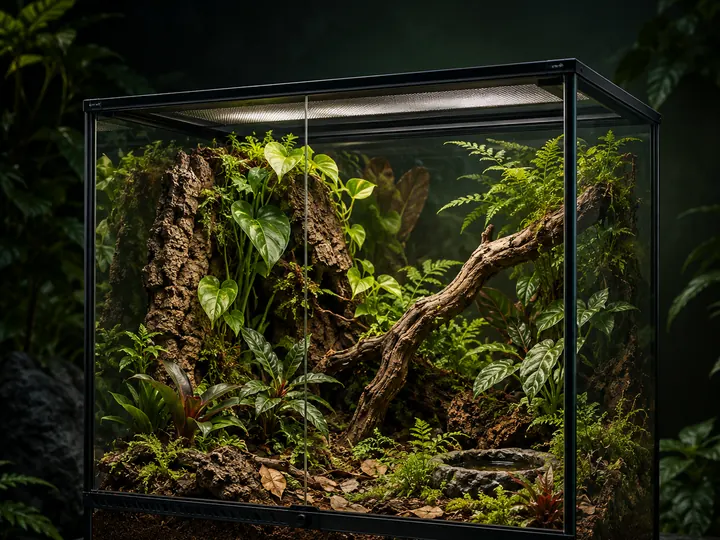 Enclosure Zoo Med ReptiBreeze Open Air Screen Cage, XL (24 x 24 x 48 in) Amazon
 - Enclosure Zoo Med ReptiBreeze Open Air Screen Cage, XL (24 x 24 x 48 in) Amazon UK
-
 UVB kit Arcadia ProT5 UVB Kit, Forest 6%, 24W Amazon
 - UVB kit Arcadia ProT5 UVB Kit, Forest 6%, 24W Amazon UK
-
 Basking bulbs Zoo Med Repti Basking Spot Lamp, 50W Amazon
 - Basking bulbs LUCKY HERP Reptile Basking Bulb, 50W (2 pack, E27) Amazon UK
- Thermostat Reptile dimming thermostat for heat lamps Amazon
- Thermostat Habistat Dimming Thermostat, 600W Amazon UK
-
 Misting system MistKing Starter Misting System Amazon
 - Misting system MistKing Starter Misting System Amazon UK
The short version
| Group | What you need |
|---|---|
| Enclosure | Screen or hybrid cage, at least 24 x 24 x 48 in tall (60 x 60 x 120 cm), a stand, a drainage tray or bucket |
| Heat | Two 50W white basking bulbs, a dome fixture, a dimming thermostat |
| Light | A T5 HO UVB tube (5% or 6%), a daylight lamp, a timer |
| Water | Misting (hand sprayer or automatic system), a dripper, a plan for drainage |
| Furniture | Live, pesticide-free plants, a network of branches and vines |
| Food | Live insects, gut-load, calcium powder, a multivitamin |
| Monitoring | Infrared temperature gun, thermometer and hygrometer with probes |
1. Enclosure
What to get: a tall screen or hybrid enclosure at least 24 x 24 x 48 inches tall (60 x 60 x 120 cm) for one adult. That is the minimum both the Long Island Bird and Exotics vet clinic (LIBEVC) and ReptiFiles give. LIBEVC prefers 36 x 30 x 48 inches (91 x 76 x 122 cm), especially for large males. PetMD’s vet-written care sheet gives at least 3 feet in every direction for adults.
Why it matters: chameleons live up in branches and need fresh air moving around them. The RVC says enclosures should be taller than they are wide, and that mesh sides give the good ventilation these lizards need. LIBEVC advises against fully enclosed glass tanks.
Look for: a front door, an open screen top that can carry lamps, and a stand to raise it. One chameleon per enclosure: LIBEVC, ReptiFiles and PetMD all say to house them alone.
Screen enclosure
Zoo Med ReptiBreeze Open Air Screen Cage, XL (24 x 24 x 48 in)
A tall aluminum screen cage at exactly the minimum size the Long Island Bird and Exotics vet clinic and ReptiFiles give for one adult veiled chameleon. Screen sides give the airflow chameleons need, and the height suits a lizard that lives in the branches.
- Size
- 24 x 24 x 48 in (61 x 61 x 122 cm)
- Material
- Black anodized aluminum screen
- Doors
- Large front door, plus a bottom door for cleaning
- Model
- NT-13 (per Zoo Med)
- Assembly
- Hardware included, screwdriver only
Best for
One adult veiled chameleon, in either market, set on a stand with a drainage tray below.
Worth knowing
Screen lets humidity escape fast in a dry home; ReptiFiles and the clinic suggest covering some sides with clear or opaque panels if needed. Large males may need more room. The bottom tray is sold separately.
Full detail: Enclosure size.
2. Drainage
What to get: a tray under the enclosure, or a bare floor on risers with a bucket or drain below. LIBEVC recommends a bare-bottom enclosure with drainage, and ReptiFiles says most keepers use a drain at the bottom.
Why it matters: you will be spraying water into the cage at least twice a day. Without drainage, the floor turns into a puddle that grows mold and bacteria. VCA also warns against loose, particle-type bedding a chameleon could swallow.
3. Heat
What to get:
- Two 50W white basking bulbs. Both ReptiFiles and LIBEVC suggest this pair rather than one large bulb.
- A dome fixture that holds both, resting on the screen top.
- A dimming thermostat, with its probe at the basking branch.
Why it matters: the basking spot needs to be warm, not scorching. Sources give a basking range of about 85 to 95°F (29 to 35°C), with the rest of the enclosure cooler. LIBEVC warns that veiled chameleons may not move away from overheating, which risks burns. A thermostat is your safety net.
Dual basking dome
Zoo Med Combo Mini Deep Dome Lamp Fixture (2 x 5.5 in)
Two 5.5 inch deep domes on one fixture, each with its own switch. It holds both 50W basking bulbs side by side on top of a screen cage, so the warm patch covers the whole chameleon.
- Domes
- Two 5.5 in (14 cm) deep domes
- Sockets
- Ceramic, up to 100W each (per Zoo Med)
- Switches
- One per dome
Best for
The two-bulb basking spot, in either market.
Worth knowing
Zoo Med rates each socket for up to 100W. Rest it flat on the screen, never inside where a chameleon can climb onto it.
Dimming thermostat (UK)
Habistat Dimming Thermostat, 600W
A UK-made dimming thermostat designed for heat bulbs. It turns the power up or down to hold your set temperature rather than switching the bulb fully on and off.
- Type
- Dimming thermostat
- Max load
- 600W
- Min load
- 40W
Best for
UK setups running two 50W basking bulbs.
Worth knowing
It needs a minimum load of 40W, which two 50W bulbs easily meet.
4. UVB and daylight
What to get:
- A linear T5 HO UVB tube, about 22 inches long, in 5% or 6% strength. LIBEVC and ReptiFiles both name the Arcadia T5 HO 6% and the Zoo Med ReptiSun T5 HO 5.0.
- A bright 6500K daylight lamp, LED or fluorescent. Both sources recommend one alongside the UVB.
- A plug-in timer for 12 hours of light and 12 hours of darkness.
Why it matters: without UVB, a chameleon cannot use calcium properly and develops metabolic bone disease. LIBEVC aims for a UV index (UVI) of 2.5 to 3.0 at the basking spot, and ReptiFiles about 3.0. The Reptile Centre lists veiled chameleons in Ferguson zone 3, the partial or open-sun baskers.
UVB kit
Arcadia ProT5 UVB Kit, Forest 6%, 24W
A complete high-output T5 UVB kit with the 6% Forest lamp, a reflector and a linkable controller. The Long Island Bird and Exotics vet clinic and ReptiFiles both name a 22 inch Arcadia T5 HO 6% as a suitable UVB lamp for a veiled chameleon.
- Lamp
- T5 HO, 6% UVB (Forest)
- Wattage
- 24W
- Fitting length
- About 22.5 in (570 mm)
- In the box
- Controller, lamp, reflector, link cable
- Mounting
- Inside the enclosure or over mesh
Best for
Lying across the top of a 24 x 24 x 48 in screen cage, over the basking branch.
Worth knowing
Screen mesh cuts UVB (the clinic says by 30 to 50%), so the branch height matters more than the box. Aim for a UV index of about 2.5 to 3.0 at the chameleon, checked with a meter, and keep lower branches for shade.
Full detail: Lighting and heating.
5. Water and misting
What to get:
- A misting method. A pump-up pressure sprayer works; an automatic system such as the MistKing Starter (named by both ReptiFiles and LIBEVC) makes it far easier.
- A dripper that drips onto leaves.
- Optional: a cool-mist fogger for night humidity, run with distilled water.
Why it matters: chameleons drink droplets from leaves, not from standing water. PetMD says plainly that they will not drink from a bowl. LIBEVC asks for misting at least twice a day, morning and evening. VCA links poor humidity to dehydration and severe kidney disease.
Automatic misting
MistKing Starter Misting System
A pump, timer and nozzle kit that mists the cage on a schedule. ReptiFiles and the Long Island Bird and Exotics vet clinic both name the MistKing Starter as the automatic option for the misting a veiled chameleon needs to drink.
- In the kit (US 5th Gen)
- 24V pump, timer, one nozzle assembly, 15 ft of tubing, reservoir filter
- Nozzles
- Expandable to 10 (US 5th Gen listing)
- UK listing
- Version 4.0
Best for
Keepers who work long hours or travel, and anyone who wants misting to happen on time every day.
Worth knowing
Plan where the water goes: a screen cage needs a drainage tray or bucket below. Clean the reservoir and nozzles regularly, as the clinic advises, to stop mold and bacteria.
6. Plants and branches
What to get:
- Live, nontoxic, pesticide-free plants. LIBEVC suggests pothos on the walls with an umbrella plant (schefflera) and ficus at the base. ReptiFiles and PetMD list hibiscus, croton and others too.
- A network of mostly horizontal branches and vines at different heights. LIBEVC says branches should be thick enough for the chameleon’s toes to wrap about halfway around.
- A basking branch placed so the chameleon’s back sits about 6 inches (15 cm) below the screen top, as ReptiFiles describes.
Why it matters: dense leaves give a chameleon places to hide and feel safe, catch misting droplets to drink, and hold humidity. PetMD says to avoid silk plants because they cannot absorb water.
7. Food and supplements
What to get:
- A supply of live feeder insects, such as crickets, dubia roaches, silkworms and black soldier fly larvae (LIBEVC’s list).
- Gut-load food for the insects.
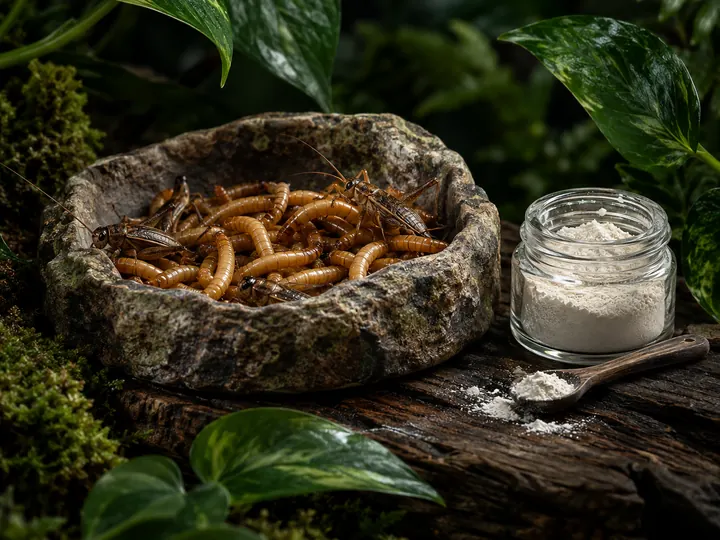
- Calcium powder without D3, and a multivitamin. Schedules differ, so agree one plan with your vet.
Calcium powder
Zoo Med Repti Calcium without D3
A fine calcium carbonate powder with no vitamin D3, for dusting insects. The Long Island Bird and Exotics vet clinic recommends calcium carbonate without D3 as the routine dusting for veiled chameleons.
- Calcium source
- Calcium carbonate
- Vitamin D3
- None
- Size
- 8 oz (US listing); 85 g (UK listing)
Best for
Routine dusting for a chameleon under good UVB, which makes its own vitamin D3.
Worth knowing
Sources give different schedules, so agree one with your vet. A light coat is enough.
Full detail: Diet and hydration.
8. Monitoring
What to get:
- An infrared temperature gun for the basking branch.
- A thermometer and hygrometer with probes. ReptiFiles and LIBEVC say to measure humidity in the middle of the enclosure.
- Optional but useful: a Solarmeter 6.5 UV index meter, which both sources use to set the branch height.
Temperature gun
Etekcity Infrared Thermometer
A handheld infrared gun that reads surface temperature without touching anything. The Long Island Bird and Exotics vet clinic suggests a probe thermometer or temperature gun to check the basking spot.
- Measures
- Surface temperature, no contact
- Units
- °F and °C
Best for
Checking the top of the basking branch, where the chameleon actually sits.
Worth knowing
It reads surfaces, not air. Pair it with a probe thermometer for air temperature and overnight lows.
The order to set it up
- Choose the spot. LIBEVC says to keep the enclosure away from drafts, vents, busy walkways and windows with direct sun, and out of reach of cats and dogs.
- Set up the stand and drainage before anything goes in the cage.
- Add plants in pots, then branches and vines, building a dense area and an open, well-lit area near the top.
- Lay the UVB tube and daylight lamp across the top, over the basking branch.
- Add the basking dome next to the UVB, with the thermostat probe at the basking branch.
- Put all lights on a timer, 12 hours on and 12 off.
- Install the mister and dripper, and check where the water lands and drains.
Test it for several days
Run everything as if the chameleon were already there, and check:
- Basking branch: read the top of the branch with the temperature gun after the lamps have warmed up. Aim within 85 to 95°F (29 to 35°C) and adjust bulb height, wattage or thermostat setting.
- Ambient: the rest of the enclosure should sit cooler, roughly 72 to 85°F (22 to 29°C) depending on source.
- Night: ReptiFiles allows a drop to 55 to 65°F (13 to 18°C) and LIBEVC to 60 to 70°F (16 to 21°C). The RVC asks for no lower than 73°F (23°C). Pick a floor with your vet and add non-light heat only if your room falls below it.
- Humidity: ReptiFiles and LIBEVC aim for about 40 to 50% in the day, rising to 80 to 100% at night.
- UVB: measure UVI at the basking branch if you have a meter.
- Water: the floor should drain, not pool.
Before you bring the chameleon home
- Find a reptile vet now. The ARAV has a Find A Vet directory. LIBEVC recommends a check-up within the first few weeks, including a fecal test for parasites.
- Stock a week of insects and start gut-loading them.
- Read your first week at home.
Go deeper
This is general husbandry guidance from the sources listed below, not veterinary advice for your own animal.
Height, airflow, UVB and water that falls like rain: get those four working before the chameleon arrives, and everything else is fine-tuning.