
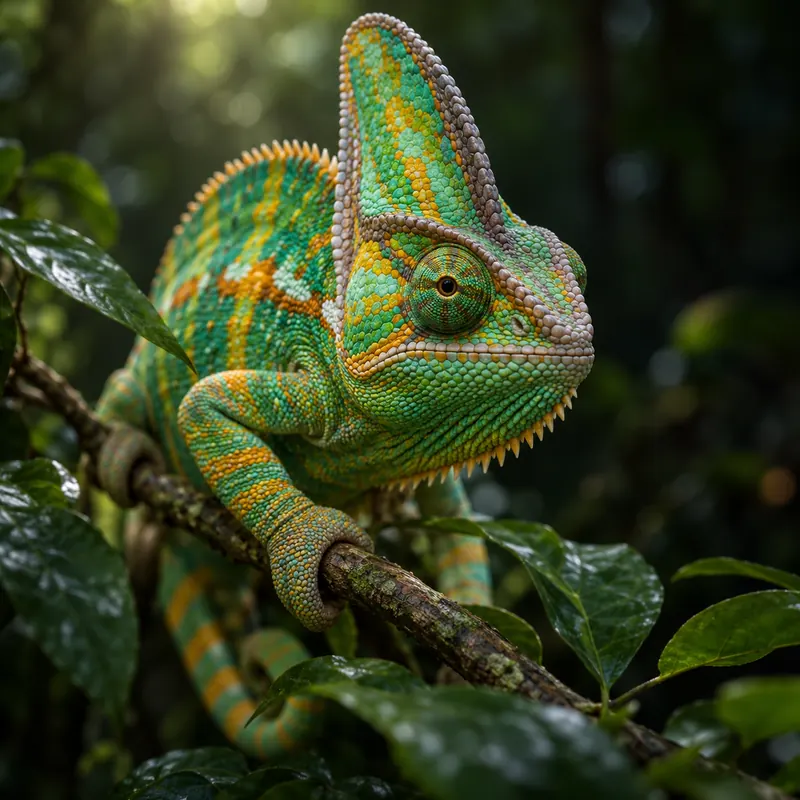
Short answers to the questions people ask most about veiled chameleons. Each one links to a fuller guide where there is more to say.
How long do veiled chameleons live?
The RVC says 4 to 7 years in captivity, and ReptiFiles says up to 6 to 8 years for a well-kept animal. Reptiles Magazine gives about 6 to 8 years for males and 4 to 6 for females. Females usually live shorter lives, partly because producing eggs takes so much energy.
How big do they get?
Reptiles Magazine puts adult males at about 2 feet (60 cm) long including the tail, and females at about 18 inches (45 cm). PetMD gives 18 to 24 inches (45 to 60 cm) and says males tend to be larger and more colorful. Hatchlings are only 3 to 4 inches (8 to 10 cm) long (Reptiles Magazine).
Are veiled chameleons good for beginners?
Not usually. The RVC calls the veiled probably the easiest chameleon to keep, but says all chameleons are high-maintenance and not suitable for first-time reptile keepers. ReptiFiles rates care difficulty as high. The daily misting, careful UVB and hands-off nature are the main reasons. If you have kept other reptiles and want an animal to watch rather than hold, a veiled can be a good next step.
What size enclosure does a veiled chameleon need?
At least 24 x 24 x 48 inches tall (60 x 60 x 120 cm) for one adult, according to the Long Island Bird and Exotics vet clinic (LIBEVC) and ReptiFiles. LIBEVC prefers 36 x 30 x 48 inches (91 x 76 x 122 cm) for large males. Screen or hybrid, not a closed glass tank. Full detail: enclosure size.
Do chameleons drink from a water bowl, and how often should I mist?
No. PetMD says chameleons will not drink from a bowl; they drink droplets from leaves and other surfaces. Water has to come from misting, a dripper or an automatic misting system. LIBEVC says to mist at least twice a day, morning and evening, with clean, room-temperature water. ReptiFiles adds a light mid-afternoon mist or a dripper. Make sure the enclosure drains, so water never pools on the floor. More in diet and hydration.
How hot should the basking spot be?
About 85 to 95°F (29 to 35°C) across sources: ReptiFiles says 85°F (29°C), while LIBEVC and the RVC say 95°F (35°C). The rest of the enclosure should be cooler. LIBEVC warns that veiled chameleons may not move away from heat that is burning them, so always use a thermostat. See lighting and heating.
Do they need heat at night?
Usually not, if your home stays reasonably warm. ReptiFiles allows nights of 55 to 65°F (13 to 18°C) and LIBEVC 60 to 70°F (16 to 21°C), while the RVC asks for no lower than 73°F (23°C). If you need night heat, use one that gives no light, on a thermostat. All lights off at night.
What UVB light do they need?
A linear T5 HO tube in 5% or 6% strength, such as the Arcadia T5 HO 6% or Zoo Med ReptiSun T5 HO 5.0, which LIBEVC and ReptiFiles both name. Aim for a UV index of about 2.5 to 3.0 at the basking branch. Screen mesh blocks some of the UVB, so the branch sits fairly close to the top.
Do they need live plants?
They are strongly recommended. Live plants hold misting droplets for drinking, raise humidity and give the chameleon cover. LIBEVC suggests pothos, umbrella plant and ficus; ReptiFiles and PetMD list hibiscus, croton and other nontoxic choices. Buy pesticide-free plants and rinse them first. PetMD says to avoid silk plants because they cannot absorb water.
What do veiled chameleons eat?
Live insects such as crickets, roaches, silkworms and black soldier fly larvae, gut-loaded and lightly dusted. LIBEVC feeds juveniles as much as they will take once or twice a day, and adults 2 to 3 insects every other day. Veiled chameleons may also nibble greens or edible flowers. Full detail: diet and hydration.
Can I handle my chameleon?
Only when you need to. LIBEVC says most veiled chameleons do not tolerate handling well, and PetMD says frequent handling can cause stress or aggression. Let a new chameleon settle for 1 to 2 weeks first (ReptiFiles). When you do move it, let it walk onto your hand and never grab it.
Can two chameleons live together?
No. LIBEVC says housing them together causes stress, aggression and injury, and PetMD and ReptiFiles also say to house them alone. Keep one per enclosure.
Will my female lay eggs without a male?
Yes. Reptiles Magazine says females still produce infertile clutches, and VCA notes veiled chameleons may lay 20 to 70 eggs. VCA links an inadequate nest site to egg binding, which is an emergency. Every female needs a laying container ready, and your vet can talk to you about spaying. See common mistakes.
Why is my chameleon so dark?
Chameleons change color, so one dark moment is not proof of a problem. A chameleon that stays dull or dark for long periods is different: LIBEVC lists dull or dark coloration among signs of illness, and PetMD says a consistently dark color warrants a vet visit. Check temperatures, then call your vet.
What is metabolic bone disease?
A condition where bones become weak and soft because the body cannot use calcium properly. The MSD Veterinary Manual lists poor diet, lack of UVB and too little heat among its causes. LIBEVC lists soft bones, tremors, lethargy, difficulty climbing and paralysis as signs. Good UVB and the right supplements prevent most cases.
How often should a chameleon see a vet?
LIBEVC recommends a check-up within the first few weeks, with a fecal test for parasites, then once a year. The RVC and PetMD also recommend yearly health checks. See a vet sooner for any of the warning signs in your first week.
This is general husbandry guidance from the sources listed below, not veterinary advice for your own animal.
Most chameleon questions have the same answer underneath: give it height, gentle heat, strong UVB and water it can see falling, and leave it in peace. Everything else is detail.