
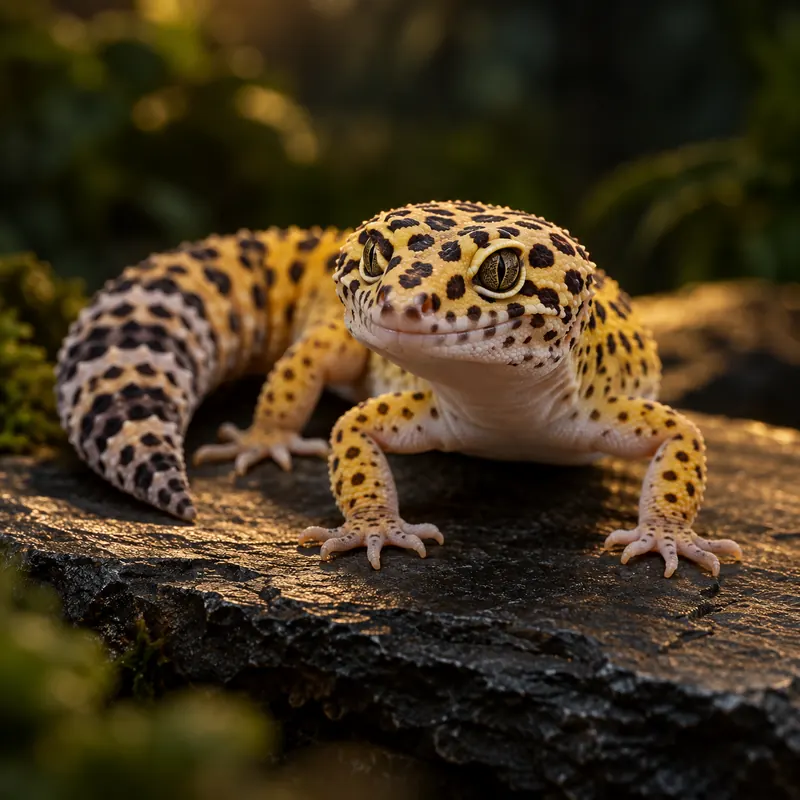
Leopard geckos eat only live insects. No vegetables, no fruit, no pellets. A healthy diet comes down to four things: a mix of feeder insects, the right size and amount, insects that are well fed themselves, and a dusting of calcium.
Staple insects
These can make up most of the diet. ReptiFiles suggests rotating at least three types if you can.
- Crickets. VCA lists commercially raised crickets as the main food.
- Dubia roaches and discoid roaches.
- Mealworms.
- Silkworms.
- Black soldier fly larvae.
- Hornworms, captive-bred only.
The RSPCA also mentions brown crickets, calciworms (black soldier fly larvae) and locusts, which are common UK feeders.
Treats
Higher in fat, so keep them occasional. ReptiFiles says no more than once a week:
- Waxworms
- Butterworms
- Small superworms
The RSPCA also says to feed waxworms sparingly. Fatty treats are useful when a gecko needs to regain weight, for example after losing its tail (ReptiFiles), but should not be the everyday meal.
Never feed
- Wild-caught insects from the yard. PetMD warns some may be toxic, and ReptiFiles says they can make the gecko sick.
- Wild hornworms, which ReptiFiles describes as toxic.
- Dried insects. ReptiFiles advises avoiding them; canned insects are acceptable if the gecko will eat them.
- Fruit, vegetables or meat. Leopard geckos are insectivores.
How big
PetMD says prey should be no longer than the gecko’s head and no wider than half its head width. The RSPCA puts it simply: no bigger than the gecko’s head. Too-large prey can be hard to swallow and digest.
How often, by age
Sources differ a little, so here is the range:
| Age | ReptiFiles | VCA | RSPCA |
|---|---|---|---|
| Juveniles | Daily | Every 1 to 2 days | Daily |
| Young adults | Every 2 to 3 days | ||
| Adults | Every 5 days, once the tail is fatter than the neck | 2 to 3 times a week | Every other day |
PetMD gives every 1 to 2 days for juveniles and three times a week for adults.
How much. ReptiFiles suggests about 2 appropriately sized insects per inch of the gecko’s length, or as many as it eats in about 15 minutes. PetMD says to remove uneaten prey after 10 to 15 minutes.
Watch the tail. A leopard gecko stores fat in its tail. ReptiFiles uses a tail fatter than the neck as the point to move an adult onto less frequent meals. A skinny tail is on PetMD’s list of illness signs, so a tail that is shrinking needs attention.
Do not leave insects loose. ReptiFiles warns that feeders left in the tank all day can bite and injure the gecko. Feed with tongs, from a smooth-sided bowl, or remove leftovers after the meal.
Gut-loading
Gut-loading means feeding the insects well before the gecko eats them, so they carry more nutrition. Sources give different time windows:
- ReptiFiles: 2 to 3 days before feeding, with a commercial gut-load food.
- RSPCA: 24 to 48 hours.
- VCA: at least 24 hours.
- PetMD: 6 to 12 hours.
A day or two of good food covers all of them. ReptiFiles adds that vegetable scraps alone are maintenance, not real gut-loading, and suggests water crystals to keep insects hydrated.
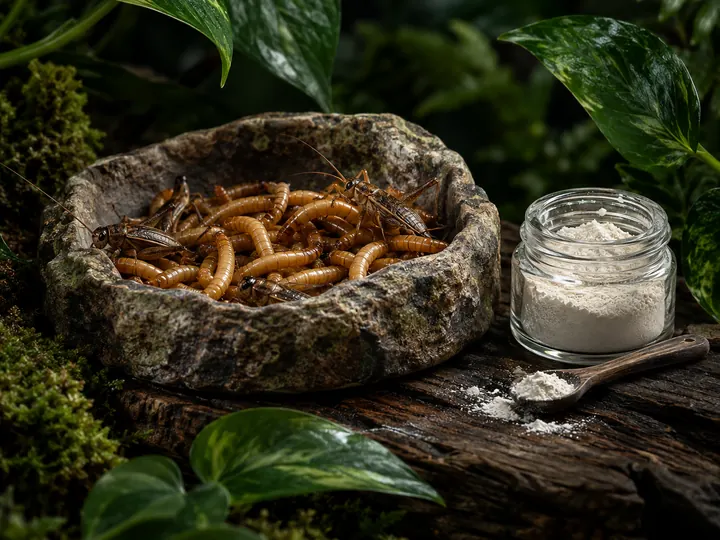
Gut-load
Arcadia InsectFuel Gut Load
A food for feeder insects, given in the days before they are fed to the gecko so they arrive full of nutrition. ReptiFiles lists it as one of the commercial gut-loading options.
- Use
- Gut-load food for feeder insects
Best for
Gut-loading crickets, roaches and worms for a couple of days before feeding.
Worth knowing
Gut-loading does not replace calcium dusting. Do both.
Calcium
Dust insects with calcium powder just before feeding. Put the insects in a bag or tub with a pinch of powder and shake gently until lightly coated.
With or without D3? Vitamin D3 helps the body use calcium. A gecko with UVB can make its own D3 in its skin; one without UVB has to get it from food. ReptiFiles advises:
- If you use UVB: calcium without D3, every feeding.
- If you do not use UVB: calcium with D3.
VCA recommends a phosphorus-free calcium powder. Both VCA and the RSPCA suggest also leaving a small dish of plain calcium in the tank at all times; ReptiFiles says a dish of D3-free calcium is optional, except for egg-laying females, which need more.
Calcium (with UVB)
Arcadia EarthPro CalciumPro Mg
A calcium powder with magnesium and no vitamin D3, for dusting insects. ReptiFiles lists it among the calcium supplements to use when the gecko has UVB.
- Contains
- Calcium and magnesium
- Vitamin D3
- None
- Use
- Dust feeder insects
Best for
Dusting every feeding when you run a UVB lamp.
Worth knowing
D3-free. If you keep a gecko without UVB, ReptiFiles advises a calcium with D3 instead.
Multivitamin
Calcium alone is not enough. ReptiFiles suggests a multivitamin:
- Young geckos: once a week.
- Adults: once every other week.
Choose one with preformed vitamin A (retinol), not only beta carotene, according to ReptiFiles. On multivitamin days, mix it about half and half with your calcium. Some all-in-one powders combine calcium and multivitamin, so check the label to avoid doubling up. Do not add vitamin drops to the water.
Multivitamin
Zoo Med Reptivite Multivitamin (without D3)
A reptile multivitamin and mineral powder for dusting insects. ReptiFiles names the without-D3 version as a multivitamin choice for leopard geckos.
- Type
- Multivitamin and mineral powder
- Version
- Without vitamin D3
Best for
The weekly (young) or every-other-week (adult) multivitamin dusting.
Worth knowing
Do not use it every feeding, and do not put vitamin powder in the water.
Special cases
After tail loss. The tail is a fat store, so a gecko that drops its tail loses a big reserve. ReptiFiles advises feeding more than usual for 2 to 4 weeks afterward, including fattier foods such as waxworms and butterworms. It says pinky mice should not normally be fed, and mentions them only for fattening a gecko after recent tail loss; ask your vet before going that route.
Egg-laying females. Females can lay eggs even without a male. ReptiFiles makes an exception to its “calcium dish is optional” advice for egg-laying females, which need extra calcium. The RSPCA suggests giving females a nest box of moist soil, or a sand and soil mix, to help prevent egg-binding. A female that looks swollen, strains, or stops eating while gravid should see a vet.
Cooler months. The RSPCA notes many leopard geckos eat less and sleep more in winter. Keep offering food on your usual schedule and keep an eye on weight.
A simple weekly routine
- Buy insects and put them on gut-load food with water crystals as soon as they arrive.
- On feeding days, take out enough for one meal, dust them with calcium (and multivitamin on vitamin days), and offer them in the evening.
- Remove leftovers after 10 to 15 minutes.
- Refresh the water bowl daily.
- Note each meal on a calendar or phone note, along with the gecko’s weight every couple of weeks.
Water
A shallow bowl of clean water, always available, changed daily (VCA, RSPCA). It should be shallow enough that the gecko cannot drown. The RSPCA places it at the cool end.
Signs the diet is off
- Weight loss or a shrinking tail.
- Twitching muscles, swollen legs or bendy limbs, which the RSPCA links to metabolic bone disease. Seek a vet urgently.
- Refusing food for weeks outside of a cool-season slowdown.
Appetite naturally drops in the cooler months, which the RSPCA describes as brumation, but the gecko should not lose weight. Weigh your gecko on a kitchen scale every couple of weeks so you notice changes early. If weight falls, see a reptile vet. This is general guidance, not veterinary advice.
Live insects, rotated, well fed, lightly dusted, and never left loose overnight. That routine, plus the right calcium for your lighting, covers almost everything a leopard gecko needs to eat.