
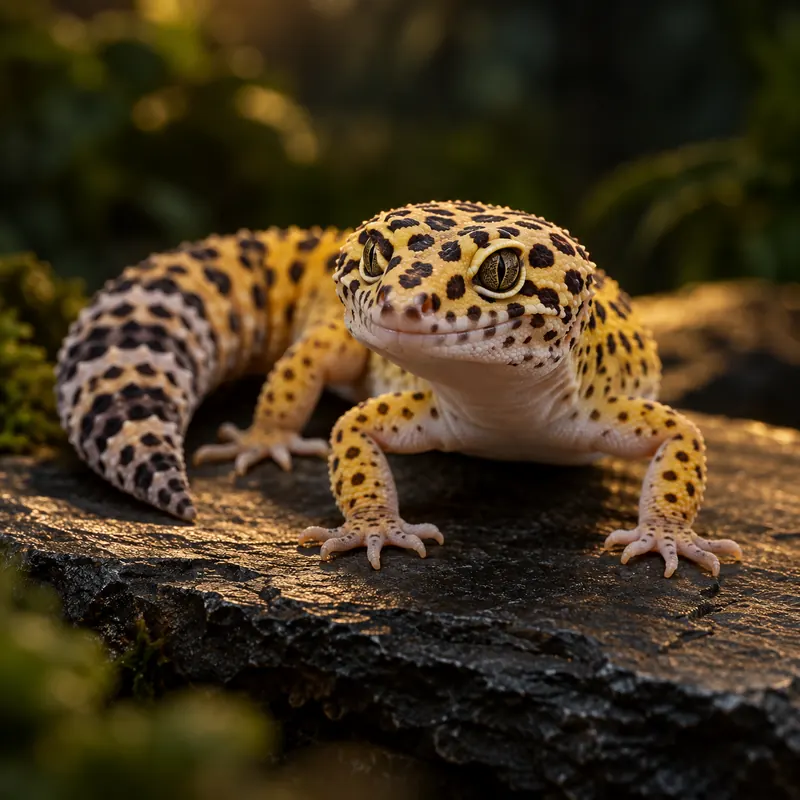
The honest answer to “how big?” is that care sources disagree, and the advice has grown over the years. Older sheets say a 10 gallon tank is enough. Newer husbandry guides ask for something closer to 36 x 18 x 18 inches. Bigger costs more up front, but it is what makes a proper warm-to-cool gradient possible.
What the sources say
| Source | Size for one adult |
|---|---|
| VCA Animal Hospitals | A 10 gallon tank, at least 6 in (15 cm) tall, with a screen top |
| PetMD (written by a vet) | Juveniles can start in 10 gallons, moving to 20 gallons as they grow |
| RSPCA | Minimum 60 cm long x 30 cm deep x 40 cm high (about 24 x 12 x 16 in), “as large as possible” |
| ReptiFiles | No smaller than 36 x 18 x 18 in (about 91 x 46 x 46 cm), with at least 4.5 sq ft of floor |
A 36 x 18 x 18 inch glass tank is usually sold as a 50 gallon. So the range runs from about 10 gallons to about 50, depending on who you ask.
Our take
Plan for 36 x 18 x 18 inches (91 x 46 x 46 cm) if you can. ReptiFiles adds that larger is better as long as the enclosure is laid out well, and the RSPCA’s own wording is “as large as possible.” Here is why the extra length matters in practice:
- The gradient needs distance. The basking spot should reach 94 to 97°F (34 to 36°C) while the cool end sits at 70 to 77°F (21 to 25°C) (ReptiFiles). That is hard to hold in a short tank, where the whole space warms up.
- Three hides need floor space. A warm hide, a cool hide and a humid hide, plus a water bowl and basking stone, crowd a small tank.
- UVB needs shade. A low-UVB species needs somewhere to get away from the lamp.
A smaller tank can work for a hatchling for a while, but buying the adult size first saves buying twice.
Floor space beats height
Leopard geckos live on the ground. ReptiFiles calls floor space “the most important consideration,” and PetMD agrees that floor matters more than height. They will climb low rocks and branches if you give them some, so 18 inches (46 cm) of height is useful, but a long, wide floor comes first.
Glass vs PVC vs wood
| Material | Good | Watch out |
|---|---|---|
| Glass | Easy to see into, easy to clean, widely sold, works with under-tank mats | Loses heat faster in a cold room; heavy |
| PVC | Holds heat and humidity well, light, does not rot | Costs more; check the top mesh if lamps sit outside |
| Wood (melamine vivarium) | Insulates well, common in the UK | Must be sealed against moisture; heavy to move |
ReptiFiles says most keepers prefer glass, and that wood and PVC “insulate very well” if you struggle to keep temperatures stable. Either is fine. Choose on your room temperature and budget.
Screen-only enclosures (all mesh sides) are, in our view, a poor match for a species that needs a warm end at 90°F (32°C) or more: mesh sides let the heat escape.
Front opening
Front doors let you reach in from the side, which is easier for feeding, spot cleaning and coaxing a gecko out of a hide. Most modern glass terrariums and nearly all PVC enclosures open at the front.
Mesh tops and UVB
If the UVB lamp sits on top of a mesh lid, some UVB is blocked. ReptiFiles notes mesh type changes how much gets through, and its distance tables assume about 30 percent is lost. Keep this in mind when you choose a top and set lamp height. See lighting and heating.
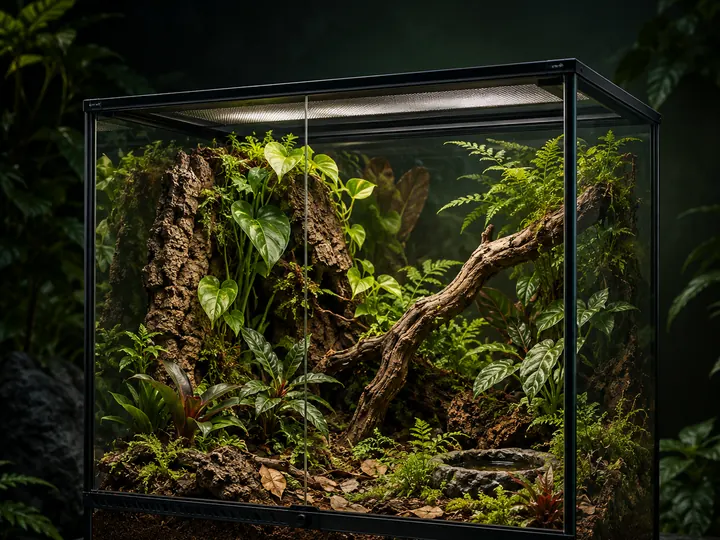
Glass enclosure
Exo Terra Glass Terrarium, 90 x 45 x 45 cm (36 x 18 x 18 in)
Exo Terra's large wide glass terrarium, with dual front-opening doors, a mesh top for lighting, and a raised bottom frame for an under-tank heater. Sold in both the US and UK at the 36 x 18 x 18 inch size.
- Size
- 90 x 45 x 45 cm (36 x 18 x 18 in)
- Access
- Dual front-opening doors
- Top
- Removable mesh cover
Best for
A widely available glass option in either market, at the size most care guides now suggest.
Worth knowing
The mesh top blocks some UVB, so the UVB lamp distance needs to account for it.
Layout
Think of the tank in three zones along its length.
Warm end
- Basking lamp overhead, with a flat stone or slate underneath.
- The warm hide, close to the basking spot. ReptiFiles aims for 90 to 92°F (32 to 33°C) inside it.
- The UVB tube over this end, so UVB and heat line up the way sunlight does.
Middle
- The humid hide, kept at 70 to 80 percent humidity inside (ReptiFiles). ReptiFiles places it in the middle to cool end.
- Low climbing pieces: cork, flat rocks, a sturdy branch.
Cool end
- The cool hide, at 70 to 77°F (21 to 25°C).
- A shallow water bowl. The RSPCA places it at the cool end.
Everywhere: clutter. Plants (real or artificial), cork pieces and rocks give the gecko cover as it crosses between hides. Keep anything climbable well below the lamps so the gecko cannot reach a hot bulb or the mesh under it.
Substrate
This is the most argued-about part of leopard gecko care, so here is each position in its own words.
Solid substrates (everyone agrees these are safe). Paper towels, newspaper or stone tile. PetMD lists paper towels, newspaper, reptile carpet and tile. ReptiFiles calls paper towels and tile acceptable but “not optimal,” since they do not allow digging. Paper towels are the easiest way to check droppings during quarantine.
Loose, natural substrates (sources disagree).
- VCA advises avoiding sand, corncob and crushed walnut shells, which “can block the intestines if swallowed.”
- PetMD does not recommend sand or bark.
- The RSPCA suggests about 50 percent organic soil and 50 percent sand for healthy adults, using clean play sand or reptile sand, and recommends bioactive setups for permanent housing. It also says young geckos should be on non-loose substrates.
- ReptiFiles says sand “can be safe for use with leopard geckos, but ONLY if it is used correctly,” recommends a packed mix of 60 percent topsoil, 30 percent sand and 10 percent clay at least 4 in (10 cm) deep, and says geckos should not go on loose substrate until they have passed quarantine and are healthy. It argues that impaction is “almost always caused by bad husbandry,” such as wrong temperatures.
Where they meet: loose substrate is for healthy adults only, after quarantine, in a setup with correct heat. Juveniles and new arrivals start on something solid.
Avoid (every source that mentions them agrees):
- Calcium or vitamin sand (calcisand). ReptiFiles warns it can neutralize stomach acid; the RSPCA says to avoid it.
- Walnut shell, corncob, wood chips and beech chips (VCA, ReptiFiles, RSPCA).
- Reptile carpet is disputed: VCA and PetMD list it as fine, while ReptiFiles lists it among the substrates to avoid.

Burrowing substrate
Zoo Med Excavator Clay Burrowing Substrate
A clay substrate that is wetted, shaped and left to dry, so it holds tunnels and ledges. ReptiFiles lists it as an acceptable option and as an ingredient in a soil, sand and clay mix.
- Type
- Burrowing clay, dries hard
- Use
- Alone or mixed with soil and sand
Best for
A solid, diggable floor for a healthy adult that has finished quarantine.
Worth knowing
It needs days to dry fully before the gecko goes in. Juveniles and new arrivals are better on a solid surface first.
Where to put the enclosure
Somewhere with a steady room temperature, away from a sunny window (glass tanks overheat fast in direct sun), radiators, air vents and drafts. A sturdy stand at about waist height makes daily checks easier.
Buy the adult size once, give the floor three distinct zones, and start on a solid surface. You can always add a natural substrate later; you cannot easily make a short tank longer.