
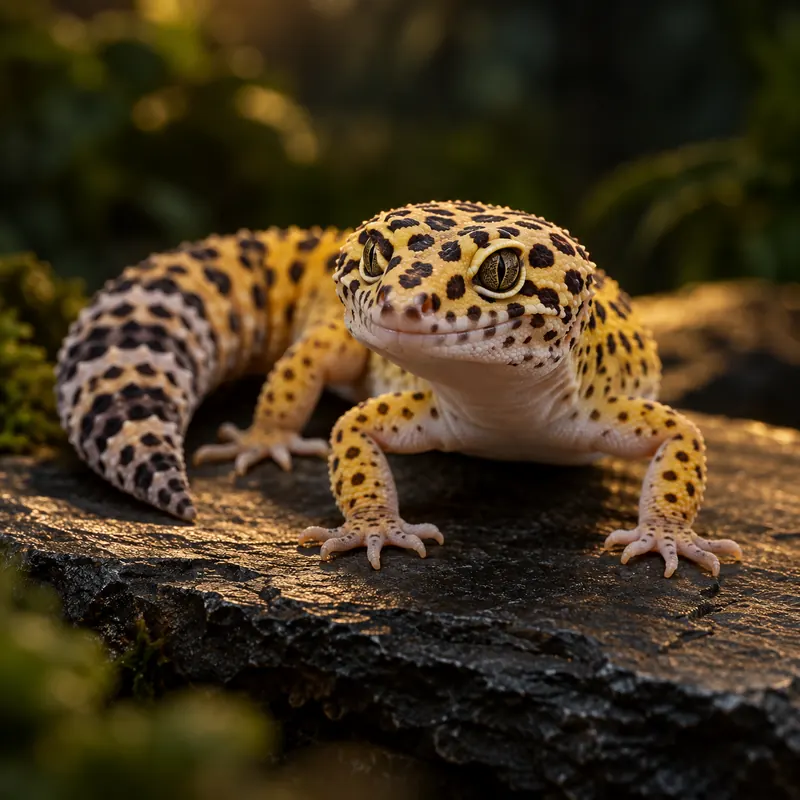
A leopard gecko cannot make its own body heat. It warms up on a hot surface, cools off in the shade, and digests its food only when it is warm enough. Your job is to build a range of temperatures from one end of the tank to the other, keep it steady with a thermostat, and add a gentle amount of UVB.
The temperature gradient
ReptiFiles gives the most detailed targets, and they are surface temperatures (what a temp gun reads on the floor or stone):
| Zone | Target |
|---|---|
| Basking surface (under the lamp) | 94 to 97°F (34 to 36°C) |
| Inside the warm hide | 90 to 92°F (32 to 33°C) |
| Cool end | 70 to 77°F (21 to 25°C) |
| Night | Can drop to about 60°F (16°C) |
Other sources give air temperatures, which run lower than a hot stone:
- RSPCA: basking zone 28 to 30°C (82 to 86°F), cool end 24 to 26°C (75 to 79°F).
- PetMD: warm end 88 to 90°F (31 to 32°C), cool end 73 to 75°F (23 to 24°C).
- VCA: around the mid 80s °F (about 30°C) during the day.
These numbers are less far apart than they look. A basking stone under a lamp is always hotter than the air a few inches above it. Measure the surface with a temp gun and the air with a probe thermometer, and aim for a warm end in the high 80s to low 90s °F (about 31 to 33°C) of air with a hotter stone right under the lamp.
Night temperatures
Leopard geckos do well with a cooler night. The sources give a range:
- ReptiFiles: temperatures can drop to about 60°F (16°C) at night.
- RSPCA: turn the heat off at night, but add heat if the room falls below 18°C (64°F).
- VCA: nights as low as 70°F (21°C).
If your home stays around normal room temperature at night, you may not need night heat at all. If it gets colder, use a heat source that gives off no visible light, on a thermostat. ReptiFiles suggests a ceramic heat emitter in a caged fixture. A deep heat projector on a dimming thermostat also works. The RSPCA mentions a heat mat set to 30°C as an alternative.
Never use colored night bulbs. ReptiFiles advises against red and black bulbs, and warns that blue light may damage reptiles’ eyes. Darkness at night is part of a healthy day and night cycle.
Overhead heat vs belly heat
There are two ways to warm a leopard gecko, and you will see keepers argue for each.
Overhead heat (halogen or deep heat projector). A lamp above warms the basking stone and the gecko’s back, the way the sun warms a rock. ReptiFiles calls halogen or incandescent heat lamps the best option, starting around 50 watts for halogen. The RSPCA suggests a 60 to 100 watt ceramic or basking lamp.
Belly heat (heat mat). A mat under the glass warms the floor of the warm hide. PetMD lists under-tank heaters as one option alongside overhead ceramic heaters and bulbs. ReptiFiles says mats must be on a thermostat, placed under the warm hide, and covered with about an inch of substrate, with the probe inside the hide.
Which to choose. Newer guides such as ReptiFiles favor overhead heat as the main source, because it warms a basking spot and the air together, and a stone under the lamp stores heat for the gecko’s belly. ReptiFiles notes that a warm hide at 90 to 92°F gives enough belly heat for digestion. Many keepers use a lamp as the main heat and add a mat only if the warm hide runs cool.

Basking lamp
Arcadia Halogen Basking Spot, 50W
A 50 watt halogen basking lamp with an E27 screw fitting and a built-in reflector. Halogen gives light and heat from above, the way the sun warms a rock, which ReptiFiles rates as the best daytime heat for leopard geckos.
- Power
- 50W
- Fitting
- E27 screw
- Beam
- 25 degree spot
- Control
- Dimmable, use with a dimming thermostat
Best for
The main daytime heat source over a flat basking stone at the warm end.
Worth knowing
Needs a dome with a ceramic socket and a dimming thermostat. Never let the gecko reach the bulb.
Placement
- Lamp at one end, in a deep dome with a ceramic socket. ReptiFiles describes a 5.5 inch deep dome at the far end of the tank.
- Flat slate or stone directly under it.
- Nothing climbable near the lamp. VCA says the gecko should stay at least 6 inches (15 cm) from a heat light, to avoid burns.
- Heat rocks are never a good idea. VCA warns they create hot spots, and PetMD says they should never be used.
Thermostats are mandatory
Every heat source needs a thermostat. A lamp or mat on its own keeps heating no matter how hot the tank gets, and a gecko sitting on an overheated mat can be burned before it moves.
Two types:
- Dimming (proportional) thermostats turn the power up and down smoothly. Use these for halogen bulbs and deep heat projectors; ReptiFiles says deep heat projectors need one.
- On/off thermostats cut power completely and switch it back on. Fine for heat mats. With a bulb, they make the light flick on and off.
Probe placement:
- Lamp: the probe goes in the basking area.
- Mat: the probe goes inside the warm hide, on the floor.
Check the thermostat. The RSPCA advises checking temperatures every day with digital or infrared thermometers, because thermostats may be inaccurate. Set the thermostat, then confirm the real number with your own gauges.
Dimming thermostat (UK)
Habistat Dimming Thermostat, 600W
A dimming thermostat that gives the heater a smooth, variable supply of power instead of switching it on and off. Made for heat bulbs, and also works with ceramic heaters and heat mats. Sold in standard and high range versions.
- Control
- Dimming (variable voltage)
- Load
- 40W minimum, 600W maximum at 230V
- Probe
- Waterproof
- Guarantee
- 5 years
Best for
UK keepers running a halogen or deep heat projector, which need dimming control.
Worth knowing
Needs a minimum 40W load. Check which range version you buy matches your basking target.
Thermostat for heat mats
Inkbird ITC-306T Pre-Wired Heating Thermostat
A plug-in on/off thermostat with a temperature probe, two heating outlets and separate day and night set points on a 24 hour timer. ReptiFiles suggests it for heat mats.
- Type
- On/off (non-proportional)
- Outlets
- 2 heating outlets
- Timer
- Day and night set points, 24 hour cycle
- Probe
- Wired temperature sensor
Best for
Controlling an under-tank heat mat, with a lower set point at night.
Worth knowing
It switches power fully on and off, so halogen bulbs will flick on and off. Use a dimming thermostat for bulbs and deep heat projectors.
Measuring: temp gun and probe
You need two tools, because they measure different things.
- Infrared temp gun: reads surfaces. Point it at the basking stone, the warm hide floor and the cool end floor. ReptiFiles names the Etekcity Lasergrip 774.
- Digital probe thermometer and hygrometer: reads air temperature and humidity where the probe sits. ReptiFiles suggests a combined probe thermometer and hygrometer.
Check morning and evening for the first week or two, and whenever the season changes.

Temp gun
Etekcity Lasergrip 774 Infrared Thermometer
A handheld infrared "temp gun" that reads surface temperature from a distance. ReptiFiles names this model for mapping the basking spot and the rest of the floor.
- Measures
- Surface temperature
Best for
Checking basking surface temperatures, which air thermometers cannot measure.
Worth knowing
It reads surfaces, not air. Pair it with a probe thermometer for air temperature and humidity.
Humidity
ReptiFiles gives 30 to 40 percent for the enclosure overall, with short spikes being fine if the tank is well ventilated. The RSPCA gives about 30 to 40 percent at the cool end. Inside the humid hide, ReptiFiles aims for 70 to 80 percent. The humid hide is where most of the moisture should be, not the whole tank.
UVB for a dawn-and-dusk species
Leopard geckos are crepuscular: most active around dawn and dusk. For years that was taken to mean they did not need UVB. Current guidance leans the other way, but sources word it differently:
- VCA: UVB is “not required but is recommended,” with the light 10 to 12 inches (25 to 30 cm) from the gecko.
- PetMD: ultraviolet light has recently been recommended for calcium absorption and immune function.
- RSPCA: use a 2 to 5 percent UVB tube over the hot end, giving about UVI 0.7 in the basking zone and falling to zero in the shade.
- ReptiFiles: basking UVI of 0.5 to 1.5 for normal-colored geckos, and no more than 0.5 to 0.7 for albino, patternless and other low-pigment morphs.
If you skip UVB, ReptiFiles advises using a calcium supplement with vitamin D3 instead (see diet). If you provide UVB, use calcium without D3.
Ferguson zone 1 and the shade method
The UV-Tool (Baines and colleagues, Journal of Zoo and Aquarium Research, 2016) sorts reptiles into four “Ferguson zones” by how much UV they get in the wild. Exo Terra’s summary of the zones lists the leopard gecko in zone 1, “crepuscular or shade dweller,” with an average UV index of 0 to 0.7 and maximum readings of 0.6 to 1.4.
In practice that means:
- A low-output lamp, not a desert-strength one.
- Over the warm end only, so UVB and heat line up.
- Plenty of shade. The hides and the cool end should get little or no UVB, so the gecko can choose its dose.
Which lamp, and how far
A linear T5 tube spreads UVB evenly along the warm end. ReptiFiles’ distance guide for the Arcadia ShadeDweller 7% (assuming a mesh top that blocks about 30 percent) is:
| Lamp position | Normal-colored gecko | Albino or low-pigment morph |
|---|---|---|
| Above a mesh top | 10 to 18 in (25 to 45 cm) | 16 to 18 in (40 to 45 cm) |
| Inside, no mesh | 12 to 20 in (30 to 50 cm) | 18 to 20 in (45 to 50 cm) |
Distances are measured to where the gecko’s back will be, not to the floor. Mesh and lamps vary, so the only way to know the real UV index is a UV meter. ReptiFiles calls a Solarmeter 6.5 the tool for the job. The RSPCA says red-eyed morphs need vet advice on UVB.
Replace the tube every 12 months. ReptiFiles notes UVB output declines “even when the visible light remains.”
Avoid coil (compact) UVB bulbs. A tube gives a wide, even gradient; a coil puts a narrow, intense beam in one spot.

UVB kit
Arcadia ShadeDweller ProT5 UVB Kit (7%, 8W)
A complete low-output T5 UVB kit: an 8 watt ShadeDweller lamp (7% UVB, 17% UVA) with the fitting, mounting hardware, power cable and a link cable. Arcadia makes it for crepuscular and shade-dwelling species, and leopard geckos are one of its listed uses.
- Lamp
- 8W T5, 7% UVB and 17% UVA
- Kit includes
- Fitting, switch, fixings, power cable, link cable
- Mounting
- Inside a vivarium or on a mesh top
- Lamp life
- 12 months
Best for
Low-level UVB over the warm end, leaving the rest of the enclosure shaded.
Worth knowing
UVB output fades before the visible light does. Replace the lamp every 12 months, and place it with a mesh top in mind.
Light schedule
- RSPCA: 12 hours on, 12 hours off.
- ReptiFiles: about 14 hours in summer and 12 in winter. It suggests heat on at sunrise and off at sunset, with the UVB starting a little after the heat and switching off a little before.
A plug-in timer or a thermostat with a timer keeps this consistent.
When something is wrong
Signs that heat or UVB may be off include a gecko that will not leave the cool end, will not eat for weeks, or sits under the lamp all day. Muscle twitching, swollen legs or soft, bending bones can mean metabolic bone disease, which the RSPCA links mainly to a lack of UVB; it advises urgent vet care. This is general guidance, not veterinary advice, so see a reptile vet if anything looks off.
Heat from above, a thermostat on every heater, a gentle UVB tube over the warm end, and shade everywhere else. Then measure, because a number on a thermostat dial is only a promise until your temp gun confirms it.