
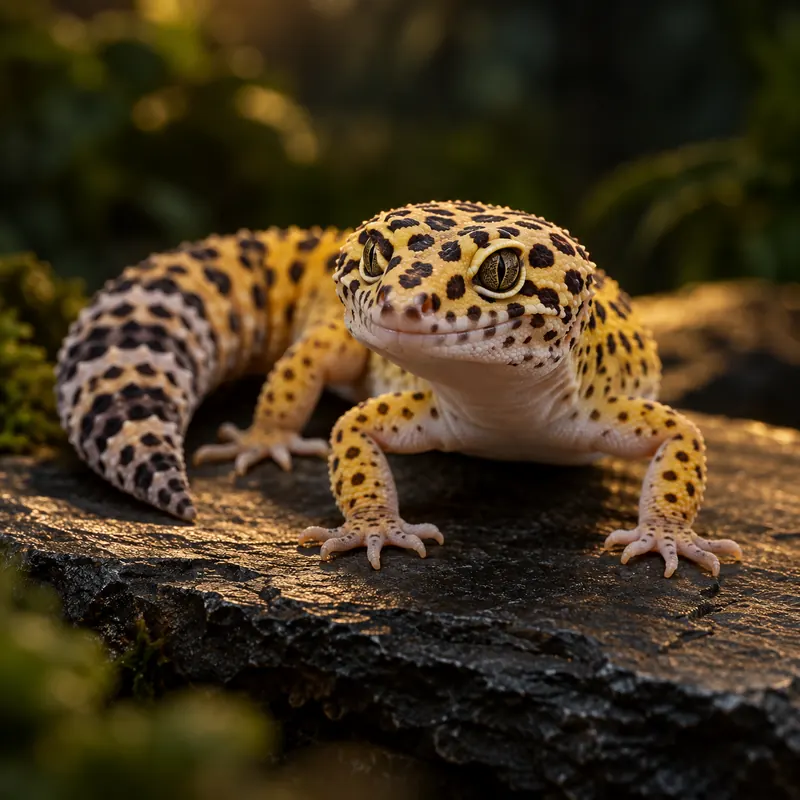
A leopard gecko needs less gear than most reptiles, but every piece matters. Get the enclosure, heat, thermostat, light, hides and supplements in place, run the whole setup for about a week, and only bring the gecko home once the temperatures read right every day.
This page is the full list, grouped the way you will set it up. Each group links to a deeper guide if you want the detail.
The core kit
-
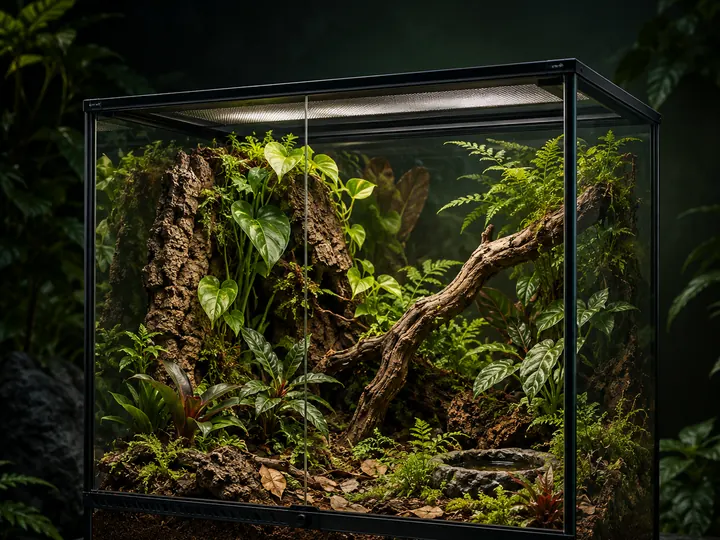 Enclosure REPTI ZOO 50 Gallon Glass Terrarium (36 x 18 x 18 in) Amazon
 - Enclosure Exo Terra Glass Terrarium, 90 x 45 x 45 cm (36 x 18 x 18 in) Amazon UK
-
 UVB kit Arcadia ShadeDweller ProT5 UVB Kit (7%, 8W) Amazon
 - UVB kit Arcadia ShadeDweller ProT5 UVB Kit (7%, 8W) Amazon UK
-
 Basking lamp Arcadia Halogen Basking Spot, 50W Amazon
 - Basking lamp Arcadia Halogen Basking Spot, 50W Amazon UK
- Thermostat Inkbird ITC-306T Pre-Wired Heating Thermostat Amazon
- Thermostat Habistat Dimming Thermostat, 600W Amazon UK
-
 Temp gun Etekcity Lasergrip 774 Infrared Thermometer Amazon
 - Temp gun Etekcity Lasergrip 774 Infrared Thermometer Amazon UK
The short version
| Group | What you need |
|---|---|
| Enclosure | 36 x 18 x 18 in (91 x 46 x 46 cm) or larger, front-opening, secure lid |
| Heat | Overhead heat lamp (halogen) in a dome, optional heat mat, a thermostat for every heat source |
| Light | Low-level T5 UVB kit, a timer |
| Floor and furniture | Substrate, three hides (warm, cool, humid), a flat basking stone, clutter |
| Food | Live insects, gut-load food, calcium powder, multivitamin, a shallow water bowl |
| Monitoring | Infrared temp gun, digital thermometer and hygrometer with a probe |
1. Enclosure
Size. Sources disagree here, so it helps to know the range. VCA Animal Hospitals says a single gecko can live in a 10 gallon tank. The RSPCA sets its minimum at 60 x 40 x 30 cm (about 24 x 16 x 12 in) and says bigger is better. ReptiFiles recommends no smaller than 36 x 18 x 18 inches (about 91 x 46 x 46 cm), with at least 4.5 square feet of floor. We suggest planning for the larger figure: the extra length makes a real temperature gradient much easier to build. The full comparison is in enclosure size.
Why it matters. Leopard geckos live on the ground, so floor space counts more than height. A long tank lets one end run hot and the other cool, and the gecko moves between them to control its body temperature.
Front opening. Doors at the front let you reach in from the side instead of from above, and make feeding and cleaning easier. A secure top is essential: VCA calls screen tops essential.
Enclosure (US)
REPTI ZOO 50 Gallon Glass Terrarium (36 x 18 x 18 in)
A front-opening glass terrarium at 36 x 18 x 18 inches, the footprint ReptiFiles gives as the minimum for an adult leopard gecko. The two front doors open separately and the bottom frame is raised so a heat mat can fit underneath.
- Size
- 36 x 18 x 18 in (91 x 46 x 46 cm)
- Volume
- Sold as 50 gallons
- Access
- Two front-opening doors, screen top
Best for
US keepers who want the recommended adult size in glass without a custom build.
Worth knowing
Glass loses heat faster than PVC, and the top frame is not meant to carry heavy fixtures. Rest lamps in a dome or on a stand.
2. Heat
An overhead heat lamp. ReptiFiles rates halogen heat lamps as the best daytime heat for leopard geckos, with about 50 watts as a starting point. The RSPCA suggests a ceramic or basking lamp of 60 to 100 watts on a thermostat. Put the lamp at one end so the far end stays cool.
A dome with a ceramic socket. Heat bulbs run hot. A deep dome with a ceramic socket keeps the bulb safe and aims the heat down.
A flat basking stone. A piece of slate or flagstone under the lamp soaks up heat and warms the gecko’s belly too.
A heat mat (optional). Some keepers add a mat under the warm hide. It must be on a thermostat, with the probe inside the hide.
A thermostat for every heat source. This is not optional. A dimming thermostat suits halogen bulbs and deep heat projectors. An on/off thermostat suits heat mats. The RSPCA also advises checking temperatures daily with your own thermometer, because thermostats can be inaccurate.
Basking lamp
Arcadia Halogen Basking Spot, 50W
A 50 watt halogen basking lamp with an E27 screw fitting and a built-in reflector. Halogen gives light and heat from above, the way the sun warms a rock, which ReptiFiles rates as the best daytime heat for leopard geckos.
- Power
- 50W
- Fitting
- E27 screw
- Beam
- 25 degree spot
- Control
- Dimmable, use with a dimming thermostat
Best for
The main daytime heat source over a flat basking stone at the warm end.
Worth knowing
Needs a dome with a ceramic socket and a dimming thermostat. Never let the gecko reach the bulb.
The numbers to aim for are in lighting and heating. In short, ReptiFiles gives a basking surface of 94 to 97°F (34 to 36°C), a warm hide of 90 to 92°F (32 to 33°C), and a cool end of 70 to 77°F (21 to 25°C).
3. Light
A low-level UVB lamp. Leopard geckos are active mainly at dawn and dusk, and older care sheets skipped UVB. Current advice leans toward offering it. VCA calls UVB recommended rather than required. The RSPCA advises a 2 to 5 percent UVB tube over the hot end. ReptiFiles suggests a low-output T5 such as the Arcadia ShadeDweller. The key is a low level with plenty of shade to escape it.
A timer. Lights on and off at the same times every day. The RSPCA suggests 12 hours on and 12 off. ReptiFiles suggests about 14 hours in summer and 12 in winter.
No colored night bulbs. Red, blue and black bulbs are out. If the room gets too cold at night, use a heat source that gives no light, on a thermostat.
UVB kit
Arcadia ShadeDweller ProT5 UVB Kit (7%, 8W)
A complete low-output T5 UVB kit: an 8 watt ShadeDweller lamp (7% UVB, 17% UVA) with the fitting, mounting hardware, power cable and a link cable. Arcadia makes it for crepuscular and shade-dwelling species, and leopard geckos are one of its listed uses.
- Lamp
- 8W T5, 7% UVB and 17% UVA
- Kit includes
- Fitting, switch, fixings, power cable, link cable
- Mounting
- Inside a vivarium or on a mesh top
- Lamp life
- 12 months
Best for
Low-level UVB over the warm end, leaving the rest of the enclosure shaded.
Worth knowing
UVB output fades before the visible light does. Replace the lamp every 12 months, and place it with a mesh top in mind.
4. Floor, hides and furniture
Substrate. For a new gecko, start with something solid and easy to check: paper towels or stone tile. Once a healthy adult has finished quarantine, sources differ on loose substrate. The RSPCA suggests about half soil and half sand for healthy adults. ReptiFiles suggests a packed soil, sand and clay mix. VCA advises against sand. Everyone agrees on one point: no calcium sand. The debate is laid out in enclosure size.
Three hides. One on the warm side, one on the cool side, and a humid hide in the middle or cool end. ReptiFiles gives 70 to 80 percent humidity for the humid hide. It helps with shedding.
Clutter. Rocks, cork, low branches and fake or live plants give cover and things to climb. A bare tank feels exposed.
A shallow water bowl. Shallow enough that the gecko cannot drown, on the cool side, cleaned daily.
Hides
Exo Terra Gecko Cave
A natural-looking resin cave with a low entrance, made in several sizes. Easy to wash, and it can be used as a warm, cool or humid hide.
Best for
One of the three hides; buy one per zone.
Worth knowing
Choose a size the gecko can turn around in while touching the walls. Too large a hide feels less secure.
5. Food and supplements
- Live insects. Crickets, dubia roaches, mealworms and similar. See diet for sizes and how often.
- Gut-load food for the insects, given before they are fed to the gecko.
- Calcium powder. Dust every feeding. ReptiFiles advises calcium without D3 if you use UVB, and calcium with D3 if you do not.
- A multivitamin, used on a schedule, not every meal.
- Feeding tongs or a smooth-sided bowl for worms.
6. Monitoring
- An infrared temp gun to read the basking surface. Air thermometers cannot tell you how hot the stone is.
- A digital thermometer and hygrometer with a probe for air temperature and humidity. ReptiFiles suggests 30 to 40 percent humidity for the enclosure overall; the RSPCA gives about 30 to 40 percent at the cool end.
Choose digital gauges with a probe over stick-on dials, which sit on the glass rather than in the air the gecko uses.
Temp gun
Etekcity Lasergrip 774 Infrared Thermometer
A handheld infrared "temp gun" that reads surface temperature from a distance. ReptiFiles names this model for mapping the basking spot and the rest of the floor.
- Measures
- Surface temperature
Best for
Checking basking surface temperatures, which air thermometers cannot measure.
Worth knowing
It reads surfaces, not air. Pair it with a probe thermometer for air temperature and humidity.
The order to set it up
- Place the enclosure where it will live: away from windows, radiators and drafts, on a stand that can take the weight.
- Fit the heat mat (if using one) under the warm end before anything goes inside.
- Add the substrate, then the basking stone directly under where the lamp will sit.
- Fit the dome and heat lamp at the warm end, and the UVB lamp over the same end.
- Wire every heat source through its thermostat. Put each probe where it should measure: the basking zone for the lamp, inside the warm hide for the mat.
- Add hides, water bowl and clutter. Keep climbing decor low enough that the gecko cannot reach the lamp or the mesh under it.
- Set the timer for lights and heat.
Run it for a week before the gecko arrives
Switch everything on and leave it. Each day, check:
- The basking surface with the temp gun, morning and evening.
- The warm hide floor and the cool end.
- The overnight low (a thermometer with min and max memory helps).
- Humidity in the room side of the tank and inside the humid hide.
Adjust lamp height, wattage or thermostat settings until the numbers hold steady for several days in a row. If your home gets much colder at night or in winter, check again then. This week costs nothing and catches most setup mistakes before an animal has to live with them.
Before pickup day
- Find a reptile vet now, not when something goes wrong. Search the Association of Reptile and Amphibian Veterinarians (ARAV) directory or ask local exotic clinics.
- Have insects and supplements ready, but do not expect the gecko to eat on day one.
- Read first week at home and common mistakes.
If you are still choosing gear, the supplies list has a pick for every line on this page, and the FAQ covers lifespan, handling and more.
Build it, run it for a week, and trust the thermometer over the label. A gecko that comes home to steady, tested temperatures settles in faster than one that comes home to a setup still being figured out.