
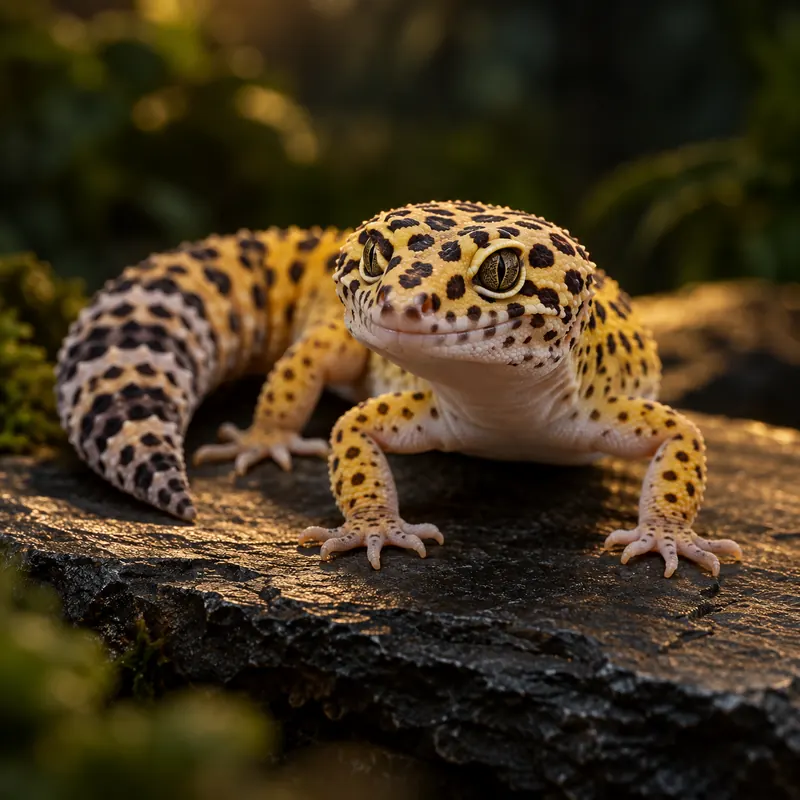
Most of what a leopard gecko needs is bought once: the enclosure, the lamps and the thermostats. Those are also the items that decide whether the gecko stays healthy, so they are where your money matters most. Get them right, then fill in hides, substrate and supplements.
Below is each category in order of importance, what to look for, and one or two picks. Specs come from each maker’s listing. We have not tested these products ourselves; picks are based on what veterinary and husbandry sources recommend for this species.
The short version
-
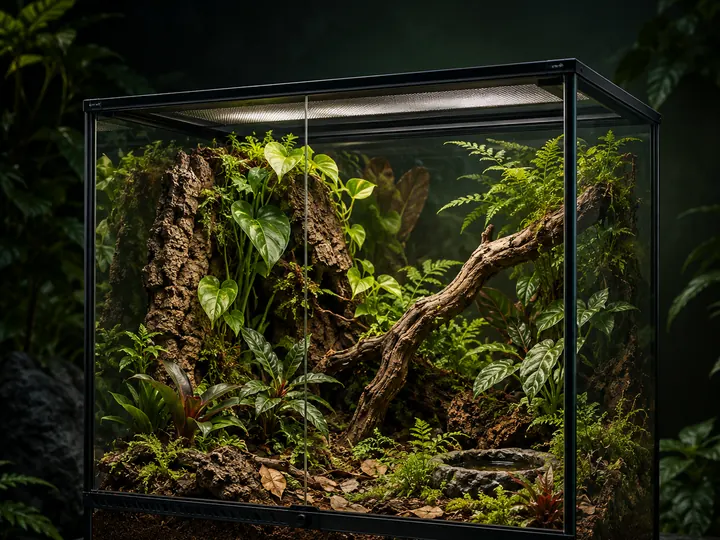 Enclosure REPTI ZOO 50 Gallon Glass Terrarium (36 x 18 x 18 in) Amazon
 - Enclosure Exo Terra Glass Terrarium, 90 x 45 x 45 cm (36 x 18 x 18 in) Amazon UK
-
 UVB kit Arcadia ShadeDweller ProT5 UVB Kit (7%, 8W) Amazon
 - UVB kit Arcadia ShadeDweller ProT5 UVB Kit (7%, 8W) Amazon UK
-
 Basking lamp Arcadia Halogen Basking Spot, 50W Amazon
 - Basking lamp Arcadia Halogen Basking Spot, 50W Amazon UK
- Lamp dome Zoo Med Deep Dome Lamp Fixture, 8.5 in Amazon
- Lamp dome Zoo Med Deep Dome Lamp Fixture, 8.5 in Amazon UK
- Thermostat Inkbird ITC-306T Pre-Wired Heating Thermostat Amazon
- Thermostat Habistat Dimming Thermostat, 600W Amazon UK
-
 Temp gun Etekcity Lasergrip 774 Infrared Thermometer Amazon
 - Temp gun Etekcity Lasergrip 774 Infrared Thermometer Amazon UK
- Thermometer and hygrometer Digital thermometer and hygrometer with remote probe Amazon
- Thermometer and hygrometer Digital thermometer and hygrometer with remote probe Amazon UK
- Hide Exo Terra Gecko Cave Amazon
- Hide Exo Terra Gecko Cave Amazon UK
-
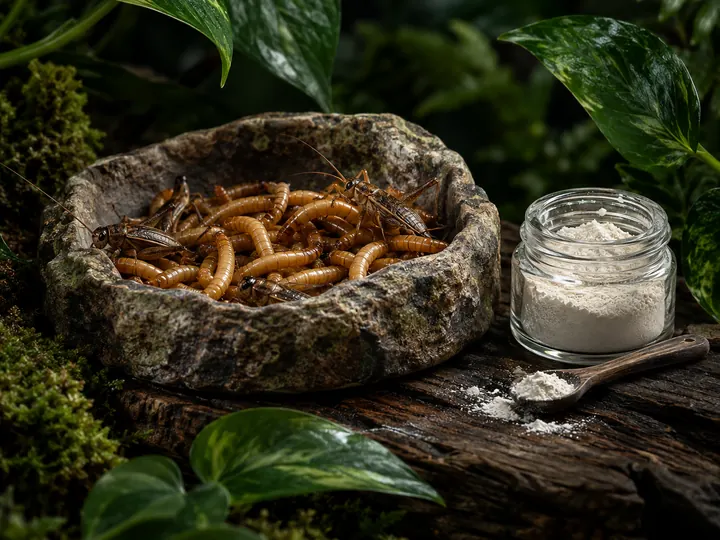 Calcium Arcadia EarthPro CalciumPro Mg Amazon
 - Calcium Arcadia EarthPro CalciumPro Mg Amazon UK
- Multivitamin Zoo Med Reptivite Multivitamin (without D3) Amazon
- Multivitamin Zoo Med Reptivite Multivitamin (without D3) Amazon UK
How to read this list
- Buy the big three first: enclosure, heat with a thermostat, and UVB. Everything else is cheap to change later.
- One thermostat per heat source. If you run a lamp and a mat, that is two thermostats.
- Picks differ by country. Some brands sell only in the US or the UK. The buttons show the store for your region.
1. Enclosure
What to look for
- Size. Care sources range from a 10 gallon tank (VCA) to the RSPCA’s 60 x 40 x 30 cm minimum to ReptiFiles’ 36 x 18 x 18 inches (91 x 46 x 46 cm). The larger size gives a far better heat gradient and room for three hides, so it is the one we would plan around. Details in enclosure size.
- Front-opening doors. Easier feeding and cleaning, and you are not reaching down from above.
- A secure, ventilated top. Mesh lets lamps sit on top. Mesh does block some UVB, which matters when you set lamp distance.
- Glass, PVC or wood. ReptiFiles notes most keepers use glass, while PVC and wood hold heat better in a cold room.
Best enclosure (US)
REPTI ZOO 50 Gallon Glass Terrarium (36 x 18 x 18 in)
A front-opening glass terrarium at 36 x 18 x 18 inches, the footprint ReptiFiles gives as the minimum for an adult leopard gecko. The two front doors open separately and the bottom frame is raised so a heat mat can fit underneath.
- Size
- 36 x 18 x 18 in (91 x 46 x 46 cm)
- Volume
- Sold as 50 gallons
- Access
- Two front-opening doors, screen top
Best for
US keepers who want the recommended adult size in glass without a custom build.
Worth knowing
Glass loses heat faster than PVC, and the top frame is not meant to carry heavy fixtures. Rest lamps in a dome or on a stand.
Best enclosure (US and UK)
Exo Terra Glass Terrarium, 90 x 45 x 45 cm (36 x 18 x 18 in)
Exo Terra's large wide glass terrarium, with dual front-opening doors, a mesh top for lighting, and a raised bottom frame for an under-tank heater. Sold in both the US and UK at the 36 x 18 x 18 inch size.
- Size
- 90 x 45 x 45 cm (36 x 18 x 18 in)
- Access
- Dual front-opening doors
- Top
- Removable mesh cover
Best for
A widely available glass option in either market, at the size most care guides now suggest.
Worth knowing
The mesh top blocks some UVB, so the UVB lamp distance needs to account for it.
2. UVB lighting
What to look for
- Low output, wide shade. Leopard geckos are a low-UVB species. The goal is a gentle dose near the basking spot and shade everywhere else. ReptiFiles gives a basking UV index of about 0.5 to 1.5 for normal-colored geckos, and lower (0.5 to 0.7) for albino and other low-pigment morphs. The RSPCA gives about UVI 0.7 in the basking zone.
- A linear T5 tube, not a coil bulb. A tube spreads UVB along the warm end. The RSPCA suggests a 2 to 5 percent tube; ReptiFiles lists the Arcadia ShadeDweller range.
- A reflector or a kit. A kit with the fitting and reflector saves wiring.
- A replacement plan. ReptiFiles says T5 lamps should be replaced every 12 months, even while they still glow.
Best UVB kit
Arcadia ShadeDweller ProT5 UVB Kit (7%, 8W)
A complete low-output T5 UVB kit: an 8 watt ShadeDweller lamp (7% UVB, 17% UVA) with the fitting, mounting hardware, power cable and a link cable. Arcadia makes it for crepuscular and shade-dwelling species, and leopard geckos are one of its listed uses.
- Lamp
- 8W T5, 7% UVB and 17% UVA
- Kit includes
- Fitting, switch, fixings, power cable, link cable
- Mounting
- Inside a vivarium or on a mesh top
- Lamp life
- 12 months
Best for
Low-level UVB over the warm end, leaving the rest of the enclosure shaded.
Worth knowing
UVB output fades before the visible light does. Replace the lamp every 12 months, and place it with a mesh top in mind.
How far to mount it, and how mesh changes the numbers, is in lighting and heating.
3. Heat source
What to look for
- Overhead heat that warms a surface. ReptiFiles rates halogen heat lamps as the best option. Start around 50 watts and adjust. The RSPCA suggests a 60 to 100 watt ceramic or basking lamp on a thermostat.
- Night heat that gives no light, only if your room drops too low. A deep heat projector or ceramic heat emitter works; a red or blue bulb does not.
- A deep dome with a ceramic socket, placed at one end of the tank.
Best basking lamp
Arcadia Halogen Basking Spot, 50W
A 50 watt halogen basking lamp with an E27 screw fitting and a built-in reflector. Halogen gives light and heat from above, the way the sun warms a rock, which ReptiFiles rates as the best daytime heat for leopard geckos.
- Power
- 50W
- Fitting
- E27 screw
- Beam
- 25 degree spot
- Control
- Dimmable, use with a dimming thermostat
Best for
The main daytime heat source over a flat basking stone at the warm end.
Worth knowing
Needs a dome with a ceramic socket and a dimming thermostat. Never let the gecko reach the bulb.
Best lamp dome
Zoo Med Deep Dome Lamp Fixture, 8.5 in
A deep metal reflector dome with a ceramic socket, rated for bulbs up to 160 watts. The deep shape keeps the bulb recessed and points the heat down onto the basking spot.
- Diameter
- 8.5 in (21.5 cm)
- Socket
- Ceramic
- Max bulb
- 160W
Best for
Holding the halogen or deep heat projector safely on top of the screen.
Worth knowing
Rest it securely on the mesh rather than clamping it where it can fall, and keep climbing decor low enough that the gecko cannot reach the mesh under the bulb.
Best night heat
Arcadia Deep Heat Projector, 50W
An infrared heat emitter that gives off heat with very little visible light, so it can run at night if the room gets too cold without disturbing the dark period.
- Power
- 50W
- Output
- Infrared heat, very little visible light
- Fitting
- E27, ceramic socket required
- Control
- Dimming or proportional thermostat
Best for
Night heat in a cold room, or as a second overhead heat source.
Worth knowing
ReptiFiles says deep heat projectors need a proportional (dimming) thermostat. Use a ceramic-socket dome; it gets very hot.
4. Thermostats
What to look for
- Dimming (proportional) for bulbs. A dimming thermostat turns a halogen or deep heat projector up and down smoothly. ReptiFiles says deep heat projectors need one.
- On/off is fine for mats. A simple on/off thermostat suits heat mats.
- Day and night settings are handy if you want a gentle drop overnight.
- Check it with your own thermometer. The RSPCA warns thermostats can be inaccurate, so verify the real temperature daily.
Best thermostat for heat mats
Inkbird ITC-306T Pre-Wired Heating Thermostat
A plug-in on/off thermostat with a temperature probe, two heating outlets and separate day and night set points on a 24 hour timer. ReptiFiles suggests it for heat mats.
- Type
- On/off (non-proportional)
- Outlets
- 2 heating outlets
- Timer
- Day and night set points, 24 hour cycle
- Probe
- Wired temperature sensor
Best for
Controlling an under-tank heat mat, with a lower set point at night.
Worth knowing
It switches power fully on and off, so halogen bulbs will flick on and off. Use a dimming thermostat for bulbs and deep heat projectors.
Best dimming thermostat (UK)
Habistat Dimming Thermostat, 600W
A dimming thermostat that gives the heater a smooth, variable supply of power instead of switching it on and off. Made for heat bulbs, and also works with ceramic heaters and heat mats. Sold in standard and high range versions.
- Control
- Dimming (variable voltage)
- Load
- 40W minimum, 600W maximum at 230V
- Probe
- Waterproof
- Guarantee
- 5 years
Best for
UK keepers running a halogen or deep heat projector, which need dimming control.
Worth knowing
Needs a minimum 40W load. Check which range version you buy matches your basking target.
In the US, dimming thermostats from specialist reptile brands are often sold outside Amazon. Whatever you choose, look for “dimming” or “proportional” in the description when it will control a bulb.
5. Heat mat (optional)
What to look for
- Sized to cover only the warm third of the floor, never the whole tank.
- Always on a thermostat, with the probe inside the warm hide. ReptiFiles describes placing the mat under the warm hide and covering it with about an inch of substrate.
- Under the glass, not inside the tank.
A mat is a supplement, not a replacement for overhead heat. ReptiFiles notes a warm hide of 90 to 92°F (32 to 33°C) already gives the gecko the belly heat it needs to digest.
Best heat mat (US)
Zoo Med ReptiTherm Under Tank Heater
A stick-on heat mat for the underside of a glass tank, sold in sizes matched to tank volume. Zoo Med lists the small pad at 6 x 8 inches and 8 watts for 10 to 20 gallon tanks.
- Mounting
- Adhesive, under a glass tank
- Small size
- 6 x 8 in, 8W, 10 to 20 gallons
- Control
- Thermostat required
Best for
Belly heat under the warm hide, alongside overhead heat.
Worth knowing
Always run it through a thermostat with the probe inside the warm hide. An uncontrolled mat can burn a gecko.
6. Thermometers
What to look for
- An infrared temp gun for surface readings: the basking stone, the warm hide floor, the cool end.
- A digital probe thermometer and hygrometer for air temperature and humidity. ReptiFiles and the RSPCA both recommend digital tools.
- Min and max memory, so you can see the overnight low without staying up.
Best temp gun
Etekcity Lasergrip 774 Infrared Thermometer
A handheld infrared "temp gun" that reads surface temperature from a distance. ReptiFiles names this model for mapping the basking spot and the rest of the floor.
- Measures
- Surface temperature
Best for
Checking basking surface temperatures, which air thermometers cannot measure.
Worth knowing
It reads surfaces, not air. Pair it with a probe thermometer for air temperature and humidity.
Best thermometer and hygrometer
Digital thermometer and hygrometer with remote probe
A small digital display with a wired probe that reads air temperature and humidity at the spot you place it. ReptiFiles and the RSPCA both recommend digital gauges over stick-on dials.
- Reads
- Air temperature and relative humidity
- Look for
- Wired remote probe, min and max memory
Best for
Watching air temperature and humidity on the cool side and in the humid hide.
Worth knowing
Look for a remote probe, so the reading comes from inside the enclosure, not the display's location.
7. Hides
What to look for
- Three of them: warm side, cool side, and a humid hide. ReptiFiles gives 70 to 80 percent humidity inside the humid hide.
- Snug, not huge. The gecko should fit inside comfortably with its body close to the walls.
- Easy to clean. Resin, ceramic or plastic wash well.
A plastic tub with a hole cut in the lid and a damp lining also works well as a humid hide. ReptiFiles advises against sphagnum moss or shredded paper towel in it because of the risk of swallowing, while the RSPCA and PetMD both mention damp moss. If you use moss, watch that the gecko is not eating it.
Best hide
Exo Terra Gecko Cave
A natural-looking resin cave with a low entrance, made in several sizes. Easy to wash, and it can be used as a warm, cool or humid hide.
Best for
One of the three hides; buy one per zone.
Worth knowing
Choose a size the gecko can turn around in while touching the walls. Too large a hide feels less secure.
8. Substrate
What to look for
- For new arrivals and juveniles: paper towels or tile. The RSPCA says young geckos should be kept on non-loose substrates, and ReptiFiles says loose substrate should wait until the gecko has passed quarantine.
- For healthy adults: sources differ. The RSPCA suggests a soil and sand mix; ReptiFiles suggests a packed mix of 60 percent topsoil, 30 percent sand and 10 percent clay, at least 4 inches (10 cm) deep. VCA advises against sand.
- Never calcium sand. ReptiFiles warns that calcium carbonate sands can upset digestion; the RSPCA lists calcisand among substrates to avoid.
Best burrowing substrate
Zoo Med Excavator Clay Burrowing Substrate
A clay substrate that is wetted, shaped and left to dry, so it holds tunnels and ledges. ReptiFiles lists it as an acceptable option and as an ingredient in a soil, sand and clay mix.
- Type
- Burrowing clay, dries hard
- Use
- Alone or mixed with soil and sand
Best for
A solid, diggable floor for a healthy adult that has finished quarantine.
Worth knowing
It needs days to dry fully before the gecko goes in. Juveniles and new arrivals are better on a solid surface first.
9. Supplements and gut-load
What to look for
- Calcium for every feeding. ReptiFiles: calcium without D3 if you use UVB, with D3 if you do not.
- A multivitamin about once a week for young geckos and every other week for adults (ReptiFiles), ideally one with preformed vitamin A rather than only beta carotene.
- A gut-load food for the insects, given for a couple of days before feeding.
Best calcium (with UVB)
Arcadia EarthPro CalciumPro Mg
A calcium powder with magnesium and no vitamin D3, for dusting insects. ReptiFiles lists it among the calcium supplements to use when the gecko has UVB.
- Contains
- Calcium and magnesium
- Vitamin D3
- None
- Use
- Dust feeder insects
Best for
Dusting every feeding when you run a UVB lamp.
Worth knowing
D3-free. If you keep a gecko without UVB, ReptiFiles advises a calcium with D3 instead.
Best multivitamin
Zoo Med Reptivite Multivitamin (without D3)
A reptile multivitamin and mineral powder for dusting insects. ReptiFiles names the without-D3 version as a multivitamin choice for leopard geckos.
- Type
- Multivitamin and mineral powder
- Version
- Without vitamin D3
Best for
The weekly (young) or every-other-week (adult) multivitamin dusting.
Worth knowing
Do not use it every feeding, and do not put vitamin powder in the water.
Best gut-load
Arcadia InsectFuel Gut Load
A food for feeder insects, given in the days before they are fed to the gecko so they arrive full of nutrition. ReptiFiles lists it as one of the commercial gut-loading options.
- Use
- Gut-load food for feeder insects
Best for
Gut-loading crickets, roaches and worms for a couple of days before feeding.
Worth knowing
Gut-loading does not replace calcium dusting. Do both.
The feeding schedule that goes with these is in diet.
10. The small stuff
- A shallow water bowl, heavy enough not to tip. VCA and the RSPCA both say to change water daily.
- A flat slate or stone tile under the basking lamp.
- A timer (or the thermostat’s built-in one) for lights.
- Feeding tongs and a smooth-sided bowl for worms.
- Reptile-safe disinfectant for the monthly deep clean (RSPCA).
- Cork, rocks and plants for cover and low climbing.
Starter kits: worth it?
Boxed “starter kits” bundle a tank with a lamp, a thermometer and sometimes substrate. They can save time, but check every item in the box against the skip list below before you buy. Things to look for:
- Is the tank the size you want long term? Many kits are built around 10 to 20 gallon tanks. That matches the lower end of the source range, not the 36 x 18 x 18 inch size ReptiFiles recommends.
- Is there a thermostat? If not, you still need to buy one for each heater.
- What kind of UVB is included? A linear T5 tube is what to look for; a coil bulb is not.
- What substrate? Calcium sand or walnut shell should go straight in the bin.
Often it works out better to buy the enclosure on its own and add the lamps, thermostat and gauges from the categories above.
What you will buy again
Most of the list is a one-time purchase. A few things are not:
| Item | How often |
|---|---|
| Live insects | Every week or two, depending on how many you keep at home |
| Gut-load food, calcium, multivitamin | When the tub runs out; check use-by dates |
| UVB tube | Every 12 months (ReptiFiles), even if it still lights up |
| Heat bulbs | When they fail; keep a spare so the tank never goes cold overnight |
| Paper towels or substrate | Paper as needed; loose substrate topped up or replaced during deep cleans |
Write the UVB install date on a piece of tape on the fixture. It is the easiest replacement to forget, because the lamp keeps glowing long after its UVB output has dropped.
If you are in the UK
The same categories apply, but brands differ. Arcadia, Habistat, Exo Terra and ProRep are names you will see on Amazon UK, and wooden vivariums are widely sold. ReptiFiles notes wood insulates well, which helps in a cool house. In a vivarium the lamps often mount inside the roof, so remember the UVB distances change when there is no mesh between the lamp and the gecko. The RSPCA’s care page is written for UK keepers and is worth reading alongside this list.
Skip these
| Item | Why |
|---|---|
| Heat rocks | VCA warns they create hot spots; PetMD says never to use them. |
| Any heater without a thermostat | Mats and lamps can overheat and burn. |
| Calcium or “vita” sand | Can upset digestion (ReptiFiles); listed to avoid by the RSPCA. |
| Walnut shell, corncob, wood chips | Impaction risk (VCA, ReptiFiles). |
| Red, blue or black “night” bulbs | ReptiFiles advises against them; use a heater that gives no light. |
| Coil (compact) UVB bulbs | A linear tube gives an even, gentle gradient. |
| Stick-on dial thermometers | They read the glass, not the basking surface or the air. |
| A tank-mate | The RSPCA advises keeping leopard geckos alone. |
Spend on the enclosure, the thermostat and the UVB tube, and save on everything else. A cheap hide is still a good hide, but a cheap heat setup with no thermostat is the one purchase that can hurt your gecko.