
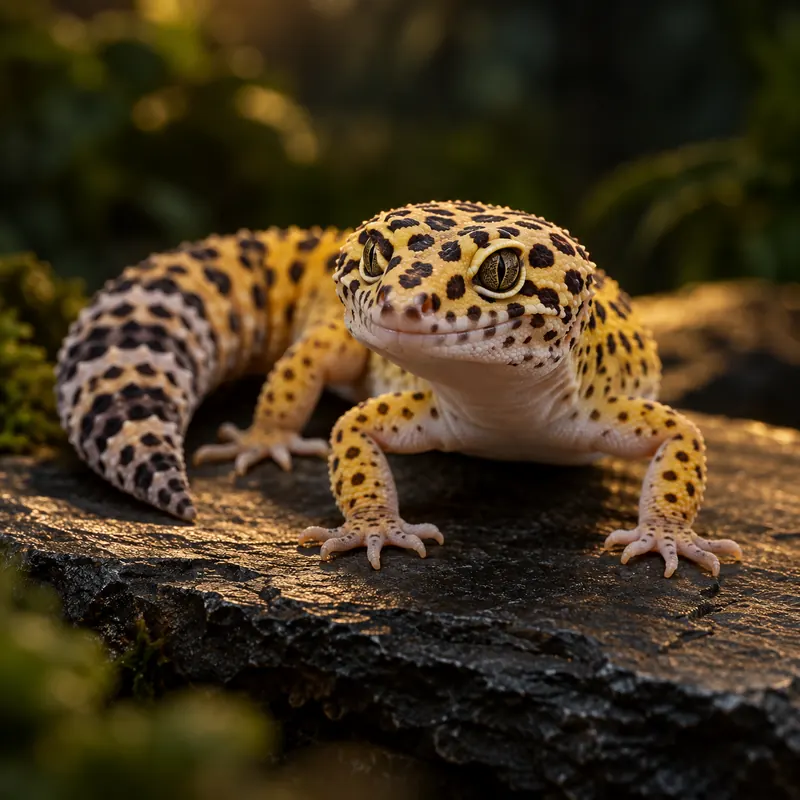
Short answers to the questions that come up most, with a link to the full guide where there is more to say.
How long do leopard geckos live?
A long time. VCA gives 10 to 15 years with good care, ReptiFiles 15 to 20 years, and the RSPCA up to 20. PetMD says they can live upwards of 25 years in captivity. Plan for a commitment of well over a decade.
How big do they get?
About 7 to 10 inches (17 to 25 cm) from nose to tail tip, according to ReptiFiles, with females usually smaller. VCA gives 5 to 10 inches (12 to 25 cm), and the RSPCA about 25 cm (10 in).
Are leopard geckos good for beginners?
Yes, they are one of the most common first reptiles. They stay a manageable size, eat insects you can buy, and are usually calm once settled. They still need correct heat, a thermostat, the right calcium and a vet who sees reptiles. See the setup checklist.
How much does a setup cost?
Most of the cost is the one-time setup: the enclosure, a heat lamp and dome, a thermostat for each heater, a UVB kit and thermometers. Ongoing costs are live insects, supplements, a new UVB tube every 12 months (ReptiFiles), and vet visits. The supplies list covers each item.
What size tank does a leopard gecko need?
Sources range from a 10 gallon tank (VCA) to the RSPCA’s minimum of 60 x 40 x 30 cm to ReptiFiles’ 36 x 18 x 18 inches (91 x 46 x 46 cm). We suggest the larger size for a proper warm-to-cool gradient. Full comparison in enclosure size.
Do leopard geckos need UVB?
VCA calls UVB “not required but recommended,” and the RSPCA and ReptiFiles both recommend a low-level UVB tube with plenty of shade. If you do not use UVB, ReptiFiles advises a calcium supplement that contains vitamin D3. Details in lighting and heating.
What temperature should the tank be?
ReptiFiles gives a basking surface of 94 to 97°F (34 to 36°C), a warm hide of 90 to 92°F (32 to 33°C) and a cool end of 70 to 77°F (21 to 25°C). Other sources quote air temperatures, which run a little lower: the RSPCA gives 28 to 30°C (82 to 86°F) in the basking zone and 24 to 26°C (75 to 79°F) at the cool end. Nights can be cooler; the RSPCA only adds heat if the room drops below 18°C (64°F). Every heat source needs a thermostat, and every thermostat needs checking with your own thermometer.
Can two leopard geckos live together?
The RSPCA advises keeping them alone: they do not need company and can be aggressive. VCA notes males can be territorial. One gecko per enclosure is the safe choice.
Do leopard geckos like being handled?
Many tolerate gentle handling once they are settled. The RSPCA says to wait at least the first week, and ReptiFiles suggests two weeks, then short sessions of about 5 minutes that build up slowly. Always support the whole body and never hold the tail. See first week at home.
Can leopard geckos live on sand?
Sources disagree. VCA advises against sand, and PetMD does not recommend it. The RSPCA suggests a mix of about half organic soil and half clean play sand for healthy adults, and ReptiFiles says sand can be safe “ONLY if it is used correctly,” ideally packed into a soil and clay mix. They agree on two things: young geckos and new arrivals should start on a solid surface such as paper towels or tile, and calcium sand should never be used. The full debate is in enclosure size.
Why did my gecko’s tail fall off?
Leopard geckos can drop their tail as a defense. ReptiFiles lists stress, fear, being grabbed by the tail, retained shed, illness and tank-mate bullying as causes. The tail regrows but will look different. Keep the stump clean, put the gecko on paper towels, and feed a little more for a few weeks. If the stump looks infected, see a vet.
How often do they shed, and should I help?
They shed their skin throughout life. A gecko about to shed turns pale or grayish, and usually eats the old skin (ReptiFiles). A humid hide helps. Never pull stuck skin: the RSPCA says to see a vet if dry skin remains around the toes or eyes, since it can cut off circulation.
How often do leopard geckos eat?
Juveniles daily or every other day; adults a few times a week. ReptiFiles feeds adults about every 5 days once the tail is fatter than the neck, VCA says 2 to 3 times a week, and the RSPCA says every other day. See diet.
Do leopard geckos smell?
A clean setup should not smell much. Odor in a reptile tank usually comes from droppings, dead insects or a dirty water bowl. The RSPCA advises spot cleaning waste as soon as it appears and a full clean monthly with a reptile-safe disinfectant.
Do leopard geckos make noise?
Sometimes. ReptiFiles describes clicking between geckos, chirping or squeaking when unhappy (usually about handling), barking that often signals hunger, and a scream from startled juveniles. Most of the time they are quiet. They are most active around dawn and dusk and spend much of the day in a hide, so any sounds or movement you notice will usually be in the evening.
My gecko is not eating. Should I worry?
Not right away. New geckos often skip meals while settling, and the RSPCA notes appetite naturally drops in cooler months, though the gecko should not lose weight. Check your temperatures first. If a new gecko has not eaten after about two weeks (ReptiFiles), or any gecko is losing weight or its tail is thinning, see a reptile vet. This is general guidance, not veterinary advice.
Long-lived, quiet, and happiest alone in a warm, well-measured tank: that sums up the leopard gecko. Most questions come back to the same three things, which are heat, calcium and patience.