
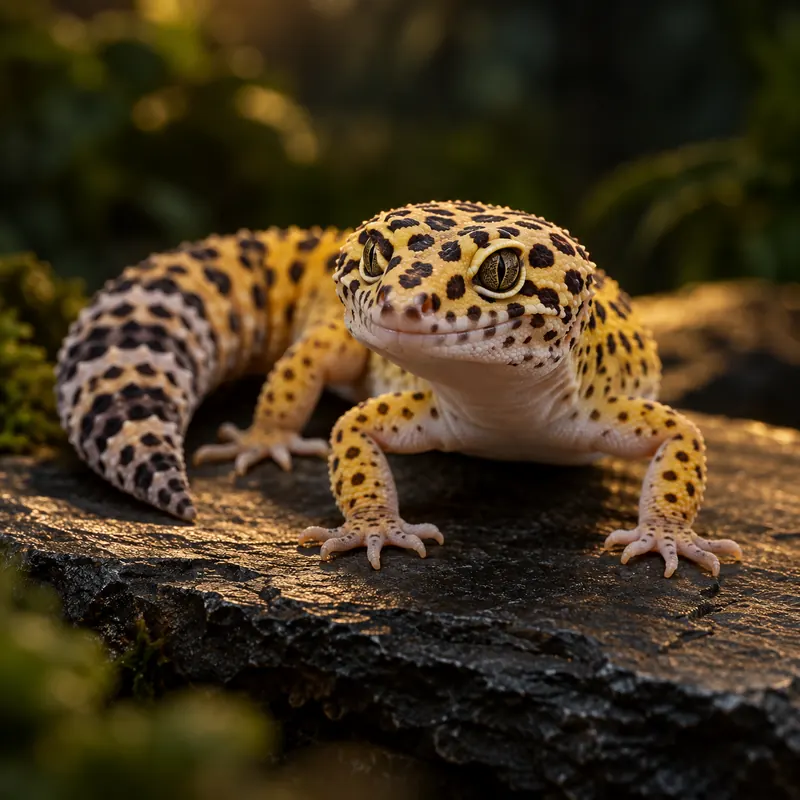
Leopard geckos have a reputation as an easy first reptile, and they are forgiving. But many of their health problems, from burns to bone disease, trace back to a handful of setup and feeding mistakes. Here are the common ones, and what to do instead.
1. Running a heater with no thermostat
The mistake. Plugging a heat mat or lamp straight into the wall. It keeps heating no matter how hot the tank gets, and a gecko resting on an overheated spot can be burned.
The fix. Every heat source goes through a thermostat, with the probe where that heater warms: the basking area for a lamp, inside the warm hide for a mat. Use a dimming thermostat for bulbs and deep heat projectors (ReptiFiles), and check the real temperature daily, because the RSPCA warns thermostats can be inaccurate.

Thermostat for heat mats
Inkbird ITC-306T Pre-Wired Heating Thermostat
A plug-in on/off thermostat with a temperature probe, two heating outlets and separate day and night set points on a 24 hour timer. ReptiFiles suggests it for heat mats.
- Type
- On/off (non-proportional)
- Outlets
- 2 heating outlets
- Timer
- Day and night set points, 24 hour cycle
- Probe
- Wired temperature sensor
Best for
Controlling an under-tank heat mat, with a lower set point at night.
Worth knowing
It switches power fully on and off, so halogen bulbs will flick on and off. Use a dimming thermostat for bulbs and deep heat projectors.
2. Guessing temperatures
The mistake. Relying on a stick-on dial, or no thermometer at all.
The fix. Use an infrared temp gun for surfaces and a digital probe thermometer for air. Aim for a basking surface of 94 to 97°F (34 to 36°C), a warm hide of 90 to 92°F (32 to 33°C) and a cool end of 70 to 77°F (21 to 25°C) (ReptiFiles). See lighting and heating for how other sources’ air figures compare.
3. No cool side
The mistake. A tank that is warm from end to end, often because it is too small or the heat source sits in the middle.
The fix. Put all heat at one end. A longer tank, such as 36 x 18 x 18 inches (91 x 46 x 46 cm), makes a real gradient much easier. The gecko needs somewhere to cool down as much as somewhere to warm up.
4. Heat rocks
The mistake. Using a heated rock as the main heat source.
The fix. Don’t. VCA warns heat rocks create hot spots, and PetMD says they should never be used. Warm a natural stone from above with a lamp instead.
5. Calcium sand, or loose substrate for a new gecko
The mistake. Starting a baby or new arrival on loose sand, especially “calcium” or “vita” sand sold as digestible.
The fix. Start on paper towels or tile. ReptiFiles warns calcium carbonate sands can upset digestion, and the RSPCA lists calcisand among substrates to avoid. Both the RSPCA and ReptiFiles say young or new geckos belong on a solid floor; loose natural substrates are only an option for healthy adults after quarantine, and VCA advises against sand altogether. More in enclosure size.
6. Wrong calcium for the lighting
The mistake. No calcium, or the wrong type: D3-free calcium with no UVB, or never dusting at all.
The fix. Dust every feeding. ReptiFiles: calcium without D3 if you use UVB, calcium with D3 if you do not. Add a multivitamin weekly for young geckos and every other week for adults. The RSPCA links metabolic bone disease (twitching, swollen legs, fragile bones) mainly to a lack of UVB, and it needs urgent vet care.
7. Skipping UVB entirely without a plan
The mistake. Assuming “nocturnal” means no UVB, then also skipping D3.
The fix. Current guidance from VCA, the RSPCA and ReptiFiles recommends UVB. Use a low-output T5 tube over the warm end, with shade elsewhere. If you choose not to, you must provide D3 in the calcium. Albino and other red-eyed morphs need a lower UV level; the RSPCA suggests asking a vet.

UVB kit
Arcadia ShadeDweller ProT5 UVB Kit (7%, 8W)
A complete low-output T5 UVB kit: an 8 watt ShadeDweller lamp (7% UVB, 17% UVA) with the fitting, mounting hardware, power cable and a link cable. Arcadia makes it for crepuscular and shade-dwelling species, and leopard geckos are one of its listed uses.
- Lamp
- 8W T5, 7% UVB and 17% UVA
- Kit includes
- Fitting, switch, fixings, power cable, link cable
- Mounting
- Inside a vivarium or on a mesh top
- Lamp life
- 12 months
Best for
Low-level UVB over the warm end, leaving the rest of the enclosure shaded.
Worth knowing
UVB output fades before the visible light does. Replace the lamp every 12 months, and place it with a mesh top in mind.
8. Colored night bulbs
The mistake. A red, blue or “moonlight” bulb left on all night for heat or viewing.
The fix. Turn lights off at night. If the room falls below about 18°C (64°F), which is the RSPCA’s threshold, add heat that gives off no light, such as a ceramic heat emitter or deep heat projector, on a thermostat. ReptiFiles warns blue light may damage reptiles’ eyes.
9. Housing two geckos together
The mistake. Buying a “pair” to keep each other company.
The fix. Keep one gecko per enclosure. The RSPCA says leopard geckos do not need company and can be aggressive, and VCA notes males can be territorial. Bullying from a tank-mate is also one of the causes of tail loss ReptiFiles lists.
10. Leaving crickets loose in the tank
The mistake. Tipping a tub of crickets in and walking away.
The fix. Feed from tongs or a smooth-sided bowl, and remove uneaten insects after 10 to 15 minutes (PetMD). ReptiFiles warns feeders left in the tank can injure the gecko.
11. Feeding the wrong insects
The mistake. Backyard bugs, wild hornworms, a diet of only mealworms, or waxworms as a daily meal.
The fix. Rotate at least three captive-bred staples such as crickets, roaches, black soldier fly larvae, silkworms and mealworms (ReptiFiles). Gut-load them first. Keep waxworms and butterworms as treats, no more than once a week. Never feed wild-caught insects; PetMD warns some may be toxic.
12. Grabbing by the tail, or handling too soon
The mistake. Picking a new gecko up on day one, or catching it by the tail.
The fix. Wait. The RSPCA says avoid handling in the first week, and ReptiFiles suggests two weeks. Then scoop from below with the whole body supported, never by the tail. The tail can drop off as a defense; it will regrow, but ReptiFiles notes the new one will not look the same, and the gecko loses a big fat store. See first week at home.
Bonus: no vet until there is an emergency
The mistake. Looking for a reptile vet only once the gecko is sick.
The fix. Find one before the gecko comes home and book a first check-up. Signs that need a vet include weight loss, a skinny tail, a swollen belly, swollen eyes, shedding problems (PetMD), twitching or swollen limbs (RSPCA), and an infected tail stump (ReptiFiles). This is general guidance, not veterinary advice.
Quick self-check
Run through this list once a month. If you can answer yes to all of it, you have avoided the mistakes that cause most problems.
| Check | Yes? |
|---|---|
| Every heater runs through a thermostat | |
| You checked the basking surface with a temp gun this week | |
| The cool end is clearly cooler than the warm end | |
| There are three hides: warm, cool and humid | |
| The floor is solid, or a healthy adult is on a soil-based mix (never calcium sand) | |
| You dust every feeding with the right calcium for your lighting | |
| The UVB tube is less than 12 months old | |
| No lights are on at night | |
| The gecko lives alone | |
| You know where your nearest reptile vet is |
Nearly every mistake on this list is a setup problem, not a gecko problem, which is good news: each one is fixed once and stays fixed. Thermostat, gradient, the right calcium, one gecko per tank.