
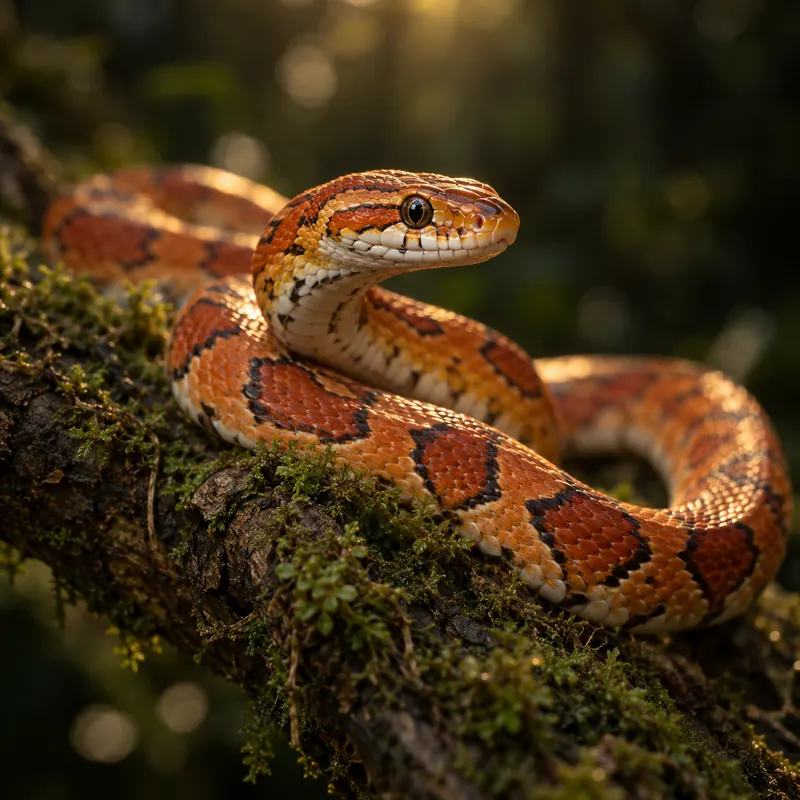
Feeding a corn snake is simple: one frozen-thawed mouse of the right size, at the right interval for its age. Most corn snakes are keen eaters, so the bigger risk is overfeeding rather than a snake that will not eat.
What corn snakes eat
Corn snakes are carnivores. Animal Diversity Web says rodents make up over half of a wild corn snake’s diet, alongside other small animals and birds’ eggs. In captivity, the RVC says the main diet is rodents, moving from pinkie mice for hatchlings up to large mice or rats for adults.
Mice are the standard. ReptiFiles also lists small rats, quail and quail eggs as occasional extras, and the RSPCA mentions quail and rats about once a month. Buy prey from a captive-bred source. ReptiFiles advises against wild-caught prey because it can carry disease and parasites.
Frozen-thawed, not live
Every source we checked prefers frozen-thawed prey:
- PetMD says to use thawed frozen rodents and never live prey.
- VCA advises against live prey because rodents can bite and injure the snake, and says dead prey is more humane and safer. If live prey is ever used, VCA says to remove it after two hours if it has not been eaten, and ReptiFiles says never to leave it in for more than one hour, and to supervise the whole time.
- ReptiFiles says corn snakes usually take frozen-thawed prey readily.
Frozen prey is also easier to store and buy in bulk.
How big should the prey be?
Go by the snake’s width, not its head:
- The RSPCA: slightly wider than the snake’s widest part.
- ReptiFiles: about 1 to 1.5 times the width of the widest part of the body, and no more than about 10% of the snake’s body weight in one meal.
- PetMD: no wider than the snake’s width at mid-body.
These differ a little. A safe middle ground is prey about as wide as the thickest part of the snake. A small bulge after eating is normal. If the snake regurgitates, or the bulge is very large, go down a size.
Moving up a prey size
As the snake grows, its prey should grow with it. Compare the mouse with the widest part of the snake every few feeds. When the current size looks small next to the snake, move up one size. If you are between sizes, ReptiFiles says two smaller prey items in one session is fine, as long as the total stays near 10% of the snake’s weight.
Prey names vary by supplier (pinkie, fuzzy, hopper, adult mouse and so on), so go by the size of the animal rather than the label.
How often to feed
Feeding intervals get longer as the snake grows. ReptiFiles gives the most detailed schedule:
| Stage | Length | Feed every |
|---|---|---|
| Hatchling | 8 to 20 in (20 to 50 cm) | 5 to 7 days |
| Juvenile | 20 to 45 in (50 to 115 cm) | 7 to 10 days |
| Subadult | 35 to 50 in (90 to 125 cm) | 10 to 12 days |
| Adult | Over 35 in (90 cm) | 14 to 21 days |
Other sources sit close to this:
- The RSPCA: a pinkie every 5 to 6 days for hatchlings, and an adult mouse every 7 to 14 days for adults.
- The RVC: adults usually every 1 to 2 weeks, depending on weight.
- VCA: young snakes about twice a week, larger adults every 1 to 2 weeks.
- PetMD: juveniles weekly and adults every 1 to 2 weeks. PetMD’s hatchling figure (every other day) is much more frequent than the others.
The safest approach is to start with the middle of these ranges and adjust using the scale. ReptiFiles suggests 21 to 35 days between meals for an overweight adult.
Weigh your snake
A kitchen scale that reads in grams is the best feeding tool you can own. ReptiFiles suggests weighing monthly on its feeding page, and weekly on its health page, because sudden weight loss is often the first sign of illness. Either way, write the numbers down along with feeds and sheds.
How to thaw prey safely
- Thaw in the fridge. ReptiFiles suggests about a day in the refrigerator.
- Warm it in a bag. Just before feeding, seal the rodent in a plastic bag and sit it in warm water for 15 to 30 minutes.
- Check the temperature. ReptiFiles aims for about 100°F (38°C), and the RVC says to warm prey to blood temperature, 99°F (37°C). An infrared thermometer makes this easy. The RVC also advises not handling prey with bare hands, so it does not carry your scent.
Feeding day
- Offer the prey with tongs, as PetMD advises, so the snake strikes the mouse and not your fingers.
- Let go once the snake strikes and starts to coil. ReptiFiles notes that gently wiggling the prey once the snake is constricting can help a hesitant feeder.
- Feed on a clean surface. The RVC warns that feeding directly on loose substrate can lead to the snake swallowing it. Use a flat dish or feed with tongs over a clear area. PetMD suggests a separate feeding tub, while ReptiFiles feeds in the home enclosure and calls “cage aggression” a misconception. Either can work.
- Leave the snake alone afterward. The RSPCA and ReptiFiles both say not to handle a corn snake for 48 hours after a meal, because handling can cause regurgitation.
Feeding tongs
Stainless Steel Feeding Tongs (about 10 to 12 in)
Long stainless tongs for offering thawed prey, so the snake strikes the mouse and not your hand. PetMD advises offering food with tongs.
- Material
- Stainless steel
- Length
- About 10 to 12 in (25 to 30 cm)
Best for
Every feed. The US pick is a straight and curved pair, 10.6 in long.
Worth knowing
Let go as soon as the snake strikes and coils. Wash your hands after touching prey so your fingers do not smell like food.
Supplements
VCA says pet snakes generally do not need vitamin supplements when they eat whole, healthy prey. ReptiFiles suggests an occasional, light dusting of a calcium and multivitamin powder. If you are unsure, ask your vet. Whole prey is the foundation either way.
Water
Fresh water must always be available. The RSPCA says to change it at least daily, VCA asks for a large, heavy bowl that is hard to tip, and the RVC suggests one big enough for the snake to submerge in. ReptiFiles recommends plain tap water and warns that distilled or softened water is not ideal.

Water bowl
Exo Terra Water Dish, Extra Large
A heavy resin water dish with a smooth surface and built-in steps, made to be hard to tip. It is big enough for a corn snake to drink and soak in.
- Size
- Extra large
- Material
- Food-grade resin (per Exo Terra)
- Feature
- Steps to climb out
Best for
The main water bowl. ReptiFiles and VCA both ask for a large, heavy bowl that will not tip.
Worth knowing
Snakes often soil their water. VCA advises cleaning the bowl daily, and the RSPCA says to change the water at least daily.
When a corn snake will not eat
A missed meal is not usually an emergency. ReptiFiles lists loss of appetite as a normal sign of an upcoming shed, and a newly moved snake often needs time to settle. Animal Diversity Web notes that wild corn snakes hibernate through winter across most of their range, so a pet may also eat less in the colder months. Check the basking temperature first, since a cool snake digests poorly and may not be hungry.
PetMD advises a vet visit if a corn snake misses more than a couple of feeds, especially when it is not shedding. Combine that with weight loss on the scale, and it is time to book in.
One mouse, as wide as the snake, every week or two depending on age. Weigh, write it down, and let the scale tell you when to change.