
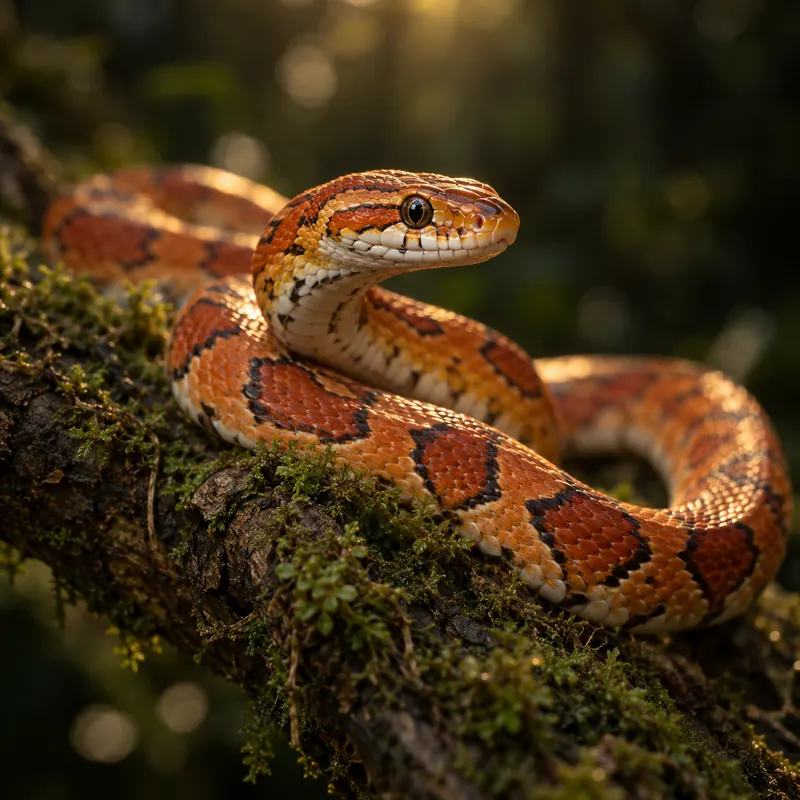
A new corn snake’s first job is to learn that its enclosure is safe. Yours is mostly to leave it alone while it does. Expect a week or two of hiding, then a curious snake that comes out to explore. Use the quiet time to check temperatures, watch for health signs, and book a vet visit.
Before it arrives
The setup should already be running and steady. Check that:
- The basking spot and cool end have held their temperatures for several days. See the lighting and heating guide.
- Every door locks and every cable hole is closed. A new snake will test the edges of its home, often on the first night.
- There is a hide at each end, plenty of cover between them, and fresh water.
Day 1: get it in and walk away
- Bring it home quickly, in a secure, ventilated container kept at room temperature.
- Put it straight into the enclosure. Open the container near a hide and let the snake move in by itself, or lift it gently with its body supported.
- Close and lock the enclosure. Check the lock twice.
- Leave it. Do not handle it, and keep the room fairly calm.
It will probably vanish into a hide or under the substrate. That is normal and a good sign that it has found somewhere it feels safe.
Days 2 to 7: hands off
ReptiFiles suggests letting a new corn snake settle for about two weeks, and not handling it until it is eating regularly. During this time:
- Check temperatures morning and evening.
- Change the water every day, as the RSPCA advises.
- Spot clean waste as soon as you see it.
- Watch quietly. Note whether it comes out at dawn, dusk or in the evening, and whether it uses both ends of the enclosure.
Avoid moving decor around or deep cleaning. Each change makes the space feel new again.
The first meal
Give the snake a few days to a week to settle before the first meal. Ask the breeder or store what it was eating, how big the prey was, and when it last ate, and match that.
- Thaw the prey fully and warm it to about blood temperature. The diet guide explains how.
- Offer it with tongs, close to the snake’s hide, and then leave the room.
- If the snake ignores it, remove the prey after a few hours and try again in a few days.
A refused first meal is common and not a cause for worry on its own. If a snake misses more than a couple of feeds, PetMD advises seeing a vet, especially if it is not about to shed.
Feeding tongs
Stainless Steel Feeding Tongs (about 10 to 12 in)
Long stainless tongs for offering thawed prey, so the snake strikes the mouse and not your hand. PetMD advises offering food with tongs.
- Material
- Stainless steel
- Length
- About 10 to 12 in (25 to 30 cm)
Best for
Every feed. The US pick is a straight and curved pair, 10.6 in long.
Worth knowing
Let go as soon as the snake strikes and coils. Wash your hands after touching prey so your fingers do not smell like food.
When and how to start handling
Wait until the snake has eaten a few meals in a row. Then, per ReptiFiles:
- Never handle within 48 hours of a meal. Both ReptiFiles and the RSPCA say this, because it can cause regurgitation.
- Wake it first. ReptiFiles suggests a gentle tap with a paper towel roll or snake hook. A flicking tongue means it is awake and knows this is not feeding time.
- Come in from the side, not from above. A hand from above looks like a predator.
- Support its body. Let it move through your hands rather than gripping it. Do not grab the tail or hold the head.
- Keep it short. ReptiFiles suggests 5 minutes or less to start, building up to 10 minutes and beyond. The RSPCA suggests keeping time out to around 10 to 15 minutes at a time.
- Handle regularly, but not too much. ReptiFiles suggests at least once or twice a week, and no more than once a day.
Corn snakes are active, so expect it to keep moving. Let it travel hand over hand, and stay low over a bed or sofa in case it slips. Wash your hands before handling, especially after touching prey, so you do not smell like food. Wash them afterward too: the RVC notes that all reptiles can carry Salmonella.
Reading its body language
ReptiFiles describes these signs of a snake that feels threatened:
- An S-shaped coil with the head pulled back.
- Hissing.
- Rattling or shaking the tail.
- Musking (a bad smell) or defecating while held.
Young corn snakes are often nervous and may strike. ReptiFiles says bites from adults are not serious. If you see these signs, put the snake back calmly and try again another day with a shorter session.
Quarantine if you have other reptiles
VCA advises keeping a new snake away from other snakes for one month and watching for signs of illness. Use a separate room if possible, look after it last, and wash your hands between enclosures.
Health checks in the first week
Look at your snake each day without handling it. Things to note:
- Mites. The MSD Veterinary Manual describes snake mites as tiny, generally under 1.5 mm, and often found around the eyes and in skin folds. A snake that spends a lot of time soaking, or drowned mites in the water bowl, can be a sign. Mites need treatment of both the snake and the enclosure, so see a vet.
- Breathing. ReptiFiles lists bubbly or stringy saliva, a rattling, clicking or whistling sound when breathing, lethargy and poor appetite as signs of a respiratory infection. It links these to cool temperatures, wrong humidity and poor hygiene. Check your setup and see a vet.
- Shedding. Cloudy or blue eyes, dull skin and more hiding mean a shed is coming. ReptiFiles advises not handling during this time.
- General. VCA says to avoid snakes that look thin, have loose skin or sunken eyes, or seem inactive. PetMD lists clear eyes, intact skin, a clean vent and regular tongue flicking as healthy signs.
The first vet visit
VCA advises a check-up with a reptile vet within one week of bringing a new snake home, including a fecal test for parasites. The RVC recommends a health check every year after that. Take notes on the setup and diet, or photos of the enclosure, as PetMD suggests. This page is general guidance, not veterinary advice.
What is normal in week one
- Hiding most of the day.
- Exploring at dawn, dusk or in the evening.
- Pushing at the doors and lid.
- Refusing the first meal.
What is not normal: wheezing or bubbles at the mouth, visible mites, swelling, or a snake that stays out in the open and seems weak. Call a vet for any of those.
Lock it in, leave it alone, and watch quietly. A corn snake that is given a calm first week usually turns into a bold, curious one.