
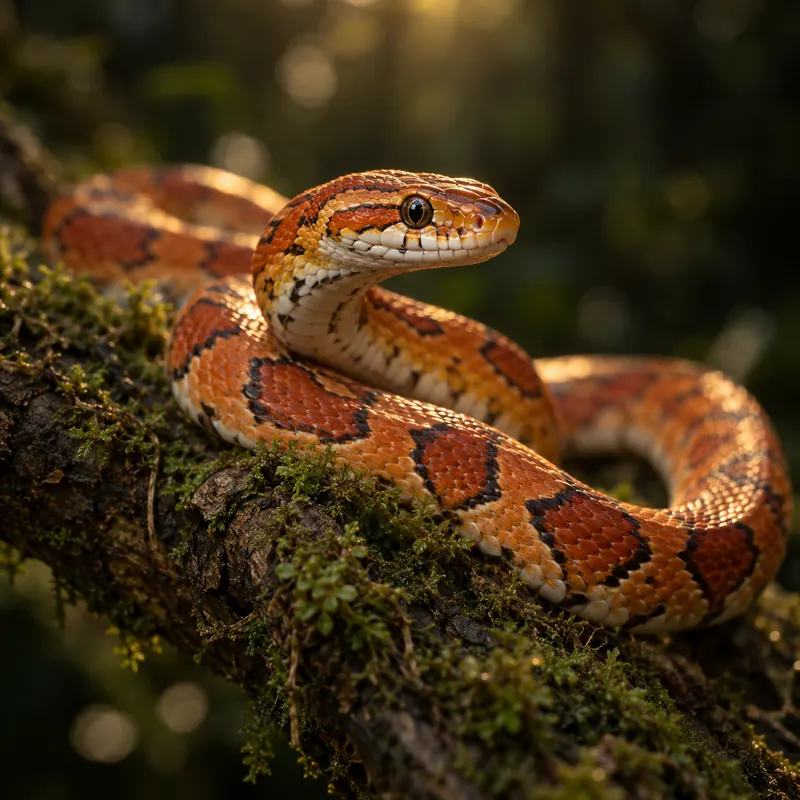
A corn snake spends most of its life exploring, climbing and burrowing, so it needs more room than its slim build suggests. For an adult, 4 x 2 x 2 ft (120 x 60 x 60 cm) is the minimum most current guidance agrees on, and bigger is better. The enclosure also has to be truly escape-proof, because corn snakes are famous for finding the one gap you missed.
How big do corn snakes get?
Size sets the enclosure, so start here. Sources give slightly different figures:
- ReptiFiles: most adults are 3 to 5 ft (0.9 to 1.5 m), with some as small as 2 ft or as large as 6 ft. Hatchlings are 10 to 15 in (25 to 38 cm).
- The RSPCA: around 150 cm (5 ft), with males normally smaller.
- The Royal Veterinary College (RVC): about 2 ft (60 cm) after the first year, and up to 150 cm (5 ft) as adults, usually within five years.
- PetMD: 4 to 6 ft.
- Animal Diversity Web: 48 to 120 cm (about 19 to 47 in) for wild corn snakes.
Sources also disagree on which sex is larger, so if you do not know your snake’s parents, plan for a large adult.
The minimums compared
| Source | Adult minimum |
|---|---|
| ReptiFiles | 48 x 24 x 24 in (120 x 60 x 60 cm), for all corn snakes |
| RVC | 48 x 24 x 24 in (120 x 60 x 60 cm), “as large a vivarium as possible” |
| RSPCA | As long as the snake, and one third of its length deep and tall |
| PetMD | 40 gallons or more for adults, 10 gallons or more for juveniles |
The first three line up well for a typical adult. Under the RSPCA rule, a 150 cm (5 ft) snake needs at least 150 x 50 x 50 cm, so a long adult outgrows a 4 ft enclosure. PetMD’s gallon figure is much smaller than the others, and a 40-gallon tank is well under 4 ft long, so treat it as an older, bare minimum rather than a target.
ReptiFiles also gives a simple formula for larger snakes, based on a Swiss standard: length equal to the snake’s length, width half its length, and height at least 2 ft (60 cm).
What about hatchlings and juveniles?
A young corn snake can feel exposed in a big, empty space, and a stressed snake may hide all the time or refuse food. ReptiFiles gives two options:
- Go straight to the adult enclosure, with plenty of small, tight hides and lots of cover, so the snake always has somewhere snug nearby.
- Use a smaller front-opening grow-out enclosure for snakes under about a year old.
The RVC says corn snakes grow to about 2 ft (60 cm) in the first year, so a grow-out setup is short-lived. Many keepers go straight to the adult size and fill it with clutter.
Height matters for a corn snake
Corn snakes are mainly ground-dwellers, but Animal Diversity Web notes that wild ones climb trees and bushes to hunt. The RVC says some pet corn snakes “love to climb,” and ReptiFiles suggests vertical climbing for adults. A 2 ft (60 cm) tall enclosure lets you add branches and still keep the lamp safely out of reach.
That last part matters. VCA advises keeping heat sources 4 to 6 in (10 to 15 cm) above the highest point the snake can reach. Plan your branch height around your lamp, not the other way round.
Escape-proofing
This is where corn snake enclosures most often fail. VCA asks for an escape-proof cage with a locking top, and the RSPCA says the enclosure must be secure.
- Front-opening enclosures need a lock or latch, ReptiFiles says. Sliding glass doors without a lock can be nosed open.
- Glass aquariums are “not particularly secure,” per ReptiFiles. It asks for at least four lid clamps, and more for larger tanks.
- Never use tape to seal a lid. ReptiFiles warns snakes can get stuck to it.
- Cable holes and vents need checking. Close any gap around wires, and make sure mesh is fixed on all sides.
- Check daily. A door left slightly open after feeding is enough.
VCA also warns that escaped snakes can be burned by heaters and lamps around the home while looking for warmth, which is one more reason to get this right.
Glass, PVC or wood?
| Material | Good points | Watch for |
|---|---|---|
| PVC | Light, holds heat well, does not mind humidity | Check the doors lock |
| Wood (melamine) vivarium | Holds heat well, common in the UK; the RVC calls wooden vivaria ideal | Harder to disinfect, as VCA notes; seal the joints |
| Glass tank | Easy to see into, widely sold | Cover three sides (ReptiFiles); top-opening lids need clamps |
ReptiFiles prefers front-opening enclosures because they are secure, easy to reach into, hold heat well, and let equipment sit on a mesh top outside the snake’s reach. The RVC adds that solid-sided vivariums give the snake visual security, with ventilation at snake level.
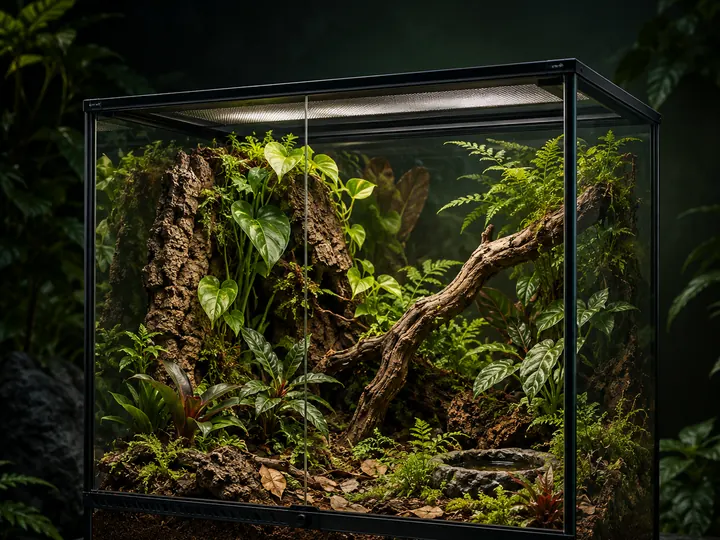
4 x 2 x 2 ft enclosure (US)
Reptile Habitats 4x2x2 PVC Enclosure V3 (120 gallon)
A 48 x 24 x 24 inch enclosure with PVC panels, front glass doors, an aluminum frame and a heavy-duty screen top. It matches the 4 x 2 x 2 ft (120 x 60 x 60 cm) minimum that ReptiFiles and the Royal Veterinary College give for an adult corn snake, and the screen top lets the heat lamp and UVB sit outside, out of reach.
- Size
- 48 x 24 x 24 in (about 120 x 60 x 60 cm)
- Walls
- PVC panels
- Front
- Glass doors
- Top
- Heavy-duty screen
- Weight
- About 25 lb (per the listing)
Best for
An adult corn snake, or a young one that will grow into it with extra hides and clutter.
Worth knowing
The listing does not describe a door lock. Corn snakes are escape artists, so fit a sliding-door lock if the doors do not lock, and check every vent and cable gap.
4 x 2 x 2 ft vivarium (UK)
4 x 2 x 2 ft (120 x 60 x 60 cm) lockable vivarium
Most UK corn snakes live in front-opening wooden or PVC vivariums with sliding glass doors. This link searches for the 120 x 60 x 60 cm size the Royal Veterinary College recommends as a minimum for a corn snake.
- Target size
- 120 x 60 x 60 cm (4 x 2 x 2 ft)
- Doors
- Front-opening, sliding glass with a lock
- Walls
- Wood (melamine) or PVC
Best for
UK keepers housing an adult, where 4 ft vivariums are the norm.
Worth knowing
Many "4ft" vivariums are only 45 to 50 cm deep and tall. Check all three measurements, make sure the doors take a lock, and plan a guard for any lamp inside.
Ventilation
The RVC says good ventilation is needed, and extra holes may have to be added. VCA also asks for a well-ventilated cage. Most commercial enclosures have vents or a mesh top. Just make sure every vent is covered with mesh the snake cannot push through.
Laying it out
Think of the enclosure in three zones:
- Warm end: basking lamp above, a basking spot below, and a warm hide nearby.
- Middle: branches, cork bark, plants and other cover, so the snake can move from end to end without crossing open ground.
- Cool end: a second hide and the water bowl.
ReptiFiles adds an optional humid hide on the warm side with damp sphagnum moss. It also suggests a background, because clear walls can stress snakes.
Under everything goes a loose substrate at least 3 in (8 cm) deep, which ReptiFiles recommends so the snake can burrow.
Where to put it
Pick a spot away from windows, radiators and drafts, so sunlight and room heaters do not throw off the gradient. A stable stand at about waist or chest height makes it easier to reach in from the front and to check the locks every day. The RVC suggests extra care in winter to make sure the heat keeps up, so avoid the coldest room in the house.
One snake per enclosure
The RSPCA and PetMD both say to keep corn snakes alone. ReptiFiles’ short answer on housing two together is “No”: it calls it an advanced practice that needs at least twice the minimum space, separate feeding, and vet clearance. Buy a second enclosure for a second snake.
Give a corn snake 4 ft of floor, 2 ft of height, and a door it cannot open. Fill the space with places to hide and climb, and it will use every inch.