
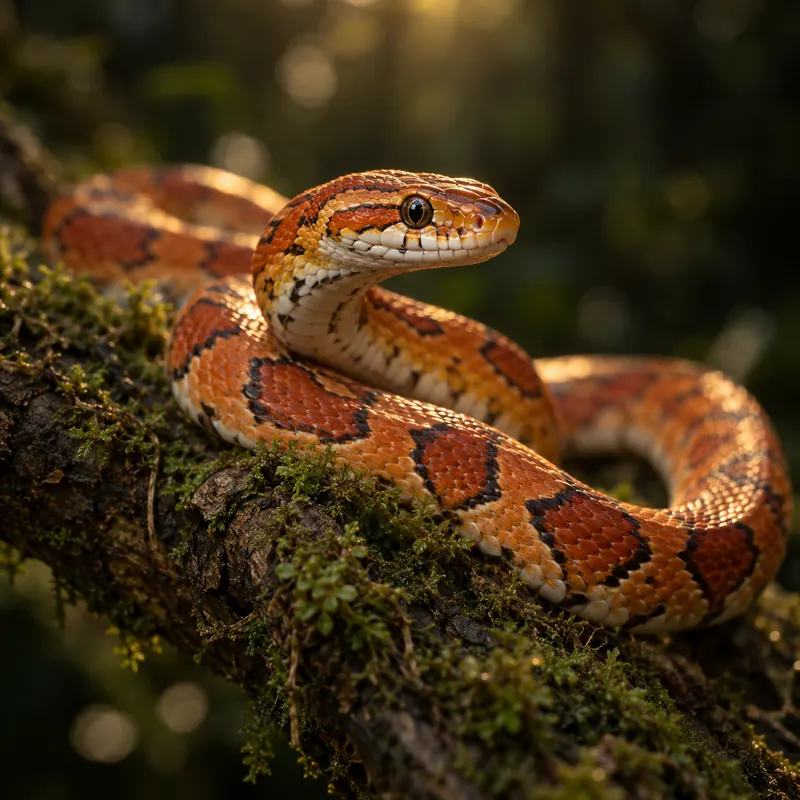
A corn snake digests, sheds and fights infection only as well as its temperature lets it. Your job is to give it a warm end and a cool end, keep both steady with a thermostat, and give it a clear day and night. Corn snakes are more relaxed about humidity than many reptiles, and UVB is a sensible low-level extra rather than the core of the setup.
Target temperatures
The sources agree on the shape of the gradient but not on every number. Here is what each says:
| Zone | RSPCA | RVC | ReptiFiles |
|---|---|---|---|
| Basking spot | 82 to 86°F (28 to 30°C) | About 86°F (30°C) | 90°F (32°C) surface |
| Cool end | 68 to 75°F (20 to 24°C) | Not given | 75 to 82°F (24 to 27°C) |
| Night | Can drop to 61 to 68°F (16 to 20°C) | Not below about 75°F (24°C) | Room temperature or 75°F (24°C); keep hatchlings warm |
The MSD Veterinary Manual gives a preferred air range of 77 to 86°F (25 to 30°C) for corn and rat snakes, with the basking spot about 9°F (5°C) warmer and nights about 9°F (5°C) cooler. PetMD gives a warm end of 85°F and a cool end in the low 70s °F.
In practice, a basking spot of about 86 to 90°F (30 to 32°C) with a cool end in the low to mid 70s °F (about 22 to 24°C) sits inside most of these ranges. The snake then picks the spot it needs.
Night temperatures are the biggest disagreement. The RSPCA allows a drop to 61 to 68°F (16 to 20°C), while the RVC asks for background heat so it does not fall below about 75°F (24°C). ReptiFiles says heat is usually off at night for adults but hatchlings under a year old should be kept warm. If your room gets cold at night, a heater that gives no light, on a thermostat, keeps things in range without breaking the day and night cycle.
Overhead heat: the main heat source
ReptiFiles rates halogen bulbs as the best heat source for corn snakes, and the RVC describes a light-emitting spot bulb over the basking area, on all day and off at night. Overhead heat warms the surface below and the snake’s back at the same time, much like the sun.
How to set it up:
- Put the lamp at one end only, so the far end stays cool.
- Use a ceramic socket. ReptiFiles warns against plastic sockets for heat lamps.
- Keep it out of reach. VCA advises putting the heat source outside the cage behind a screen, at least 4 to 6 in (10 to 15 cm) above the highest point the snake can reach. The RVC says heat sources should be guarded. In a UK vivarium with the lamp inside, a mesh guard is essential.
- Place a basking spot underneath, such as a flat rock, cork round or low branch.

Basking lamp
Halogen basking lamp (Zoo Med Repti Tuff in the US, Arcadia in the UK)
A halogen heat bulb for the basking spot. ReptiFiles rates halogen bulbs as the best heat source for corn snakes, because they warm the surface below the way the sun does. The US pick is a Zoo Med 75 W two pack; the UK link searches for the Arcadia Halogen Basking Spot.
- Type
- Halogen heat bulb
- US pick
- Zoo Med Repti Tuff, 75 W, 2 pack
- US rated life
- Up to 2,500 hours (per Zoo Med)
- UK fitting
- E27 screw
Best for
The daytime basking lamp: in a ceramic-socket dome on a screen top, or in a guarded ceramic holder inside a vivarium.
Worth knowing
Run it on a dimming thermostat. Pick the wattage that suits your enclosure and room: start low and step up only if the basking spot will not reach temperature.
Heat mats: useful, but secondary
Heat mats are common in corn snake kits. ReptiFiles says they are fine as a secondary heat source under a hide, but not as the main one. The RSPCA describes a heat mat at the hot end for hatchlings, set to 86°F (30°C) on a thermostat, and the RVC lists a heat mat on the back wall as one way to provide background heat.
The rule for every source is the same: a heat mat must run on a thermostat. ReptiFiles says this applies whatever temperature the packaging advertises.
The thermostat
A thermostat reads the temperature through a probe and turns the heater down when it gets warm enough. Without one, a lamp or mat simply keeps heating. VCA lists burns from lamps, bulbs and heaters among the common problems in pet snakes.
Match the thermostat to the heater:
| Heater | Thermostat type |
|---|---|
| Halogen or other bulb that gives light | Dimming (or proportional). ReptiFiles says on/off is not suitable. |
| Heat mat or heat cable | On/off, pulse or proportional |
| Heater with no light, such as a ceramic emitter | Pulse, proportional or dimming |
Fix the probe where the snake actually lies, such as at the basking spot or on the floor of the warm hide. Then check the temperature yourself with a separate thermometer. Probes get knocked, and thermostats can drift.
Dimming thermostat (UK)
Habistat Dimming Thermostat, Classic Range (600 W)
A UK-made dimming thermostat designed for heat bulbs. It turns the power down smoothly as the probe reaches the set temperature, instead of flicking the lamp on and off.
- Max load
- 600 W
- Control
- Dimming
- Use with
- Heat bulbs and heaters
Best for
Running a halogen basking lamp or Deep Heat Projector in a UK vivarium.
Worth knowing
Made for lamps and heaters. For a heat mat, use a mat or pulse thermostat.
Dimming and pulse thermostat (US)
Exo Terra Thermostat with Day and Night Timer (600 W)
A reptile thermostat with both dimming and pulse-proportional control, so it can run a halogen lamp smoothly or a heater that gives no light. Day and night targets are set separately.
- Max load
- 600 W
- Control modes
- Dimming and pulse proportional
- Set range
- 50 to 140°F (10 to 60°C)
- Timer
- Separate day and night settings
Best for
Controlling the basking lamp in a US setup.
Worth knowing
Fix the probe at the basking spot where the snake lies, and check it against a separate thermometer.
On/off thermostat for a heat mat
Inkbird ITC-306T Heating Thermostat with Timer
A plug-in on/off thermostat with a probe, two heating outlets and separate day and night targets. On/off control suits heat mats, which ReptiFiles says must always run on a thermostat.
- Control
- On/off, heating only
- Outlets
- 2 (heating)
- Max load
- 10 A
- Timer
- Day and night set points
Best for
Keeping a heat mat under a hatchling's warm hide at a safe temperature.
Worth knowing
On/off control makes a light bulb flash, so use a dimming thermostat for lamps. Tape the probe where the snake rests so it cannot be moved.
Measuring
The RVC recommends a digital thermometer that records the maximum and minimum, and says to check carefully in winter that the heat is keeping up. VCA suggests two thermometers, one at each end, near the height where the snake rests. An infrared thermometer is the quickest way to read the basking surface itself.

Thermometer and hygrometer
ThermoPro (TempPro) TP50 Digital Thermometer and Hygrometer
A small digital gauge that shows temperature and humidity and keeps the highs and lows, which the Royal Veterinary College recommends for checking reptile heat.
- Reads
- Temperature and humidity
- Memory
- Min and max records
Best for
One at each end of the enclosure. The UK listing is a 2 pack.
Worth knowing
It reads the air where it sits, not the surface under the lamp. Pair it with an infrared thermometer.
Humidity
Corn snakes come from the United States, and most sources set their humidity well below that of a tropical snake. Here too, sources give different ranges:
- RSPCA: about 40 to 50%.
- PetMD: 40 to 60%, rising to about 70% while shedding.
- RVC: 50 to 60%.
- MSD Veterinary Manual: 30 to 70%, higher during shedding.
- ReptiFiles: 65 to 75% on average, with occasional swings outside that range being fine.
Most homes sit somewhere in the lower half of that range. A damp substrate, a large water bowl and a humid hide with damp sphagnum moss are usually enough. If sheds come off in pieces, raise humidity a little. If the enclosure stays wet and stale, improve ventilation.
Day and night
The RSPCA and RVC both suggest 12 hours of light and 12 hours of dark. ReptiFiles adds an optional seasonal shift: 13 hours in summer and 11 in winter. Put the lights on a plug-in timer so the cycle never slips.
Skip colored “night” bulbs. ReptiFiles says red, blue and similar bulbs may disrupt the day and night cycle. If a hatchling or a cold room needs night heat, use a heater that gives no light.
UVB: what the sources say
This is the area where sources disagree most, so here is each view:
- The MSD Veterinary Manual lists no special lighting requirement for corn snakes, but still recommends broad-spectrum light.
- VCA says vets disagree about UVB for snakes, but that it is not harmful and may help.
- The RVC says corn snakes “appear to benefit” from UVB and recommends a low level for 12 hours a day.
- The RSPCA asks for a low-output 2 to 7% tube covering one third to one half of the enclosure at the hot end. It gives a UV index (UVI) of up to 1.0 at the basking spot, falling to zero in the shade, and a lower maximum of 0.7 for albino corn snakes.
- ReptiFiles suggests a higher UVI of 2.0 to 3.0 at the basking spot, using a T5 tube, and recommends checking with a UV meter.
A fair reading is that UVB is helpful rather than essential, and that low output is the safe choice. If you add it, mount a low-output linear tube at the warm end, beside the heat lamp, so the brightest, warmest spot is in one place and the cool end stays shaded. Follow the maker’s distance chart, and replace the lamp on schedule.

Low-output UVB
Arcadia ShadeDweller Max UVB Kit (2.5%, 14 W)
A low-output UVB and full-spectrum lamp kit made for shade-dwelling and partly basking snakes. The RSPCA asks for a low-output 2 to 7% UVB tube for corn snakes, and the Royal Veterinary College recommends a low level of UV.
- UVB
- 2.5%
- Power
- 14 W
- Length
- About 22 to 24 in (55 to 60 cm)
Best for
Gentle UVB and a bright day over the warm half of a 4 ft enclosure, including albino morphs, which the RSPCA says need lower UV.
Worth knowing
Mount it at the warm end so the snake can move into shade. Follow Arcadia's distance chart, and replace the lamp on schedule.
A sample day
Putting it all together for a typical adult:
- Morning: the timer turns on the basking lamp and the UVB tube, if you use one.
- Daytime: the thermostat holds the basking spot at about 86 to 90°F (30 to 32°C). The cool end stays in the low to mid 70s °F (about 22 to 24°C).
- Evening: after about 12 hours, the timer turns the lights off.
- Night: the enclosure cools toward room temperature. For a hatchling, or in a cold room, a heater that gives no light keeps it above your chosen night minimum.
Check both thermometers each morning and evening for the first few weeks, then daily. The RVC advises extra checks in winter, when the heat has to work harder.
Never use
- Heat rocks. VCA calls them dangerous and ineffective.
- A heater without a thermostat.
- An unguarded lamp inside the enclosure.
Warm at one end, cool at the other, steady on a thermostat, dark at night. Get that right and a corn snake will look after the rest itself.