
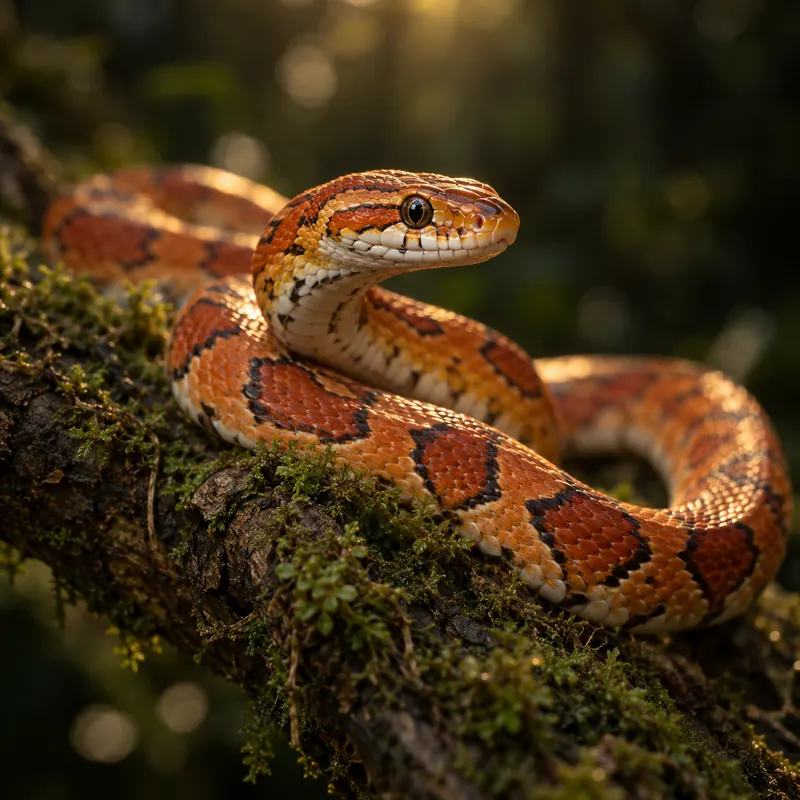
Corn snakes are hardy, which is why they are so often recommended as a first snake. But hardy does not mean problem-proof. Most trouble comes from a handful of setup and feeding mistakes, and every one of them is easy to fix once you know about it.
1. A lid or door that does not lock
The mistake: a screen lid that simply rests on a glass tank, or sliding doors with no lock.
Why it matters: corn snakes are strong, curious and excellent at finding gaps. VCA asks for an escape-proof cage with a locking top. An escaped snake is also at risk around the house: VCA notes that snakes looking for warmth can burn themselves on heaters and lamps.
The fix: use a front-opening enclosure with a lock, as ReptiFiles prefers, or at least four lid clamps on a glass tank. Close off cable holes. Check the lock every time you close it.
2. Taping the lid shut
The mistake: using tape to seal a gap or hold a lid down.
Why it matters: ReptiFiles warns that snakes can get stuck to the sticky side.
The fix: use proper clamps, a lock, or a better-fitting lid.
3. A heat mat or lamp with no thermostat
The mistake: plugging a heater straight into the wall because the box says it is “safe” or “ready to use.”
Why it matters: an unregulated heater keeps heating. VCA lists burns from lamps, bulbs and heaters among the common problems in pet snakes. ReptiFiles says heat mats must always be used with a thermostat, whatever temperature they claim.
The fix: every heater gets its own thermostat. Use a dimming thermostat for bulbs, and an on/off or pulse thermostat for mats. See the lighting and heating guide.

Thermostat for a heat mat
Inkbird ITC-306T Heating Thermostat with Timer
A plug-in on/off thermostat with a probe, two heating outlets and separate day and night targets. On/off control suits heat mats, which ReptiFiles says must always run on a thermostat.
- Control
- On/off, heating only
- Outlets
- 2 (heating)
- Max load
- 10 A
- Timer
- Day and night set points
Best for
Keeping a heat mat under a hatchling's warm hide at a safe temperature.
Worth knowing
On/off control makes a light bulb flash, so use a dimming thermostat for lamps. Tape the probe where the snake rests so it cannot be moved.
4. A heat mat as the only heat source
The mistake: relying on a small mat under one corner to heat the whole enclosure.
Why it matters: ReptiFiles says heat mats are fine as a secondary heat source but should not be the main one. A mat warms a small patch of floor, not the basking area or the air.
The fix: use an overhead halogen lamp on a dimming thermostat as the main heat. Keep the mat, on its own thermostat, under a hide if you want extra warmth for a hatchling.
5. A lamp the snake can reach
The mistake: a bare bulb inside the enclosure, or a branch that climbs right up to the lamp.
Why it matters: corn snakes climb, and a hot bulb can burn them badly.
The fix: mount the lamp outside the enclosure on a mesh top, or inside behind a guard. VCA advises keeping heat sources 4 to 6 in (10 to 15 cm) above the highest point the snake can reach.
6. Heat rocks
The mistake: buying a heated rock as the warm spot.
Why it matters: VCA calls heat rocks dangerous and ineffective, and ReptiFiles says they cause severe burns.
The fix: skip them entirely. Overhead heat on a thermostat does the job safely.
7. Guessing the temperature
The mistake: trusting the thermostat dial, or a stick-on dial gauge, without checking.
Why it matters: the snake lives in the temperatures you actually have, not the ones you set. The RSPCA’s basking range is 82 to 86°F (28 to 30°C), and ReptiFiles aims for a 90°F (32°C) basking surface. Both are easy to miss by several degrees.
The fix: use a digital thermometer at each end and an infrared thermometer for the basking spot. Check daily.

Thermometer and hygrometer
ThermoPro (TempPro) TP50 Digital Thermometer and Hygrometer
A small digital gauge that shows temperature and humidity and keeps the highs and lows, which the Royal Veterinary College recommends for checking reptile heat.
- Reads
- Temperature and humidity
- Memory
- Min and max records
Best for
One at each end of the enclosure. The UK listing is a 2 pack.
Worth knowing
It reads the air where it sits, not the surface under the lamp. Pair it with an infrared thermometer.
8. Cedar or pine bedding
The mistake: using cedar or pine shavings because they are cheap and smell nice.
Why it matters: VCA says cedar shavings are toxic to reptiles. ReptiFiles says to avoid cedar entirely, and to steer clear of pine too, although kiln-dried pine may be relatively harmless short term.
The fix: use a loose, soil-like substrate such as coconut fiber, at least 3 in (8 cm) deep, as ReptiFiles suggests. It also lets your snake burrow.
9. An empty enclosure
The mistake: one hide, a water bowl and a lot of bare floor.
Why it matters: corn snakes feel safest when they can move under cover. ReptiFiles stresses plenty of tight hiding places for young snakes and room to climb for adults. With only one hide, the snake has to choose between feeling safe and being at the right temperature.
The fix: a hide at each end, plus branches, cork bark and plants filling the space between. Use the height of the enclosure for climbing, with the lamp kept out of reach.
10. Feeding live prey, or leaving it unattended
The mistake: dropping a live mouse in and walking away.
Why it matters: VCA warns that live rodents can bite and injure a snake, and that dead prey is safer and more humane. ReptiFiles says corn snakes usually take frozen-thawed prey readily.
The fix: feed frozen-thawed prey with tongs. If a vet ever advises live prey for a snake that will not take anything else, never leave it unattended. ReptiFiles says no more than one hour, and VCA says to remove uneaten live prey after two hours.
11. Overfeeding
The mistake: feeding an adult every week, or offering prey that is too big, because the snake always seems hungry.
Why it matters: corn snakes are eager eaters, and that makes them easy to overfeed. ReptiFiles suggests adults eat every 14 to 21 days and that an overweight adult may need 21 to 35 days between meals. The RSPCA gives 7 to 14 days for adults, so the safe range is wide, but feeding at the short end of it every time can add weight.
The fix: follow an age-based schedule, size prey to about the width of the snake’s thickest part, and weigh the snake regularly in grams. See the diet guide.
12. Handling too soon, or right after a meal
The mistake: picking up a new snake on day one, or handling it the day after it eats.
Why it matters: ReptiFiles suggests letting a new snake settle for about two weeks and waiting until it is eating regularly. Both ReptiFiles and the RSPCA say to wait 48 hours after a meal, because handling can cause regurgitation.
The fix: leave a new snake alone for its first couple of weeks, and keep a simple log of feeding days so you always know when it last ate.
Bonus: pulling off stuck shed
If a shed comes off in pieces, it is tempting to peel it. ReptiFiles says never to pull stuck shed off without soaking first, and that stuck shed should be dealt with quickly because it can harden and restrict blood flow. Offer a warm soak or a humid hide with damp moss, then check that the eye caps and tail tip came off. VCA warns that retained eye caps can cause permanent eye damage, so see a vet if they stay on.
Lock it, regulate it, measure it, and do not overfeed it. Most corn snake problems start with one of those, and all of them are cheap to fix.