
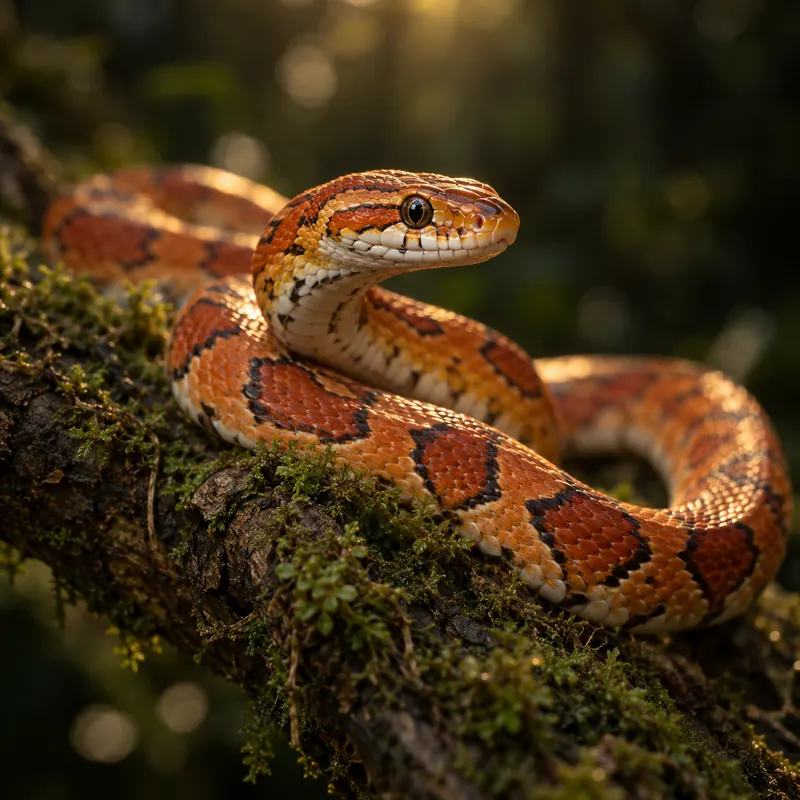
Short answers to the questions people ask most about corn snakes. Each one links to the page with more detail.
How long do corn snakes live?
Usually well over a decade. The RSPCA gives around 10 to 15 years, the RVC up to 20 years, PetMD 20 years or more, and ReptiFiles 15 to 25 years with good care. Animal Diversity Web lists a captive record of just over 32 years. Plan for a commitment of 15 to 20 years or more.
How big do corn snakes get?
Most adults are about 3 to 5 ft (90 to 150 cm). ReptiFiles gives 3 to 5 ft, with some as small as 2 ft or as large as 6 ft, and PetMD says 4 to 6 ft. The RVC says they reach about 2 ft (60 cm) in the first year and full size, up to about 5 ft (150 cm), usually within five years.
What size enclosure does an adult need?
At least 4 x 2 x 2 ft (120 x 60 x 60 cm), the minimum given by both ReptiFiles and the RVC. The RSPCA scales it to the snake: at least as long as the snake, and a third of its length deep and tall. See the enclosure size guide.
Are corn snakes good for beginners?
Yes. ReptiFiles describes them as docile, active and generally hardy, and they are not venomous. They are forgiving of small mistakes, but they still need a proper heat gradient, a thermostat and an escape-proof enclosure, and they live for decades.
Do corn snakes bite?
They can, especially as hatchlings. ReptiFiles says young corn snakes are often nervous and may strike, but that bites from adults are not serious or very painful. Most bites happen when a snake is startled, or when your hands smell like food. Wash your hands after touching prey.
How often can I handle my corn snake?
Once it has settled and is eating well, ReptiFiles suggests handling at least once or twice a week, but no more than once a day. Start with sessions of 5 minutes or less and build up. The RSPCA suggests about 10 to 15 minutes out at a time. Never handle within 48 hours of a meal, or while the snake’s eyes are cloudy before a shed. The first week guide covers how to pick one up.
Why do corn snakes escape so often?
They are active explorers that test every edge of their space, and many enclosures have weak spots: unlocked sliding doors, loose screen lids or open cable holes. Use a lock or clamps, close every gap, and check the lock each time you close the enclosure.
What temperatures does a corn snake need?
A basking spot of about 82 to 90°F (28 to 32°C) and a cooler end. The RSPCA gives 82 to 86°F (28 to 30°C) for basking and 68 to 75°F (20 to 24°C) at the cool end. ReptiFiles aims a little warmer, with a 90°F (32°C) basking surface and a 75 to 82°F (24 to 27°C) cool side. The MSD Veterinary Manual gives an air range of 77 to 86°F (25 to 30°C). See the lighting and heating guide.
What humidity do corn snakes need?
Moderate. The RSPCA gives about 40 to 50%, PetMD 40 to 60%, the RVC 50 to 60%, and the MSD Veterinary Manual 30 to 70%. ReptiFiles aims higher, at 65 to 75%. A humid hide with damp moss helps around shedding time.
Do corn snakes need UVB?
Sources differ. The MSD Veterinary Manual lists no special lighting requirement but still recommends broad-spectrum light. The RVC says corn snakes appear to benefit from a low level of UVB, and the RSPCA asks for a low-output tube at the hot end with plenty of shade. If you add it, keep it low-output, especially for albino morphs, which the RSPCA says need less.
What do corn snakes eat, and how often?
Whole rodents, usually frozen-thawed mice. The RSPCA suggests a pinkie every 5 to 6 days for hatchlings and an adult mouse every 7 to 14 days for adults. The RVC says adults usually eat every 1 to 2 weeks, and PetMD agrees. Prey should be about as wide as the thickest part of the snake. The diet guide has the full schedule.
My corn snake will not eat. Should I worry?
Not straight away. Snakes often skip meals before a shed or after a move. Check the basking temperature first. PetMD advises a vet visit if a snake misses more than a couple of feeds, especially if it is not shedding, or if it also seems lethargic or is losing weight.
How often do corn snakes shed?
The RSPCA says there is no fixed schedule and that young snakes shed more often. Dull skin and cloudy, blue-looking eyes mean a shed is coming. A healthy shed comes off in one piece. If it comes off in patches, check humidity and offer a humid hide.
Can two corn snakes live together?
It is best not to. The RSPCA and PetMD both advise keeping corn snakes alone, and the RVC notes that they generally live alone in the wild except when breeding. PetMD warns that housing more than one can cause stress and competition.
How often should a corn snake see a vet?
VCA advises a check-up with a reptile vet within one week of bringing a new snake home, then at least once a year, with a fecal test for parasites each time. The RVC also recommends yearly health checks, because problems are easier to treat when caught early. See a vet sooner for wheezing, bubbles at the mouth, visible mites, swellings, stuck shed around the eyes, or weight loss.
Where do corn snakes come from?
The eastern and south-central United States. Animal Diversity Web describes their range as running from southern New Jersey to Florida and west to Louisiana, with the closely related Great Plains rat snake further west. They live in forests, fields and rocky areas, and climb trees and bushes to hunt.
A corn snake asks for a secure home, a steady warm end and a mouse every week or two. Give it those, and you have a calm, curious companion for twenty years.