
The enclosure is the biggest single purchase in a reptile setup, and the one you least want to buy twice. The material decides how well it holds heat and humidity, the doors decide how calm your animal is when you reach in, and the shape decides whether it can climb, burrow or stretch out. This guide compares the four common materials and explains how to size an enclosure for the kind of animal you keep.
The short version
-
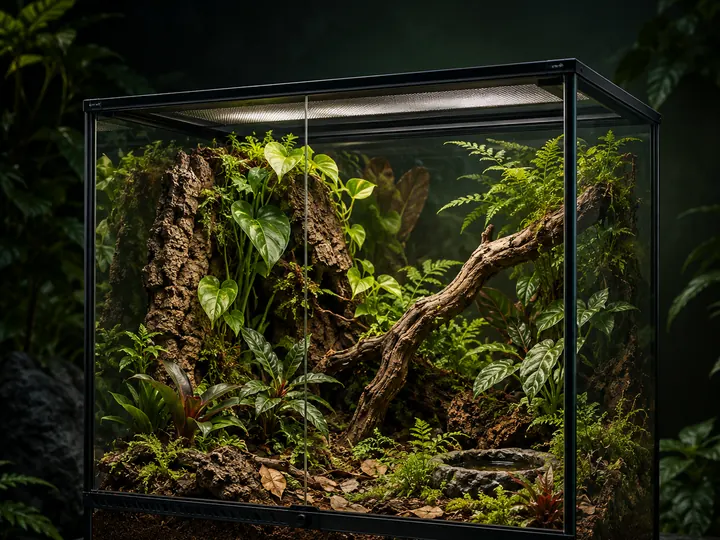 Glass, 3 ft, front-opening REPTI ZOO 50 Gallon Glass Terrarium (36 x 18 x 18 in) Amazon
 - Glass, 3 ft, front-opening Exo Terra Glass Terrarium, 90 x 45 x 45 cm (36 x 18 x 18 in) Amazon UK
- PVC, 4 x 2 x 2 ft Reptile Habitats 4x2x2 PVC Enclosure V3 (120 gallon) Amazon
- PVC, 4 x 2 x 2 ft 4 x 2 x 2 ft (120 x 60 x 60 cm) front-opening vivarium Amazon UK
- Large 4 x 2 x 2 ft for lizards 4 x 2 x 2 ft front-opening reptile enclosure (120 gallon) Amazon
- Large 4 x 2 x 2 ft for lizards Repti-Life 48 x 24 x 24 inch Vivarium (4ft, flatpacked) Amazon UK
-
 Heat for solid-top enclosures Reptile radiant heat panel, ceiling mounted (about 40 to 80W) Amazon
 - Heat for solid-top enclosures Reptile radiant heat panel, ceiling mounted (about 40 to 80W) Amazon UK
-
 Humidity and temperature gauge ThermoPro TP50 Digital Thermometer and Hygrometer Amazon
 - Humidity and temperature gauge ThermoPro TP50 Digital Thermometer and Hygrometer Amazon UK
- Soil base for a naturalistic setup Zoo Med Eco Earth Coconut Fiber Substrate (3 bricks) Amazon
- Soil base for a naturalistic setup Exo Terra Plantation Soil, 8.8 L Amazon UK
What every enclosure must do
Before material or size, check the basics. The RSPCA says a snake vivarium must be secure, well ventilated, easy to clean and able to hold heat. VCA adds that snake cages must be escape-proof, with sealed seams and a top that locks. Those rules apply to lizards too.
ReptiFiles makes a useful point in its own comparison: the enclosure itself does not define good care. It is how you set it up and run it that counts. Any of the materials below can work if you plan around its weak spots.
The four materials compared
| Material | Heat | Humidity | Ventilation | Weight | Main drawbacks |
|---|---|---|---|---|---|
| Glass terrarium | Loses heat | Hard to hold without changes | Good, through a mesh top | Heavy | Shatters if damaged; mesh top blocks some UVB |
| PVC | Holds heat very well | Holds it very well | Often limited | Light | Higher-end ones cost more; can hold heat too well |
| Screen (mesh) | Hard to hold | Hard to hold | Very high | Very light | Leaky, harder to see through and disinfect |
| Wood or melamine | Holds heat fairly well | Fairly well | May be limited | Light to medium | Can rot with standing water; hard to disinfect; flammable |
These pros and cons come from ReptiFiles’ comparison, with VCA’s note that wooden cages are very difficult to clean and disinfect thoroughly.
Glass
A glass terrarium is easy to buy, easy to see into, and the mesh top makes it simple to sit lamps on top. ReptiFiles calls the front-opening glass terrarium the best all-around enclosure. Its weak points: glass is heavy, it does not hold heat or humidity well without changes, and it shatters into sharp pieces if broken. ReptiFiles also notes that glass front-opening terrariums for ground dwellers top out at about 48 x 24 x 24 inches (122 x 61 x 61 cm).
Glass has one quiet strength. ReptiFiles says glass sheds heat well and lets the enclosure dry out between mistings, which discourages mold. That suits dry-country species.
Glass terrarium, 36 x 18 x 18 in (US)
REPTI ZOO 50 Gallon Glass Terrarium (36 x 18 x 18 in)
A front-opening glass terrarium at 36 x 18 x 18 inches, the footprint ReptiFiles gives as the minimum for an adult leopard gecko. The two front doors open separately and the bottom frame is raised so a heat mat can fit underneath.
- Size
- 36 x 18 x 18 in (91 x 46 x 46 cm)
- Volume
- Sold as 50 gallons
- Access
- Two front-opening doors, screen top
Best for
US keepers who want the recommended adult size in glass without a custom build.
Worth knowing
Glass loses heat faster than PVC, and the top frame is not meant to carry heavy fixtures. Rest lamps in a dome or on a stand.
Glass terrarium, 90 x 45 x 45 cm
Exo Terra Glass Terrarium, 90 x 45 x 45 cm (36 x 18 x 18 in)
Exo Terra's large wide glass terrarium, with dual front-opening doors, a mesh top for lighting, and a raised bottom frame for an under-tank heater. Sold in both the US and UK at the 36 x 18 x 18 inch size.
- Size
- 90 x 45 x 45 cm (36 x 18 x 18 in)
- Access
- Dual front-opening doors
- Top
- Removable mesh cover
Best for
A widely available glass option in either market, at the size most care guides now suggest.
Worth knowing
The mesh top blocks some UVB, so the UVB lamp distance needs to account for it.
PVC
PVC enclosures are light, strong, stackable and hold both heat and humidity very well, which is why many snake keepers prefer them. ReptiFiles warns they are often not well ventilated and can hold heat so well that the cool end warms up too. Plan heating carefully: most have a solid top, so lamps go inside with guards, or you use a ceiling-mounted radiant panel.
PVC enclosure, 4 x 2 x 2 ft (US)
Reptile Habitats 4x2x2 PVC Enclosure V3 (120 gallon)
A 48 x 24 x 24 inch enclosure with PVC side and back panels, front glass doors, an aluminum frame and a heavy-duty screen top. Opaque PVC walls hold heat and humidity better than an all-glass tank, and the screen top lets a heat lamp and UVB tube sit above it.
- Size
- 48 x 24 x 24 in (about 120 x 60 x 60 cm)
- Walls
- PVC panels
- Front
- Glass doors
- Top
- Heavy-duty screen
- Frame
- Aluminum
Best for
An adult ball python, sized to the 4 x 2 x 2 ft (120 x 60 x 60 cm) enclosure ReptiFiles recommends.
Worth knowing
A screen top lets humidity escape, so you may need to cover part of it. Lamps on top still need a thermostat. Check the door lock before you trust it with a strong snake.
Screen
All-mesh cages give the most airflow and are light and cheap. They struggle to hold heat or humidity. ReptiFiles’ veiled chameleon care sheet notes that although chameleons are often said to need full mesh, in a moderate or humid climate it is still best to cover two sides with opaque plastic, and in a very dry climate a glass, wood or PVC enclosure may suit better. Screen is rarely the right choice for ground-dwelling lizards or snakes.
Wood and melamine
Wooden vivariums, common in the UK, are usually made of melamine-faced board with a glass front. They hold heat fairly well and give the animal solid walls for security. The weak spots are water and cleaning: ReptiFiles says wood may rot where water stands, and VCA says wooden cages are very difficult to disinfect. Seal the corners with aquarium-safe silicone if you plan to keep humidity high, and keep heat bulbs guarded, since wood burns.
Wooden vivarium, 4 x 2 x 2 ft (UK)
Repti-Life 48 x 24 x 24 inch Vivarium (4ft, flatpacked)
A UK-made wooden vivarium in the 4 x 2 x 2 ft size, built from 15 mm melamine-faced board with a toughened glass front. Wooden vivaria hold heat well and give a dragon solid walls for security.
- Size
- 48 x 24 x 24 in (about 122 x 61 x 61 cm)
- Material
- 15 mm MFC (melamine-faced chipboard)
- Front
- 4 mm toughened safety glass
- Ventilation
- Four large vents
- Other
- Stackable, solid back, made in the UK
Best for
UK keepers who want a full adult-size vivarium at the RSPCA minimum footprint.
Worth knowing
It arrives flatpacked, so plan an hour or two to build it. Lamps mount inside a wooden viv, so every heat bulb needs a guard and a thermostat.
Front-opening vs top-opening
Pick front doors if you can. ReptiFiles says front-opening enclosures make reaching the animal easier and less startling, and notes that top-only access can make animals more defensive. Front doors also let you clean and change water without lifting heavy lamps off the lid.
Sizing by body plan
Every species has its own minimum (see the species pages), but the logic follows the animal’s shape and lifestyle.
Ground dwellers (terrestrial lizards)
The MSD Veterinary Manual says terrestrial species usually need more horizontal space. Floor length matters most, because the gradient runs from end to end. A long enclosure lets you put real distance between the hot basking spot and the cool hide. Leopard geckos and bearded dragons fall here, and both still use some height to climb. Depth (front to back) matters too: it gives room for hides, a water bowl and a basking stone without crowding them into one line.
4 x 2 x 2 ft enclosure (US)
4 x 2 x 2 ft front-opening reptile enclosure (120 gallon)
Not one product but the size to shop for: a 48 x 24 x 24 inch (about 120 x 60 x 60 cm) enclosure with front doors. That footprint matches the RSPCA minimum for one adult dragon and leaves room for a real hot-to-cool gradient.
- Size to look for
- 48 x 24 x 24 in (about 120 x 60 x 60 cm) or larger
- Access
- Front-opening doors
- Top
- Mesh or solid top that can carry lamp fixtures
- Materials
- PVC, glass or melamine
Best for
US keepers who want one enclosure from baby to adult, without buying a starter tank first.
Worth knowing
Listings vary a lot. Check the inside dimensions, that the top can carry a T5 UVB fixture and heat domes, and whether the lamps sit over mesh (which cuts UVB) or mount inside.
Climbers (arboreal lizards)
For tree dwellers, height comes first. ReptiFiles says that because crested geckos are arboreal, height is better than width or depth, and gives an adult minimum of 18 x 18 x 36 inches (46 x 46 x 91 cm). For veiled chameleons it gives 24 x 24 x 48 inches (60 x 60 x 120 cm) as the minimum and strongly recommends larger. A tall enclosure also gives a natural gradient, warm at the top and cooler near the floor.
Snakes
For snakes, sources measure against the snake’s length:
- ReptiFiles says a ball python should have an enclosure at least as long as the snake, and suggests 48 x 24 x 24 inches (122 x 61 x 61 cm) for adults, with extra height for climbing as best practice.
- The RSPCA says the vivarium should be at least one third of the snake’s length in both width and height.
Taken together: the length should at least match the snake, and the width and height should each be at least a third of its length. Larger is better in every source we read.
Vivarium, 120 x 60 x 60 cm (UK)
4 x 2 x 2 ft (120 x 60 x 60 cm) front-opening vivarium
In the UK most royal pythons live in wooden or PVC vivariums with sliding glass front doors. This link searches for the 120 x 60 x 60 cm size that matches the adult guidance from ReptiFiles and is above the RSPCA minimum for a typical adult.
- Target size
- 120 x 60 x 60 cm (4 x 2 x 2 ft)
- Doors
- Front-opening, sliding glass with a lock
- Walls
- Wood (melamine) or PVC
Best for
UK keepers housing an adult, where 4 ft wooden and PVC vivariums are the norm.
Worth knowing
Many "4ft" vivariums are only 45 to 50 cm deep and tall. Check all three measurements. Wooden vivariums need sealed joints if you keep humidity high, and any lamp inside needs a guard.
Ventilation and humidity: a balancing act
Airflow and humidity pull against each other. More vents let stale, damp air out, which keeps mold away, but they also let humidity escape.
- Dry species in glass: usually easy. The mesh top vents well and humidity stays low.
- Humid species in glass: cover part of the mesh top (never the part under a heat lamp or UVB lamp) to hold moisture in.
- Humid species in PVC: usually easy. Watch for stuffy air and condensation; if the walls stay wet, add ventilation.
- Screen for humid species: cover some sides, as ReptiFiles suggests for chameleons.
The RSPCA notes that if humidity stays high all the time, ventilation needs improving. Put a digital hygrometer probe at animal level to see what is really happening.
Temperature and humidity gauge
ThermoPro TP50 Digital Thermometer and Hygrometer
A small digital gauge that shows temperature and humidity and records the highs and lows. The magnetic back makes it easy to fit and move.
- Humidity range
- 10 to 99% RH
- Stated accuracy
- ±1°F, 2 to 3% RH
- Mounting
- Stand or magnet
Best for
Watching humidity on the cool and warm sides. Buy two, one for each end.
Worth knowing
It reads the air where it sits, not the surface under the heat lamp. Pair it with an infrared thermometer.
Bioactive basics
A bioactive enclosure is a small living system: real soil, live plants, leaf litter and a “cleanup crew” of tiny invertebrates that eat waste and mold.
- The crew: ReptiFiles describes springtails and isopods as breaking down organic matter and returning nutrients to the soil. It says springtails can build a stable population within a few weeks.
- They hide well. New keepers often think the crew has died. ReptiFiles suggests looking under the water dish or the top layer of leaves before deciding.
- Feed the crew if there is not enough waste for them. ReptiFiles mentions leaf litter and wood for isopods, plus occasional produce.
- Avoid red wiggler worms. ReptiFiles warns they can release a toxic substance when disturbed.
Bioactive works best in glass or PVC, which handle damp soil without rotting. It suits species whose substrate stays slightly moist. It still needs spot cleaning, and it takes more planning than a simple setup, so many keepers start simple and switch later. Our substrate, hides and decor guide covers soil mixes and plants.
Coconut fiber soil base (US)
Zoo Med Eco Earth Coconut Fiber Substrate (3 bricks)
Compressed coconut fiber bricks that expand in water into a loose, soil-like substrate that holds moisture well.
- Pack
- 3 compressed bricks
- Each brick makes
- About 7 to 8 liters
- Material
- Coconut fiber
Best for
A humidity-holding base layer, alone or mixed with coconut husk chips.
Worth knowing
ReptiFiles rates it as acceptable rather than ideal because fine fibers can stick in heat pits. Keep it damp, not soggy.
Before you buy: a short checklist
- Check the inside size. Listings often give outside measurements or gallons. Compare the floor and height with your species’ minimum.
- Look at the locks. Doors should latch, and a mesh top should clip or lock down. VCA’s rule for snakes is a secure top that locks, and many lizards push at lids too.
- Plan the lamps first. Will they sit on a mesh top or mount inside? Can the top carry a dome and a UVB fitting? Is there room for guards inside a solid-top enclosure?
- Find the cable route. Good enclosures have cable ports or a gap at the back so doors still close properly.
- Pick the spot in your home. Somewhere stable and level, out of direct sun through a window, and away from heaters and drafts. A glass enclosure on a full stand is very heavy, so check the furniture can take it.
- Think about cleaning. Smooth, sealed inside surfaces are far easier to disinfect than raw wood or rough corners.
By species
- Leopard gecko enclosure size
- Bearded dragon enclosure size
- Ball python enclosure size
- Crested gecko enclosure size
- Corn snake enclosure size
- Veiled chameleon enclosure size
Buy the adult enclosure first, choose the material that fits your animal’s climate, and get doors on the front. Everything else in the setup is easier from there.