
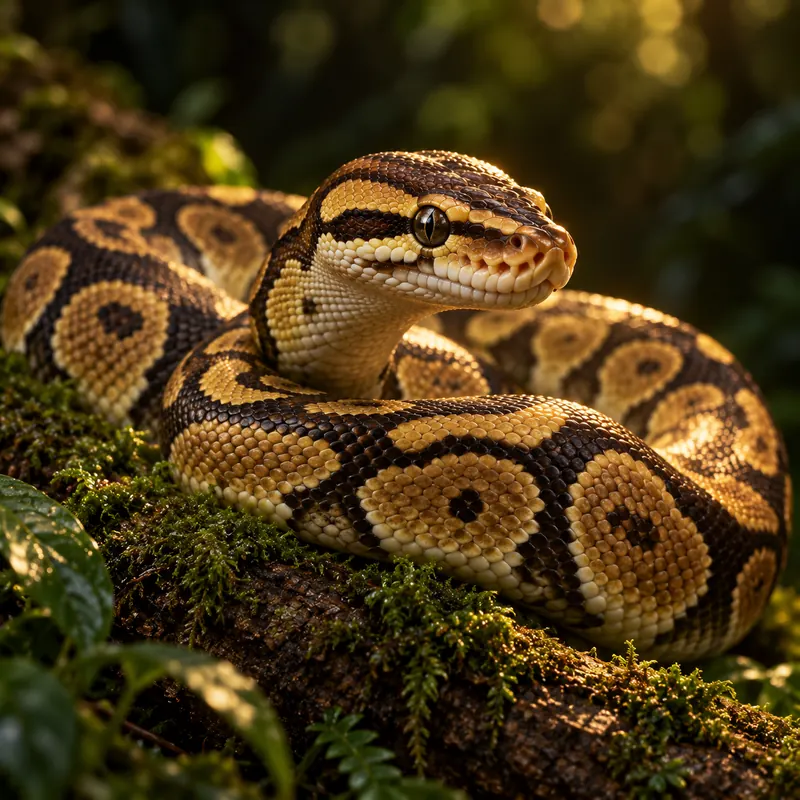
Most ball python problems are setup problems. The good news is that nearly every one has a simple fix, and most cost little or nothing once the core gear is right. Here are the mistakes keepers make most often, in roughly the order they matter.
1. Running a heater without a thermostat
The mistake: plugging a heat mat or heat lamp straight into the wall.
Why it matters: with nothing to limit it, the heater keeps getting hotter. ReptiFiles warns that heat mats in particular can cause serious burns, and VCA lists burns among common snake injuries.
The fix: put every heater on its own thermostat. Use a dimming thermostat for lamps and a pulse-proportional or on/off thermostat for heat mats. Place the probe where the snake sits.

Thermostat (UK)
Habistat Dimming Thermostat, Classic Range (600 W)
A UK-made dimming thermostat designed for heat lamps and heaters. It smoothly turns the power down as the probe reaches the set temperature, instead of switching the lamp fully on and off.
- Max load
- 600 W
- Min load
- 40 W
- Control
- Dimming
- Use with
- Heat lamps, ceramic and infrared heaters
Best for
Running a heat lamp or Deep Heat Projector in a UK vivarium.
Worth knowing
It has a minimum load, so very low-wattage heaters may not dim correctly. Not intended for heat mats: use a mat stat or pulse stat for those.
Thermostat (US)
Exo Terra Thermostat with Day and Night Timer (600 W)
A reptile thermostat that offers both dimming and pulse-proportional control, so it can run a heat lamp smoothly or a non-light heater such as a ceramic emitter or radiant panel. A built-in timer lets you set a lower target at night.
- Max load
- 600 W
- Control modes
- Dimming and pulse proportional
- Timer
- Day and night settings
Best for
Controlling a Deep Heat Projector, halogen lamp or ceramic emitter in a US setup.
Worth knowing
Put the probe where the snake actually sits (in or by the warm hide), and check it against a separate thermometer.
2. Using a heat rock
The mistake: buying a heated “rock” or “sizzle rock.”
Why it matters: VCA calls them dangerous, ineffective and a cause of injury. ReptiFiles is equally clear.
The fix: use overhead heat, such as a Deep Heat Projector or heat lamp, on a thermostat.
3. Guessing temperatures
The mistake: trusting the thermostat dial or a cheap stick-on dial gauge.
Why it matters: the RSPCA notes that thermostats can be inaccurate, and a few degrees can be the difference between a snake that digests well and one that refuses food.
The fix: use a digital thermometer at each end and an infrared thermometer for surfaces. Aim for a warm hide at 86 to 90°F (30 to 32°C) and a cool side of 72 to 80°F (22 to 27°C), and check both daily.

Infrared thermometer
Etekcity Lasergrip 774 Infrared Thermometer
A point-and-read infrared thermometer that measures the surface temperature of whatever it is aimed at, such as the top of the warm hide or the ground under the heat lamp.
- Range
- -58 to 842°F (-50 to 450°C)
- Emissivity
- Adjustable, 0.1 to 1.0
- Power
- 2 x AAA
Best for
Checking surface temperatures around the enclosure, and the temperature of thawed prey.
Worth knowing
It measures surfaces, not air. Do not point the laser at the snake's eyes, or yours.
4. No real gradient
The mistake: an enclosure that is warm all over, or one heat source in the middle.
Why it matters: a snake controls its temperature by moving between warm and cool. Without a gradient it cannot do that.
The fix: heat one end only. Put the warm hide under the heat source and the cool hide at the far end.
5. Air that is too dry
The mistake: a glass tank with a full screen lid in a heated or air-conditioned home.
Why it matters: low humidity causes stuck sheds. The RSPCA and ReptiFiles give targets between roughly 50 and 80%, and many homes are drier than that.
The fix: use a deep, moisture-holding substrate, a humid hide with damp sphagnum moss, and cover part of a screen top. Measure with a hygrometer.
6. Air that is soaking wet and stale
The mistake: overcorrecting with constant spraying and no airflow.
Why it matters: the RSPCA links persistent high humidity and poor ventilation to respiratory infection and mold.
The fix: keep the substrate damp, not dripping, and let humidity fall a little between mistings. Keep some ventilation open.
7. Only one hide, or hides that are too big
The mistake: a single hide, or a large, roomy one.
Why it matters: with one hide, the snake has to choose between feeling safe and being the right temperature. ReptiFiles notes that ball pythons prefer snug hides, and roomy ones can stress them.
The fix: two matching hides, one warm and one cool, each small enough that the snake touches the sides when curled up.
Hides (buy two)
Exo Terra Reptile Cave, Large
A low, natural-looking cave that Exo Terra describes as very stable, so larger animals do not easily tip it over. It is easy to lift out and wash.
- Size
- About 26 x 19 x 10 cm (10.2 x 7.5 x 3.9 in)
- Listed size
- Large
Best for
A snug hide at each end of the enclosure. Buy two the same, so the snake never has to choose between safety and the right temperature.
Worth knowing
Ball pythons want a hide that fits closely. A very large adult may need a bigger hide; a small juvenile may feel safer in a smaller one.
8. An empty, open enclosure
The mistake: a bare floor with just a hide and a water bowl.
Why it matters: ball pythons like cramped, dark spaces, and ReptiFiles advises filling the enclosure with cover. An exposed snake is more likely to stay stressed and refuse food.
The fix: add artificial plants, cork bark, leaf litter and a branch or two.
9. Feeding live prey, or leaving it in
The mistake: dropping a live mouse or rat in and walking away.
Why it matters: VCA warns that even a small bite from a mouse can cause a severe infection in a snake, and prey wounds need prompt veterinary care.
The fix: feed frozen-thawed prey, warmed through and offered with tongs. If you ever do use live prey, never leave it unattended.
10. Panicking over a skipped meal
The mistake: offering food every day, switching prey constantly, or handling more to “encourage” eating.
Why it matters: ball pythons often skip meals during sheds, in a new home or in cooler months. ReptiFiles notes that feeding too often and handling too much can themselves cause refusals.
The fix: check temperatures, humidity and hides, then offer food at normal intervals. Weigh weekly. ReptiFiles says a fast is acceptable while the snake stays healthy and loses no more than 10% of its weight. Past that, see a vet.
Gram scale
Digital Scale That Reads in Grams
A kitchen-style digital scale. Weighing your snake and its prey in grams is the simplest way to spot weight loss and size meals.
- Units
- Grams
- Capacity
- 2 kg or more
Best for
Weekly or monthly weigh-ins, and checking prey is about 10 to 15% of the snake's weight.
Worth knowing
Pick one that reads to at least 2 kg (about 4.4 lb) and use a tub on top to hold the snake.
11. Handling too soon or too often
The mistake: handling on day one, right after a meal, or during a shed.
Why it matters: handling a new snake adds stress, and handling soon after feeding can cause it to bring up its meal.
The fix: wait about two weeks, or until it is eating regularly. After that, wait 48 hours after a meal (RSPCA) and skip handling while the eyes are blue.
12. Pulling off a stuck shed or soaking the snake
The mistake: peeling skin off by hand, or forcing a long soak in a tub.
Why it matters: ReptiFiles warns against soaking a snake that is struggling to shed, because it is very stressful and can be dangerous. Retained eye caps need a vet, as VCA warns they can damage the eye.
The fix: raise humidity, refresh the humid hide, and let the snake shed on its own. For a stuck shed, ReptiFiles describes a short session in a warm, damp, ventilated box instead of a soak. If skin is still stuck after that, or around the eyes, see a vet.
13. The wrong substrate
The mistake: cedar or pine shavings, or a dry bedding such as aspen in a humid setup.
Why it matters: VCA warns that cedar is toxic to reptiles. ReptiFiles advises against pine too, and notes that aspen holds moisture poorly and molds when damp.
The fix: a humidity-holding substrate such as coconut husk chips, coconut fiber or a soil mix, kept damp but not wet. Paper towels are fine during quarantine or illness.
14. Skipping the vet check
The mistake: waiting until something looks wrong before finding a reptile vet.
Why it matters: not every vet treats reptiles, so finding one in a hurry can be hard, and problems are easier to fix when caught early. VCA advises a check-up within a week of bringing a new snake home, including a fecal test for parasites, and then once a year.
The fix: find a reptile vet before the snake arrives, book the first check-up, and keep a simple log of feeds, sheds and weights to bring along.
One more: two snakes together
Ball pythons are solitary. PetMD advises keeping each snake in its own enclosure. One snake, one enclosure, every time.
Thermostat on every heater, a real warm-to-cool gradient, damp but not stale air, and two snug hides. Fix those four and most other problems never show up.