
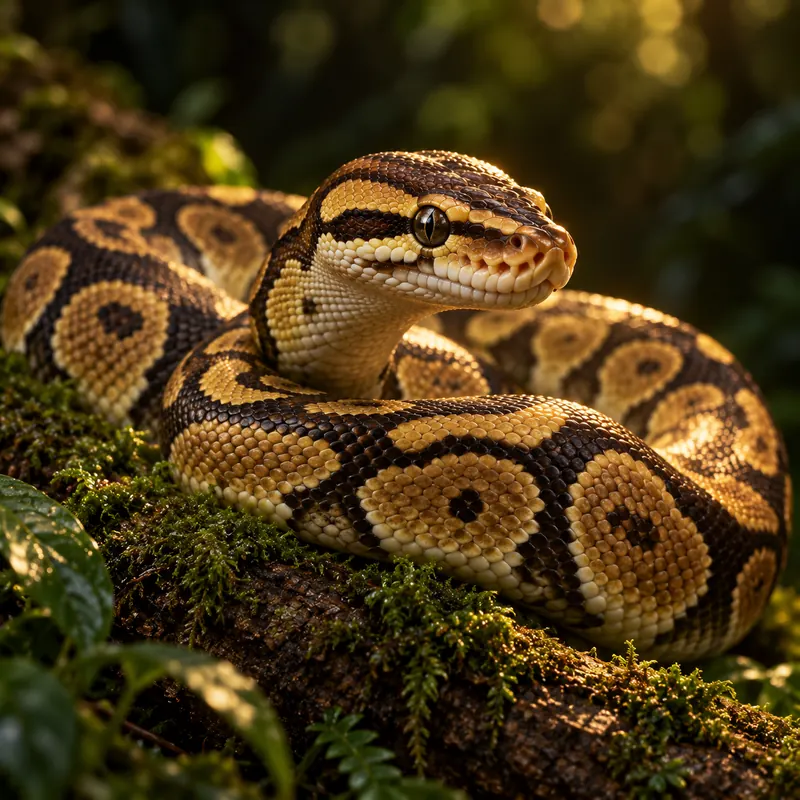
Short answers to the questions people ask most about ball pythons (also called royal pythons). Each one links to the page with more detail.
How long do ball pythons live?
A long time. The RSPCA says they can live longer than 20 years in captivity, PetMD says up to 30 years, and ReptiFiles gives 15 to 30 years. VCA gives a lower range of 10 to 20 years. Zoo records listed by Animal Diversity Web reach about 50 years. Plan for a commitment of two decades or more.
How big do ball pythons get?
Most adults are about 3.5 to 5 ft (105 to 150 cm). ReptiFiles gives typical adult lengths of about 3.6 to 4.3 ft (109 to 131 cm) for males and slightly more for females, and the RSPCA gives around 150 cm (5 ft). PetMD says they reach adult size in about three years.
What size enclosure does an adult need?
ReptiFiles recommends 4 x 2 x 2 ft (120 x 60 x 60 cm). The RSPCA’s minimum is the snake’s length long, and one third of its length deep and tall. See the enclosure size guide.
Are ball pythons good for beginners?
Yes, for a keeper who is ready to manage heat and humidity carefully. PetMD rates them as a beginner species. They are calm and not venomous, but they live for decades and can be fussy eaters.
How much does a ball python setup cost?
The enclosure, heat source and thermostat are the biggest costs, and together they often add up to more than many people expect. Prices change often, so the supplies list shows what to buy rather than what it costs.
Do ball pythons bite?
They can, but they are not venomous (PetMD). Hatchlings are more defensive and more likely to strike, which usually settles as they grow (RSPCA, ReptiFiles). Many bites happen when a snake mistakes a hand for food, so wash your hands before handling, as ReptiFiles advises, and always feed with tongs.
How often can I handle my ball python?
ReptiFiles suggests one or two times a week, no more than once a day. The RSPCA suggests about 10 to 15 minutes at a time, and waiting 48 hours after a meal. Do not handle during a shed. See first week for how to pick one up.
Why won’t my ball python eat?
Ball pythons often skip meals in a new home, before a shed, or in cooler months. Check temperatures, humidity and hides first, stop handling until it eats, and weigh it weekly. If it loses more than 10% of its weight or shows other signs of illness, see a reptile vet. The diet guide covers this in detail.
What humidity do ball pythons need?
Sources range from about 40 to 80%. The MSD Veterinary Manual lists 50 to 80%, the RSPCA about 50 to 60% at the cool end with misting up to about 80%, and PetMD 40 to 60%, rising to about 70% during a shed. Keep the substrate damp and provide a humid hide, but keep some airflow.
How do I help with a stuck shed?
Raise humidity and refresh the humid hide. Do not peel the skin off and do not force long soaks, which ReptiFiles warns against. If the shed is still stuck after a day or two of better humidity, or the eye caps have not come off, see a vet.
Do ball pythons need UVB?
Not strictly, but it may help. The MSD Veterinary Manual lists no special lighting need, yet still recommends broad-spectrum light. VCA says vets disagree but UV is not harmful and may be beneficial. The RSPCA recommends a low-output tube with shade. See lighting and heating.
What temperatures do ball pythons need?
A warm hide of 86 to 90°F (30 to 32°C) and a cool side of about 72 to 80°F (22 to 27°C), with every heater on a thermostat (RSPCA, ReptiFiles).
Can two ball pythons live together?
No. They are solitary (Animal Diversity Web), and PetMD advises keeping each snake in its own habitat.
Do ball pythons smell?
A healthy snake in a clean enclosure has very little smell. Odor usually comes from waste, soiled water or old, wet substrate. VCA advises removing feces and urates every 24 to 72 hours and keeping water fresh.
Are ball pythons nocturnal?
Mostly. Animal Diversity Web describes them as mainly nocturnal and most active around dawn and dusk, spending much of their time in burrows. Expect a snake that hides by day and explores in the evening.
How often do ball pythons shed?
ReptiFiles says a healthy ball python sheds in one piece roughly every 4 to 6 weeks. PetMD notes young snakes shed about monthly and healthy adults a few times a year. Blue, cloudy eyes are the first sign.
Can I use a heat mat?
Yes, but only as a secondary heat source and only on a thermostat. ReptiFiles advises placing it under the warm hide, out of direct contact with the snake, with the probe inside the hide. Overhead heat on a thermostat should do most of the work.
What are morphs?
Morphs are captive-bred color and pattern variations, such as albino, piebald and many others. Their care is the same as for a normal-colored ball python, with one exception noted by the RSPCA: albino and some other morphs need lower UVB levels, with a maximum UVI of 0.7 in the basking zone.
What should I feed my ball python?
Whole frozen-thawed rodents, warmed through and offered with tongs. The RSPCA says prey should be slightly wider than the widest part of the snake. The RSPCA suggests every 5 to 6 days for young snakes and every 7 to 14 days for adults. PetMD gives weekly for juveniles and every 1 to 2 weeks for adults. Never leave live prey unattended.
Calm, long-lived and not venomous, but particular about heat, humidity and feeling hidden. Get the setup right and a ball python is one of the easiest snakes to live with for a very long time.