
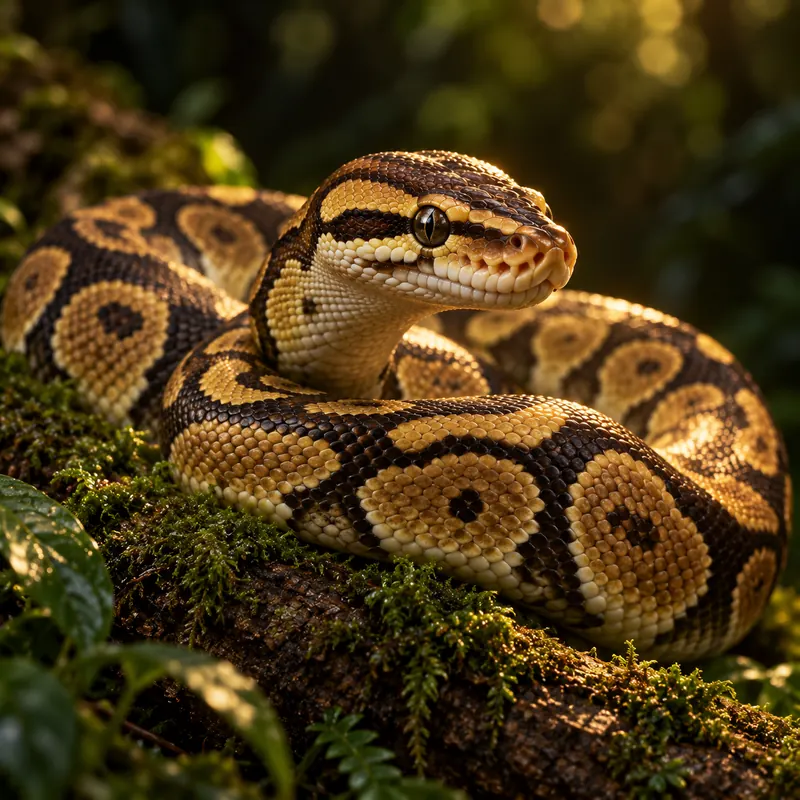
A ball python digests, sheds and fights off infection only as well as its temperature allows. Your job is to give it a warm end and a cool end, keep both steady with a thermostat, and hold humidity in the right range. Get those three right and most problems never start.
Target temperatures
These figures come from the RSPCA and ReptiFiles, which agree closely, with the MSD Veterinary Manual’s ranges as a cross-check.
| Zone | Temperature | Source |
|---|---|---|
| Warm hide / basking zone | 86 to 90°F (30 to 32°C) | RSPCA, ReptiFiles |
| Cool side | 72 to 80°F (22 to 27°C) | ReptiFiles (RSPCA: 75 to 79°F, 24 to 26°C) |
| Night | 70 to 78°F (21 to 26°C) | ReptiFiles |
| Air ceiling | Never above 95°F (35°C) | ReptiFiles |
The MSD Veterinary Manual gives a preferred air range of 77 to 86°F (25 to 30°C) for ball pythons, with basking spots about 9°F (5°C) warmer and a night drop of about 9°F (5°C). That lines up with the table above.
PetMD gives a warm end as high as 95°F (35°C). ReptiFiles treats 95°F as the ceiling for air, not the target, so aim for the warm hide range above and make sure the snake can always move somewhere cooler.
Measure where the snake sits. Check the air with a digital thermometer at each end, and the surface of the warm hide and the ground under the heat with an infrared thermometer.
Heat sources
One good overhead heat source on the warm side does most of the work. The RSPCA suggests a guarded 60 to 100 watt reptile heat lamp on a thermostat. ReptiFiles’ notes on each option:
- Infrared lamp units and halogen or incandescent heat bulbs. ReptiFiles rates these best for daytime heat, because they warm deeply and give light. Turn light-giving bulbs off at night.
- Deep Heat Projectors (DHP). Arcadia’s infrared lamp gives IR-A and IR-B heat with no visible light, so it can run by day without being bright and keep running at night. ReptiFiles lists DHPs among its night heat options.
- Ceramic heat emitters. No light, so useful for night heat. The RSPCA suggests a ceramic heater on a thermostat if the room gets cold at night.
- Radiant heat panels. Mounted on the ceiling of the enclosure. They give gentle, even heat and need a proportional thermostat.
- Heat mats. ReptiFiles says use them only as a secondary heat source, never as the main one, and always on a thermostat. Put the mat under the warm hide, not where the snake can lie directly on it. The RSPCA allows a heat mat at 90°F (32°C) for hatchlings in small tanks, with a mat guard.

Heat source for day and night
Arcadia Deep Heat Projector
A lamp that gives off infrared heat (IR-A and IR-B) with no visible light, so it can run by day and at night without disturbing the snake. Arcadia lists it for use with a dimming thermostat.
- Output
- Infrared A and B, no visible light
- Wattages
- 50 W and 80 W
- Fitting
- Screw (E26 in the US, E27 in the UK)
- Control
- Suitable for dimming thermostats (per Arcadia)
Best for
The main overhead heat source in a 4 ft enclosure, warming the hide and the ground below it.
Worth knowing
The surface gets very hot. It needs a ceramic holder, a guard if it is inside the enclosure, and a thermostat. Pick the wattage to suit your room and enclosure.
The burn risk
Snakes can burn themselves on hot surfaces, and VCA lists burns among common problems in pet snakes. The danger comes from heat with no limit: a heat mat or lamp plugged straight into the wall keeps getting hotter until something fails. ReptiFiles describes an unregulated heat pad that warped a plastic tub and scorched the wood under it.
- Never use heat rocks. VCA calls them dangerous and ineffective.
- Guard any lamp that sits inside the enclosure. VCA advises keeping bulbs at least 4 to 6 in (10 to 15 cm) above the highest point the snake can reach.
- Never run any heater without a thermostat.
Thermostats are mandatory
A thermostat reads a probe and controls the heater to hold the temperature you set. It is the single most important safety item in the setup.
| Thermostat type | Use it with |
|---|---|
| Dimming | Heat lamps, halogen bulbs, Deep Heat Projectors |
| Pulse-proportional | Ceramic emitters, radiant heat panels, heat mats |
| On/off | Heat mats and cables only (not lamps that give light) |
Where the probe goes. Put it where the snake sits, such as inside or right beside the warm hide. ReptiFiles advises placing a mat probe inside the hide on the substrate, not on the mat itself. Fix it in place so the snake cannot move it.
Check the thermostat. The RSPCA advises recording both ends daily with thermometers, because thermostats can be inaccurate.
Dimming thermostat (UK)
Habistat Dimming Thermostat, Classic Range (600 W)
A UK-made dimming thermostat designed for heat lamps and heaters. It smoothly turns the power down as the probe reaches the set temperature, instead of switching the lamp fully on and off.
- Max load
- 600 W
- Min load
- 40 W
- Control
- Dimming
- Use with
- Heat lamps, ceramic and infrared heaters
Best for
Running a heat lamp or Deep Heat Projector in a UK vivarium.
Worth knowing
It has a minimum load, so very low-wattage heaters may not dim correctly. Not intended for heat mats: use a mat stat or pulse stat for those.
Dimming and pulse thermostat (US)
Exo Terra Thermostat with Day and Night Timer (600 W)
A reptile thermostat that offers both dimming and pulse-proportional control, so it can run a heat lamp smoothly or a non-light heater such as a ceramic emitter or radiant panel. A built-in timer lets you set a lower target at night.
- Max load
- 600 W
- Control modes
- Dimming and pulse proportional
- Timer
- Day and night settings
Best for
Controlling a Deep Heat Projector, halogen lamp or ceramic emitter in a US setup.
Worth knowing
Put the probe where the snake actually sits (in or by the warm hide), and check it against a separate thermometer.
On/off thermostat for heat mats
Inkbird ITC-306T Heating Thermostat with Timer
A plug-in on/off thermostat with a probe and two heating outlets, plus day and night time periods with separate targets. On/off control suits heat mats and other heaters that do not give off light.
- Control
- On/off, heating only
- Outlets
- 2 (heating)
- Max output
- 10 A
- Timer
- Day and night set points
Best for
Keeping a heat mat or heat cable under safe control, as a low-cost option.
Worth knowing
On/off control makes a light bulb flash on and off, so use a dimming stat for any lamp that gives light. Tape the probe in place so it cannot be moved.
Night heat
Most homes stay warm enough at night for a ball python with a small drop. If your room falls below about 70°F (21°C), keep a non-light heater running on its thermostat with a lower night setting. Do not use colored “night” bulbs: ReptiFiles advises against red, blue and black bulbs because ball pythons can see color.
Humidity
Humidity is where ball python sources vary most:
- MSD Veterinary Manual: 50 to 80%.
- RSPCA: about 50 to 60% at the cool end, with misting up to about 80%, allowed to drop between mistings.
- ReptiFiles: 60 to 80% in the day, higher at night.
- PetMD: 40 to 60%, raised to about 70% during shedding.
A sensible target is the middle of these ranges, with a humid hide for the snake to use when it needs more. Too dry leads to stuck sheds. Too wet with poor airflow is linked to respiratory infection and mold, according to the RSPCA, so the goal is damp substrate with some ventilation, not a dripping box.
How to hold humidity:
- A deep, moisture-holding substrate (coconut fiber, coconut husk chips, sphagnum). ReptiFiles suggests at least 4 in (10 cm).
- A humid hide with damp sphagnum moss.
- Misting with a sprayer when it drops.
- A large water bowl on the cool side.
- Partly covering a screen top to slow drying.

Hygrometer
ThermoPro TP50 Digital Thermometer and Hygrometer
A small digital gauge that shows temperature and humidity and records the highs and lows. The magnetic back makes it easy to fit and move.
- Humidity range
- 10 to 99% RH
- Stated accuracy
- ±1°F, 2 to 3% RH
- Mounting
- Stand or magnet
Best for
Watching humidity on the cool and warm sides. Buy two, one for each end.
Worth knowing
It reads the air where it sits, not the surface under the heat lamp. Pair it with an infrared thermometer.
UVB: helpful, not strictly required
Ball pythons are mostly active at dawn, dusk and night, and for years they were kept without UVB. Current guidance has shifted, though sources still differ:
- MSD Veterinary Manual: no special lighting requirement for ball pythons, but broad-spectrum lighting is still recommended because it likely has health benefits.
- VCA: vets disagree on whether snakes need UVB; providing it is “certainly not harmful and may be beneficial.”
- RSPCA: a low-output 2 to 7% UVB tube over one third to one half of the enclosure at the hot end, with a UV index (UVI) of about 1.0 in the basking zone falling to zero in the shade. Albino and some other morphs need less, with a maximum UVI of 0.7.
- ReptiFiles: a low-strength T5 tube giving a UVI of 2.0 to 3.0 at the basking area, replaced every 12 months.
If you add UVB, use a low-output linear tube (not a coil), mount it on the warm side, leave plenty of shade, and follow the maker’s distance chart. A UV meter takes the guesswork out. For albino and other light-sensitive morphs, stay at the low end.

Low-output UVB
Arcadia ShadeDweller Max ProT5 UVB Kit (2.5%, 14 W)
A low-output T5 UVB and full-spectrum lamp in a fitting with a built-in reflector, made for shade-dwelling and partly basking snakes. Low-output tubes are what the RSPCA and ReptiFiles describe for royal pythons.
- UVB
- 2.5%
- Power
- 14 W
- Length
- About 22 to 24 in (55 cm)
- Type
- T5 with reflector
Best for
Giving a ball python gentle UVB and a bright day across about half of a 4 ft enclosure.
Worth knowing
Mount it on the warm side so the snake can move into shade. Check the distance against a UV meter or the maker's chart, and replace the tube on schedule.
Day and night cycle
Both the RSPCA and ReptiFiles recommend about 12 hours of light and 12 hours of dark. Put the lights on a timer, and turn all lights off at night. ReptiFiles suggests a slightly longer day in summer and shorter in winter if you want to follow the seasons.
Quick weekly check
- Warm hide surface 86 to 90°F (30 to 32°C).
- Cool side 72 to 80°F (22 to 27°C).
- Night no lower than about 70°F (21°C).
- Humidity in range at both ends.
- Thermostat probe still in place.
- Lamp guards secure, cables tidy.
If your snake hides on the cool side all the time, or sits pressed against the heat, recheck the numbers. If it stops eating, makes clicking or whistling sounds when breathing, or has bubbles at the mouth, see the common mistakes page and contact a reptile vet. This is general guidance, not veterinary advice.
A warm hide at 86 to 90°F, a cooler end to retreat to, humidity in range, and a thermostat on every heater. That is the whole recipe, and the thermostat is the part you never skip.