
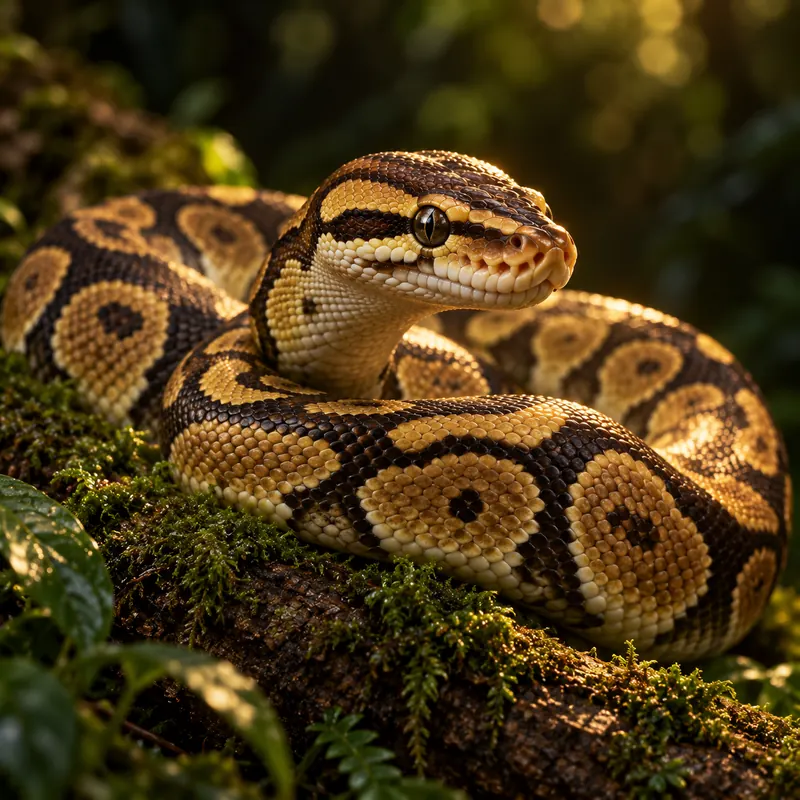
Most of what a ball python needs is simple, but three items decide whether the setup works: the enclosure, the heat source, and the thermostat that controls it. Spend your budget there first, then fill in the smaller things.
Below is every item, in order of importance, with what to look for and a pick for each. Products differ between the US and UK, so some sections have one pick per market. We have not tested these products ourselves: picks are based on the manufacturers’ specifications and on how well they match the husbandry guidance cited at the bottom of the page.
The short version
-
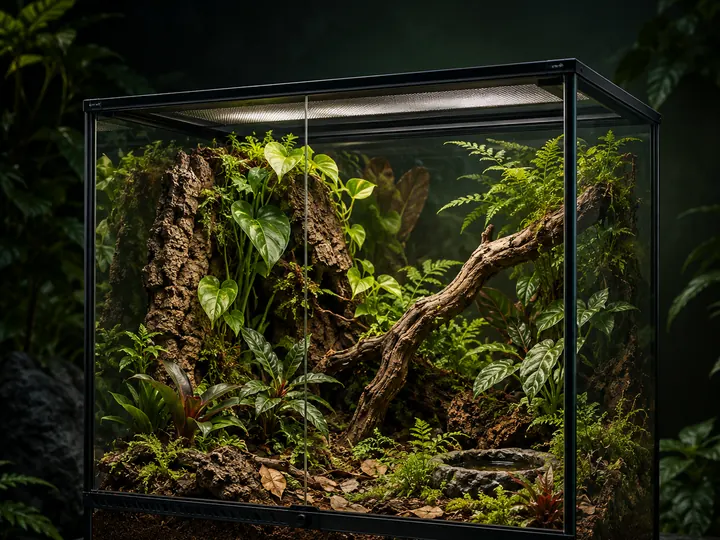 Enclosure Reptile Habitats 4x2x2 PVC Enclosure V3 (120 gallon) Amazon
 - Enclosure 4 x 2 x 2 ft (120 x 60 x 60 cm) front-opening vivarium Amazon UK
-
 Heat source Arcadia Deep Heat Projector Amazon
 - Heat source Arcadia Deep Heat Projector Amazon UK
- Thermostat Exo Terra Thermostat with Day and Night Timer (600 W) Amazon
- Thermostat Habistat Dimming Thermostat, Classic Range (600 W) Amazon UK
-
 Thermometer and hygrometer ThermoPro TP50 Digital Thermometer and Hygrometer Amazon
 - Thermometer and hygrometer ThermoPro TP50 Digital Thermometer and Hygrometer Amazon UK
- Temp gun Etekcity Lasergrip 774 Infrared Thermometer Amazon
- Temp gun Etekcity Lasergrip 774 Infrared Thermometer Amazon UK
- Hides (buy two) Exo Terra Reptile Cave, Large Amazon
- Hides (buy two) Exo Terra Reptile Cave, Large Amazon UK
- Substrate Zoo Med Eco Earth Coconut Fiber Substrate (3 bricks) Amazon
- Substrate Exo Terra Plantation Soil, 8.8 L Amazon UK
- Water bowl Zoo Med Repti Rock Water Dish, X-Large Amazon
- Water bowl Exo Terra Corner Water Dish, Extra Large Amazon UK
-
 Feeding tongs Stainless Steel Feeding Tongs (about 10 to 12 in) Amazon
 - Feeding tongs Stainless Steel Feeding Tongs (about 10 to 12 in) Amazon UK
- Gram scale Digital Scale That Reads in Grams Amazon
- Gram scale Digital Scale That Reads in Grams Amazon UK
1. The enclosure
What to look for:
- Size. For an adult, aim for 4 x 2 x 2 ft (120 x 60 x 60 cm), the size ReptiFiles recommends. The RSPCA’s minimum is the snake’s length long and one third of its length deep and tall, so a 4 ft snake needs at least 4 ft x 16 in x 16 in (120 x 40 x 40 cm). See the enclosure size guide for how sources compare.
- Material. PVC and sealed wood hold heat and humidity far better than an all-glass tank. ReptiFiles notes that glass makes temperature and humidity harder to control, and recommends covering three sides if you use it.
- Front-opening doors. Reaching in from the front, at the snake’s level, makes feeding, handling and cleaning much easier.
- A lock. Ball pythons are escape artists. Sliding glass doors should lock.
- Ventilation. Some airflow keeps the enclosure from going stale and moldy. The RSPCA links poor ventilation and constant high humidity to respiratory infection.
Best enclosure (US)
Reptile Habitats 4x2x2 PVC Enclosure V3 (120 gallon)
A 48 x 24 x 24 inch enclosure with PVC side and back panels, front glass doors, an aluminum frame and a heavy-duty screen top. Opaque PVC walls hold heat and humidity better than an all-glass tank, and the screen top lets a heat lamp and UVB tube sit above it.
- Size
- 48 x 24 x 24 in (about 120 x 60 x 60 cm)
- Walls
- PVC panels
- Front
- Glass doors
- Top
- Heavy-duty screen
- Frame
- Aluminum
Best for
An adult ball python, sized to the 4 x 2 x 2 ft (120 x 60 x 60 cm) enclosure ReptiFiles recommends.
Worth knowing
A screen top lets humidity escape, so you may need to cover part of it. Lamps on top still need a thermostat. Check the door lock before you trust it with a strong snake.
Best enclosure (UK)
4 x 2 x 2 ft (120 x 60 x 60 cm) front-opening vivarium
In the UK most royal pythons live in wooden or PVC vivariums with sliding glass front doors. This link searches for the 120 x 60 x 60 cm size that matches the adult guidance from ReptiFiles and is above the RSPCA minimum for a typical adult.
- Target size
- 120 x 60 x 60 cm (4 x 2 x 2 ft)
- Doors
- Front-opening, sliding glass with a lock
- Walls
- Wood (melamine) or PVC
Best for
UK keepers housing an adult, where 4 ft wooden and PVC vivariums are the norm.
Worth knowing
Many "4ft" vivariums are only 45 to 50 cm deep and tall. Check all three measurements. Wooden vivariums need sealed joints if you keep humidity high, and any lamp inside needs a guard.
2. Main heat source
A ball python needs a warm side where the warm hide sits at 86 to 90°F (30 to 32°C), according to both the RSPCA and ReptiFiles. One good overhead heat source does most of the work.
What to look for:
- Overhead heat that warms the ground and the top of the hide. ReptiFiles rates infrared lamps and halogen bulbs highly. A Deep Heat Projector gives infrared heat with no visible light, so it can run day and night.
- A ceramic socket rated for the bulb’s wattage.
- A guard if the lamp sits inside the enclosure. The RSPCA asks for a guarded heat lamp, and VCA advises keeping hot bulbs out of the snake’s reach.
- No colored “night” bulbs. ReptiFiles advises against red, blue and black bulbs, as ball pythons can see color.
Heat source for day and night
Arcadia Deep Heat Projector
A lamp that gives off infrared heat (IR-A and IR-B) with no visible light, so it can run by day and at night without disturbing the snake. Arcadia lists it for use with a dimming thermostat.
- Output
- Infrared A and B, no visible light
- Wattages
- 50 W and 80 W
- Fitting
- Screw (E26 in the US, E27 in the UK)
- Control
- Suitable for dimming thermostats (per Arcadia)
Best for
The main overhead heat source in a 4 ft enclosure, warming the hide and the ground below it.
Worth knowing
The surface gets very hot. It needs a ceramic holder, a guard if it is inside the enclosure, and a thermostat. Pick the wattage to suit your room and enclosure.
Lamp fixture (US, screen top)
Zoo Med Deluxe Porcelain Clamp Lamp, 8.5 in
A dome lamp with a ceramic (porcelain) socket that sits on a screen top and holds a heat lamp or Deep Heat Projector.
- Dome
- 8.5 in
- Socket
- Ceramic (porcelain)
- Base
- E26
Best for
Holding the heat lamp above a screen-topped PVC enclosure.
Worth knowing
Rest it flat on the screen rather than relying on the clamp, and keep it on a thermostat. Check the wattage rating against your lamp.
In a UK wooden vivarium, the lamp is usually mounted inside with a ceramic holder and a mesh lamp guard. Buy a guard that fully covers the bulb and fits your holder.
3. Thermostat
This is the one item you must never skip. A heater without a thermostat keeps getting hotter until something fails, and snakes do not always move away from heat in time to avoid burns.
What to look for:
- Dimming thermostats for heat lamps. They lower the power smoothly, so a light does not flash on and off.
- Pulse-proportional thermostats for ceramic emitters, radiant heat panels and heat mats.
- On/off thermostats are fine for heat mats and cables, but not for lamps that give off light.
- A long probe that reaches the warm hide, and a night setting if you want a gentle drop after dark.
Best thermostat (UK)
Habistat Dimming Thermostat, Classic Range (600 W)
A UK-made dimming thermostat designed for heat lamps and heaters. It smoothly turns the power down as the probe reaches the set temperature, instead of switching the lamp fully on and off.
- Max load
- 600 W
- Min load
- 40 W
- Control
- Dimming
- Use with
- Heat lamps, ceramic and infrared heaters
Best for
Running a heat lamp or Deep Heat Projector in a UK vivarium.
Worth knowing
It has a minimum load, so very low-wattage heaters may not dim correctly. Not intended for heat mats: use a mat stat or pulse stat for those.
Best thermostat (US)
Exo Terra Thermostat with Day and Night Timer (600 W)
A reptile thermostat that offers both dimming and pulse-proportional control, so it can run a heat lamp smoothly or a non-light heater such as a ceramic emitter or radiant panel. A built-in timer lets you set a lower target at night.
- Max load
- 600 W
- Control modes
- Dimming and pulse proportional
- Timer
- Day and night settings
Best for
Controlling a Deep Heat Projector, halogen lamp or ceramic emitter in a US setup.
Worth knowing
Put the probe where the snake actually sits (in or by the warm hide), and check it against a separate thermometer.
Budget thermostat for heat mats
Inkbird ITC-306T Heating Thermostat with Timer
A plug-in on/off thermostat with a probe and two heating outlets, plus day and night time periods with separate targets. On/off control suits heat mats and other heaters that do not give off light.
- Control
- On/off, heating only
- Outlets
- 2 (heating)
- Max output
- 10 A
- Timer
- Day and night set points
Best for
Keeping a heat mat or heat cable under safe control, as a low-cost option.
Worth knowing
On/off control makes a light bulb flash on and off, so use a dimming stat for any lamp that gives light. Tape the probe in place so it cannot be moved.
4. Humidity tools
Ball pythons do best with humidity well above most homes. The MSD Veterinary Manual lists 50 to 80%. The RSPCA suggests about 50 to 60% at the cool end, misted up to about 80%. Getting this right is mostly about substrate, a humid hide and measuring.
Substrate. ReptiFiles recommends coconut husk chips, sphagnum moss and soil-based mixes. It rates loose coconut fiber as acceptable, with the warning that fine fibers can stick in the heat pits. VCA warns against cedar shavings, which are toxic to reptiles. ReptiFiles also advises against aspen, which molds when damp, and pine.
Substrate (US)
Zoo Med Eco Earth Coconut Fiber Substrate (3 bricks)
Compressed coconut fiber bricks that expand in water into a loose, soil-like substrate that holds moisture well.
- Pack
- 3 compressed bricks
- Each brick makes
- About 7 to 8 liters
- Material
- Coconut fiber
Best for
A humidity-holding base layer, alone or mixed with coconut husk chips.
Worth knowing
ReptiFiles rates it as acceptable rather than ideal because fine fibers can stick in heat pits. Keep it damp, not soggy.
Substrate (UK)
Exo Terra Plantation Soil, 8.8 L
A ground coconut husk substrate from Exo Terra that holds moisture and can be dug into.
- Volume
- 8.8 L per pack
- Material
- Coconut husk fiber
Best for
A humidity-holding substrate in a UK vivarium.
Worth knowing
Several listings exist (loose bags and compressed bricks). Check the volume, and keep it damp rather than wet.
Sphagnum moss. Damp moss inside one hide gives the snake a humid retreat for shedding.
For the humid hide
New Zealand Sphagnum Moss
Dried long-fiber moss that soaks up and slowly releases water. Damp moss inside a hide makes a humid hide for shedding.
- Type
- Long-fiber sphagnum
- Use
- Humid hide, top layer
Best for
Filling one hide with damp moss, as ReptiFiles suggests, to help sheds come off in one piece.
Worth knowing
Replace it often so it does not go moldy.
A sprayer. A simple hand or pressure sprayer from a hardware or garden store is enough. ReptiFiles suggests daily misting if humidity drops.
5. Thermometers and hygrometers
You need to see what the snake feels. Put a digital thermometer and hygrometer at each end, at snake height. The RSPCA advises recording temperatures at both ends daily, because thermostats can be inaccurate.
An infrared thermometer is the quickest way to check surfaces, such as the top of the warm hide, and to check that thawed prey is warmed through.
Thermometer and hygrometer
ThermoPro TP50 Digital Thermometer and Hygrometer
A small digital gauge that shows temperature and humidity and records the highs and lows. The magnetic back makes it easy to fit and move.
- Humidity range
- 10 to 99% RH
- Stated accuracy
- ±1°F, 2 to 3% RH
- Mounting
- Stand or magnet
Best for
Watching humidity on the cool and warm sides. Buy two, one for each end.
Worth knowing
It reads the air where it sits, not the surface under the heat lamp. Pair it with an infrared thermometer.
Infrared thermometer
Etekcity Lasergrip 774 Infrared Thermometer
A point-and-read infrared thermometer that measures the surface temperature of whatever it is aimed at, such as the top of the warm hide or the ground under the heat lamp.
- Range
- -58 to 842°F (-50 to 450°C)
- Emissivity
- Adjustable, 0.1 to 1.0
- Power
- 2 x AAA
Best for
Checking surface temperatures around the enclosure, and the temperature of thawed prey.
Worth knowing
It measures surfaces, not air. Do not point the laser at the snake's eyes, or yours.
6. Optional UVB
Sources differ on UVB for ball pythons. The MSD Veterinary Manual says they have no special lighting needs but still recommends broad-spectrum light as likely beneficial. VCA notes that vets disagree, and that UV light is not harmful and may help. The RSPCA asks for a low-output 2 to 7% UVB tube at the hot end, covering one third to one half of the length. ReptiFiles also recommends a low-strength T5 tube.
If you add UVB, choose a low-output tube, place it on the warm side, and leave plenty of shade. The lighting and heating guide gives the UV index targets.

Best low-output UVB
Arcadia ShadeDweller Max ProT5 UVB Kit (2.5%, 14 W)
A low-output T5 UVB and full-spectrum lamp in a fitting with a built-in reflector, made for shade-dwelling and partly basking snakes. Low-output tubes are what the RSPCA and ReptiFiles describe for royal pythons.
- UVB
- 2.5%
- Power
- 14 W
- Length
- About 22 to 24 in (55 cm)
- Type
- T5 with reflector
Best for
Giving a ball python gentle UVB and a bright day across about half of a 4 ft enclosure.
Worth knowing
Mount it on the warm side so the snake can move into shade. Check the distance against a UV meter or the maker's chart, and replace the tube on schedule.
7. Hides
Two at minimum, one at each end, so the snake never has to choose between feeling safe and being the right temperature. ReptiFiles says ball pythons prefer hides that fit snugly. Low, wide hides that can be partly buried work well.
Hides (buy two)
Exo Terra Reptile Cave, Large
A low, natural-looking cave that Exo Terra describes as very stable, so larger animals do not easily tip it over. It is easy to lift out and wash.
- Size
- About 26 x 19 x 10 cm (10.2 x 7.5 x 3.9 in)
- Listed size
- Large
Best for
A snug hide at each end of the enclosure. Buy two the same, so the snake never has to choose between safety and the right temperature.
Worth knowing
Ball pythons want a hide that fits closely. A very large adult may need a bigger hide; a small juvenile may feel safer in a smaller one.
8. Clutter and climbing
ReptiFiles advises “cluttering up” the enclosure with plants and cover, plus one or two sturdy branches. Artificial plants, cork bark rounds and flat pieces of bark are fine. Anything you add should be stable, secured, and free of pesticides, as VCA notes for branches.
9. Water bowl
A large, heavy bowl that is hard to tip and big enough to soak in. ReptiFiles and the RSPCA both ask for a large bowl, and ReptiFiles notes that ball pythons soak, especially before a shed.
Water bowl (US)
Zoo Med Repti Rock Water Dish, X-Large
A heavy, shallow plastic water dish with a smooth, easy-clean surface, wide enough for a ball python to drink and soak.
- Size
- About 11 in across, 2 in deep
- Material
- Plastic
- Model
- WD-50
Best for
The main water bowl on the cool side of a US setup.
Worth knowing
Snakes often soil their water. Clean it as soon as it is dirty.
Water bowl (UK)
Exo Terra Corner Water Dish, Extra Large
A resin corner water dish with a pebble finish and built-in steps, sized for larger reptiles to drink and soak.
- Size
- Extra large
- Material
- Resin
- Feature
- Steps to climb out
Best for
The main water bowl on the cool side of a UK vivarium.
Worth knowing
Fits a corner, so it suits square-cornered vivariums best. Clean it as soon as it is soiled.
10. Feeding tools
Feeding tongs keep your fingers clear of the strike. The RSPCA advises feeding thawed rodents with tongs inside the enclosure. A gram scale lets you weigh both the snake and its prey. ReptiFiles suggests prey around 10 to 15% of the snake’s body weight, and weighing helps you spot weight loss early.
Feeding tongs
Stainless Steel Feeding Tongs (about 10 to 12 in)
Long stainless tongs for offering thawed prey, so the snake strikes at the rodent and not your hand.
- Material
- Stainless steel
- Length
- About 10 to 12 in
Best for
Every feed. The RSPCA advises feeding with tongs.
Worth knowing
Hold the prey by the scruff or tail and let go as soon as the snake strikes and coils.
Gram scale
Digital Scale That Reads in Grams
A kitchen-style digital scale. Weighing your snake and its prey in grams is the simplest way to spot weight loss and size meals.
- Units
- Grams
- Capacity
- 2 kg or more
Best for
Weekly or monthly weigh-ins, and checking prey is about 10 to 15% of the snake's weight.
Worth knowing
Pick one that reads to at least 2 kg (about 4.4 lb) and use a tub on top to hold the snake.
11. Smaller extras
These are cheap but make daily care easier.
- A plug-in timer for the lights, set to about 12 hours on and 12 off, as the RSPCA and ReptiFiles suggest. Many thermostats have a built-in day and night timer for the heat, but lights usually need their own.
- A snake hook or paper towel roll. ReptiFiles suggests a gentle touch with one before handling, so the snake knows it is not feeding time.
- Reptile-safe disinfectant. PetMD advises disinfecting the habitat at least weekly with a reptile cleaner or a 3% bleach solution left on for at least 10 minutes, then rinsed well. VCA suggests removing waste every 24 to 72 hours and washing the enclosure weekly.
- A spare thermometer. Gauges fail. A second one lets you check the first.
- A secure travel box with air holes for vet visits.
Starter kits vs buying separately
Many stores sell ball python starter kits. Check each part against the list above before buying one. Some kits include a small glass tank, a heat mat with no thermostat, a dial gauge or a single hide, each of which falls short of the guidance on this page. Buying the core items separately usually gives a safer setup, and you can add the cheap extras over time.
A worked example: how the heat fits together
For a typical adult in a 4 x 2 x 2 ft PVC enclosure:
- A Deep Heat Projector or halogen lamp in a ceramic dome sits on the screen top over one end.
- The warm hide sits directly under it.
- The thermostat probe is fixed inside or beside the warm hide, at the height where the snake lies.
- The thermostat is set so the warm hide reads 86 to 90°F (30 to 32°C), checked with the infrared thermometer.
- A digital thermometer and hygrometer at each end confirm the cool side stays around 72 to 80°F (22 to 27°C).
- At night, the thermostat’s night setting lets the enclosure drop a few degrees, staying no lower than about 70°F (21°C).
If the warm hide will not reach temperature, try a higher-wattage lamp or cover more of the screen top. If it overshoots, the thermostat should hold it down. If it cannot, the lamp is too strong for your enclosure.
Skip these
Some products sold for snakes are unsafe or simply not needed.
- Heat rocks. VCA calls them dangerous and ineffective, and ReptiFiles is just as firm. They heat one spot and can burn.
- Any heater without a thermostat. This includes heat mats sold “ready to use.” ReptiFiles warns that heat mats are a common burn risk when not controlled.
- Colored night bulbs (red, blue, purple, black). If the enclosure needs heat at night, use a heater that gives no light, such as a Deep Heat Projector or ceramic emitter.
- Cedar and pine shavings. VCA warns that cedar is toxic to reptiles, and ReptiFiles advises against both.
- Reptile carpet. ReptiFiles finds it hard to keep clean.
- Oversized hides. A big, roomy hide feels exposed to a ball python.
- Coil UVB bulbs. If you use UVB, choose a linear T5 tube, as ReptiFiles recommends.
- A second snake for company. Ball pythons are solitary, and PetMD advises one per enclosure.
Where to start
If budget is tight, buy in this order: enclosure, heat source, thermostat, gauges, hides, substrate, water bowl, then the rest. The setup checklist shows how to put it together and test it before the snake arrives.
Spend on the enclosure, the heat and the thermostat. Those three keep the snake safe. Everything else is cheap, easy to swap, and easy to get right.